📖 Genesis 11 Explained: The Tower of Babel and the Road to Abram
One language. One plan. One act of defiance that changes how the whole world talks.
Genesis 11 explained is a chapter of two very different halves. The first nine verses tell the famous story of a tower built to reach the sky, and a God who comes down and scatters the builders across the earth. The rest of the chapter slows all the way down into a quiet genealogy, ten generations long, that ends on one name you have been waiting for since the book began: Abram.
Maybe you only ever heard the first part, the tower, and never noticed where the chapter actually lands.
- ❓ What was actually wrong with building a city and a tower?
- ❓ Did God really need to come down to see what was happening?
- ❓ Why does the word Babel show up right after a word that sounds like confusion?
- ❓ Why does a genealogy nobody memorizes matter enough to close out this chapter?
📌 Genesis 11 is the last chapter of Genesis where all of humanity moves as one group. Every chapter after this one narrows down to a single family.
This walkthrough goes through the whole chapter in order: the building project at Shinar, why God stepped in, the scattering that gave the place its name, and the ten generations that quietly walk the story from the flood to the man God is about to call.
A tower falls in this chapter. A promise starts rising in its place.
What Happened Just Before This Chapter
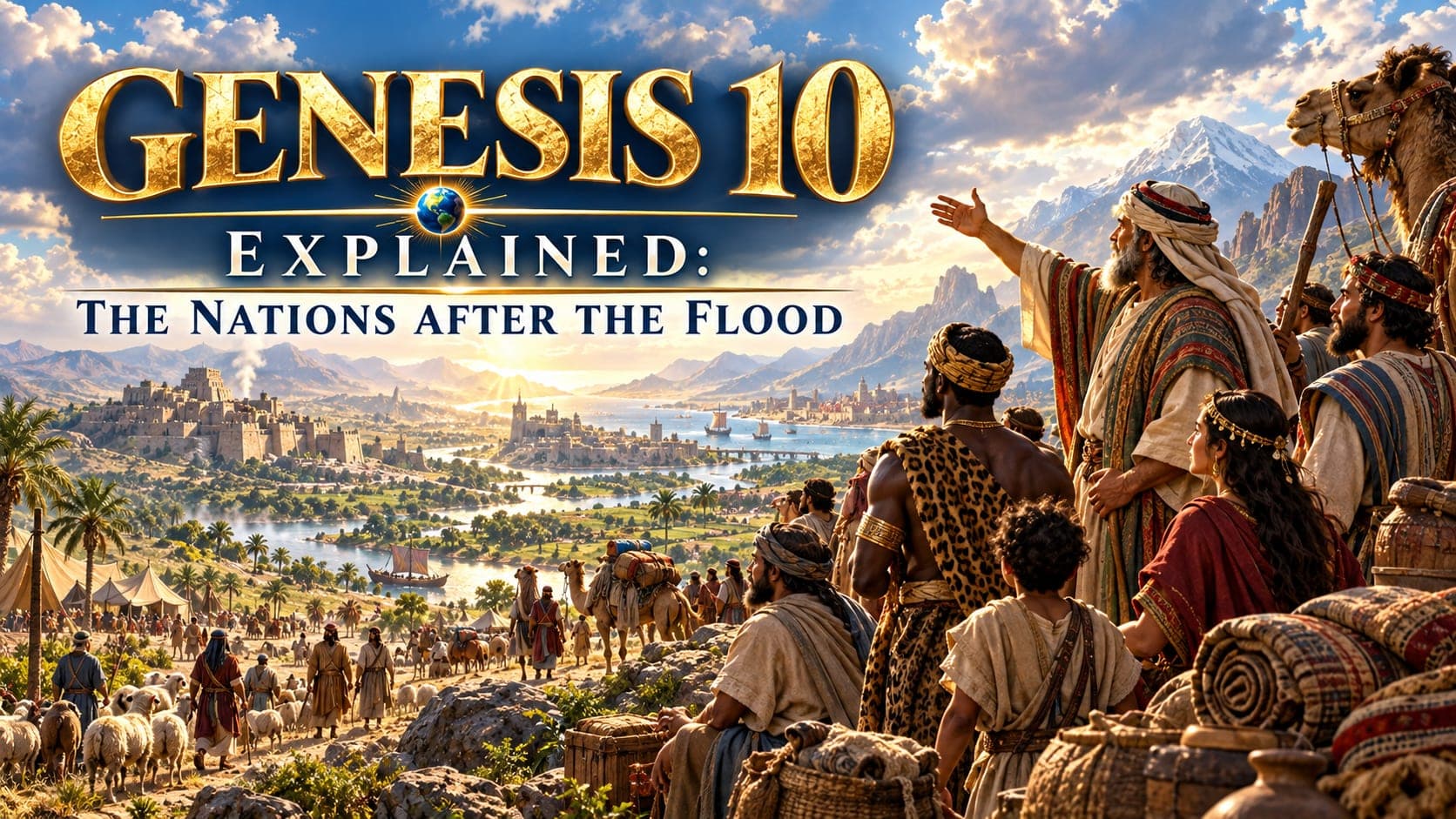
Genesis 10 spent an entire chapter tracing Noah's three sons out into the nations that fill the rest of the Bible. It already named Babel as the beginning of Nimrod's kingdom in the land of Shinar, and it already flagged one strange line about a man named Peleg: "in his days was the earth divided."
That chapter closed with one shared family covering the whole earth, still one people, still one language. Genesis 11 opens by picking up that exact detail and showing what happens to it.
📌 Genesis 10 told you the nations existed. Genesis 11 tells you how they got separated in the first place. The Babel this chapter is named for is the very city Genesis 10 already pointed to as Nimrod's starting point.
Genesis 11 Explained Verse by Verse
1. One Earth, One Language, One Plan (verses 1 and 2)
The chapter opens on a detail that sounds like good news.
"And the whole earth was of one language, and of one speech."
"And it came to pass, as they journeyed from the east, that they found a plain in the land of Shinar; and they dwelt there."
One language sounds like unity, and it is. But the chapter is about to show that shared language put toward the wrong goal does not stay a good thing for long. The people are moving as one body, and they settle on a plain in Shinar, the same region Genesis 10 already named as the beginning of Nimrod's kingdom.
💡 "Shinar" is the general region later Scripture calls Babylonia. The people who end up scattered from this plain are the same ones whose descendants will later build the empire that carries Israel into exile.
2. Let Us Build Us a Name (verses 3 and 4)
The people speak to each other twice in this section, and both times the words start the same way.
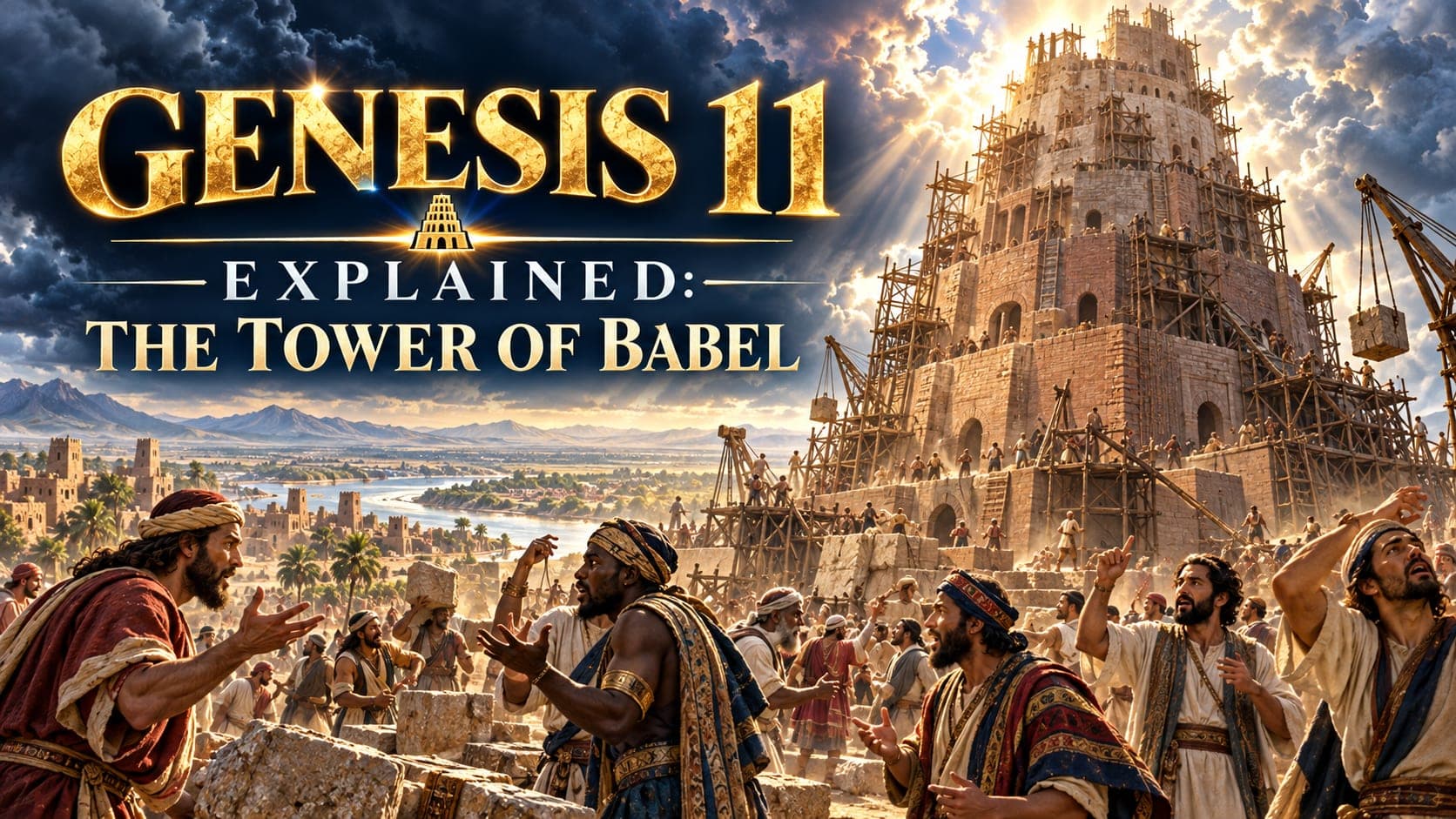
"And they said one to another, Go to, let us make brick, and burn them thoroughly. And they had brick for stone, and slime had they for morter."
📌 Notice the improvising. Shinar had no natural stone the way the hill country did, so the builders manufacture their own: fired brick instead of quarried stone, tar instead of mortar. This is a technical, deliberate upgrade, not a primitive attempt. They are building to last.
Then comes the line the whole chapter turns on.
"And they said, Go to, let us build us a city and a tower, whose top may reach unto heaven; and let us make us a name, lest we be scattered abroad upon the face of the whole earth."
⚠️ Read the actual reasons they give, and the problem is not architecture. "Let us make us a name" and "lest we be scattered" are both aimed directly at what God had already told them to do. God's renewed blessing on Noah's family was to be fruitful, multiply, and fill the earth. Here the people openly plan to stay put and build their own reputation instead.
A tower reaching toward heaven was never really about height. Ancient Mesopotamia is full of archaeological remains of stepped towers called ziggurats, built as staged platforms meant to bring the worship of a city's god down to where people lived. The builders at Shinar were not trying to physically touch the sky. They were building a monument to their own name and their own security, in defiance of the one command they had already been given twice.
3. The LORD Comes Down to See (verses 5 and 6)
The builders call their tower a reach toward heaven. God's response is quietly sarcastic about that claim.
"And the LORD came down to see the city and the tower, which the children of men builded."
📌 God has to come down to see it. A tower the builders imagined reaching heaven does not even register from where God actually is. The verse is not describing God's limits. It is exposing how small the whole project really was.
God then explains, to no one in particular, exactly why this matters.
"And the LORD said, Behold, the people is one, and they have all one language; and this they begin to do: and now nothing will be restrained from them, which they have imagined to do."
💡 This is not God feeling threatened by human ability. It is God naming a real danger: a united humanity turned toward its own name instead of His will can carry that direction very far, very fast. Unity is not automatically good. It depends entirely on what it is united around.
4. Confusion, Scattering, and the Name Babel (verses 7 to 9)
God's response does not tear down the tower. It removes the one thing holding the project together.
"Go to, let us go down, and there confound their language, that they may not understand one another's speech."
"So the LORD scattered them abroad from thence upon the face of all the earth: and they left off to build the city."
📌 "Let us go down" echoes back to "let us make us a name" in verse 4. The people planned in the plural to build their own name. God answers in the same plural, and undoes it. Once they cannot understand each other, the building simply stops. No fire, no flood, just the removal of shared speech is enough to end it.
"Therefore is the name of it called Babel; because the LORD did there confound the language of all the earth: and from thence did the LORD scatter them abroad upon the face of all the earth."
💡 The name plays on the Hebrew word for confuse. The city meant to make a name for its builders ends up permanently named after their failure instead. And the scattering itself is not only judgment. It is God finally accomplishing, by force, the very thing He had already commanded and the people had refused to do on their own.
5. Ten Generations From Shem to Abram (verses 10 to 26)
The chapter changes speed completely here. After nine verses of story, it drops into a genealogy that runs in the same "begat, and lived, and begat sons and daughters" pattern as the list before the flood.
"These are the generations of Shem: Shem was an hundred years old, and begat Arphaxad two years after the flood."
📌 Count the names from here to the end of the chapter and you get exactly ten generations: Shem, Arphaxad, Salah, Eber, Peleg, Reu, Serug, Nahor, Terah, and Abram. That is the same count as the ten generations from Adam to Noah before the flood. Genesis is quietly structured in matching sets of ten, one line ending in the man who survived judgment by water, the next ending in the man God is about to call out to become a nation.
There is a second pattern worth noticing, and it is a real number, not a feeling.
"And Eber lived four and thirty years, and begat Peleg: And Eber lived after he begat Peleg four hundred and thirty years, and begat sons and daughters."
"And Peleg lived thirty years, and begat Reu: And Peleg lived after he begat Reu two hundred and nine years, and begat sons and daughters."
📌 Add up each man's full lifespan and the drop is sharp, not gradual. Shem lives 600 years total. Arphaxad, Salah, and Eber all live into their 430s or 460s. Then Peleg lives only 239 years, and no one in the rest of the list, all the way to Terah at 205, ever gets close to the earlier numbers again. The steepest drop in the whole genealogy lands right at Peleg, the very man whose name marks the earth being divided. Genesis does not explain the connection directly, but the timing lines up exactly where the text places the scattering at Babel.
The list keeps moving through Reu, Serug, and Nahor, each one shorter than the last, until it reaches the man whose son changes everything.
"And Nahor lived nine and twenty years, and begat Terah: And Nahor lived after he begat Terah an hundred and nineteen years, and begat sons and daughters."
"And Terah lived seventy years, and begat Abram, Nahor, and Haran."
6. Terah's Family and the Road to Haran (verses 27 to 32)
The genealogy pattern breaks. The text slows down again, because this is the family the whole book has been walking toward.
"Now these are the generations of Terah: Terah begat Abram, Nahor, and Haran; and Haran begat Lot."
"And Haran died before his father Terah in the land of his nativity, in Ur of the Chaldees."
📌 This is the first death of a son before his father recorded anywhere in Genesis's genealogies. Every other list in these chapters moves in order: father, then son, then grandson. Haran dying young, in Ur, before Terah, is a small, specific grief dropped quietly into a list that otherwise reads like a ledger.
The text then introduces two names that matter far more than a genealogy usually gives away.
"And Abram and Nahor took them wives: the name of Abram's wife was Sarai; and the name of Nahor's wife, Milcah, the daughter of Haran, the father of Milcah, and the father of Iscah."
"But Sarai was barren; she had no child."
⚠️ That single sentence is placed right before the most important call in the whole book of Genesis. Abram's wife cannot have children. Whatever God is about to promise this family in the next chapter, it will have to start with a biological dead end. Sarai's story begins here, with a fact the text refuses to soften or hide.
The chapter closes with one journey, started but not finished.
"And Terah took Abram his son, and Lot the son of Haran his son's son, and Sarai his daughter in law, his son Abram's wife; and they went forth with them from Ur of the Chaldees, to go into the land of Canaan; and they came unto Haran, and dwelt there."
"And the days of Terah were two hundred and five years: and Terah died in Haran."
📌 Terah leaves Ur heading for Canaan, and stops short at Haran. He dies there, never reaching the destination the text already named as the goal. The chapter ends on a family that got partway to where God was leading, and it takes the LORD speaking directly to Abram, in the very next verse of the Bible, to finish the journey his father started.

Hard Questions Genesis 11 Raises
Who is God talking to when He says "let us go down"? The text does not name the audience. Some Christians read the plural as an early hint of the Trinity, pointing to the same plural language in Genesis 1:26. Others read it as a royal or majestic way of speaking, common in the ancient world, or as God addressing His heavenly court of angels. Genesis 11 itself does not settle which reading is correct, and the honest answer is that faithful readers hold more than one view here.
Did God really not know what the builders were doing until He came down to see? No. Scripture consistently describes God as already knowing everything. "Came down to see" is the text's way of contrasting the builders' own claim, a tower reaching heaven, with how small that tower actually looked from where God is. It is description written for a human reader, not a statement about God gaining information He lacked.
Was building a city and a tower sinful by itself? Genesis 11 does not condemn cities or building in general. What it names directly is the motive: making a name for themselves and refusing to scatter and fill the earth as God had already commanded twice, once at creation and again to Noah. The same skills used here for defiance get used elsewhere in Scripture, including the building of the temple, without any judgment attached.
Was scattering the nations only a punishment? It is described as a response to defiance, but it is also God accomplishing the very command the people had just refused. Genesis 9:1 already told Noah's family to fill the whole earth. Genesis 11 ends with the earth finally filled, just not by choice. Judgment and the completion of God's original purpose happen in the very same act.
Is there a real archaeological tower behind this story? Ancient Shinar, the region later called Babylonia, is well documented as home to ziggurats, stepped temple towers built from fired brick, which matches the building method described in verse 3 closely. No specific tower has been identified as the exact one in Genesis 11, but the building style and location fit what archaeology has confirmed about the region.
Top 5 Bible Verses From Genesis 11
1. Genesis 11:4
"And they said, Go to, let us build us a city and a tower, whose top may reach unto heaven; and let us make us a name, lest we be scattered abroad upon the face of the whole earth."
The whole chapter's conflict in one sentence: a shared language turned toward a self made name instead of the command God had already given.
2. Genesis 11:9
"Therefore is the name of it called Babel; because the LORD did there confound the language of all the earth: and from thence did the LORD scatter them abroad upon the face of all the earth."
The verse that names the place, and explains why one language ever became many in the first place.
3. Genesis 11:6
"And the LORD said, Behold, the people is one, and they have all one language; and this they begin to do: and now nothing will be restrained from them, which they have imagined to do."
A warning about what unity can accomplish when it is aimed away from God, not just a comment on one building project.
4. Genesis 11:30
"But Sarai was barren; she had no child."
Six plain words placed right before the biggest promise in the book of Genesis, making clear from the start that the coming story will not run on human ability.
5. Genesis 11:31
"And Terah took Abram his son, and Lot the son of Haran his son's son, and Sarai his daughter in law, his son Abram's wife; and they went forth with them from Ur of the Chaldees, to go into the land of Canaan; and they came unto Haran, and dwelt there."
A family starts toward the promise before the promise is even spoken, and stops short of finishing the journey on its own.

Frequently Asked Questions About Genesis 11
What does Genesis 11 mean?
It records the Tower of Babel, where a united humanity building a city and tower to make a name for itself gets scattered across the earth when God confuses their language, then traces ten generations from Shem down to Abram, setting up the call of Abraham in Genesis 12.
Why did God confuse the languages at Babel?
Genesis 11:6 says a united people speaking one language could accomplish anything they imagined, which here meant building a monument to their own name instead of obeying God's command to fill the earth. Confusing their language stopped the project and scattered people the way they had already been told to.
Where was the Tower of Babel located?
In the land of Shinar, the region later called Babylonia, the same area Genesis 10 already named as the beginning of Nimrod's kingdom. Ancient Shinar is well documented as home to stepped brick towers called ziggurats.
Was the Tower of Babel meant to reach heaven literally?
The builders describe it that way in Genesis 11:4, but God still has to come down to see it in verse 5, which quietly shows how small the tower actually was compared to the builders' own claim about it.
What does the name Babel mean?
Genesis 11:9 ties the name directly to the LORD confounding, or confusing, the language of the whole earth there. The name marks the place where a project meant to build a lasting reputation instead became famous for failing.
How many generations are between Shem and Abram?
Ten: Shem, Arphaxad, Salah, Eber, Peleg, Reu, Serug, Nahor, Terah, and Abram, the same count Genesis 5 uses for the ten generations between Adam and Noah before the flood.
Why do lifespans drop so sharply in this genealogy?
Shem lives 600 years, and Arphaxad, Salah, and Eber all live past 430. Starting with Peleg, no one in the list lives past 240. Genesis does not explain the drop directly, but it begins exactly at the generation whose name marks the earth being divided.
Who was Sarai in Genesis 11?
Abram's wife, introduced in Genesis 11:29 and immediately described as barren in the very next verse. That detail sets up the entire promise God gives Abram in Genesis 12, which will require a child this couple cannot produce on their own.
Why did Terah stop in Haran instead of reaching Canaan?
Genesis 11:31 says the family set out for Canaan but settled in Haran instead, and Terah died there. The text does not explain why they stopped. It simply records an unfinished journey that God completes through Abram in the next chapter.
How does Genesis 11 connect to Pentecost in the New Testament?
Many readers see Babel and Pentecost in Acts 2 as mirror images. Babel scatters one people into many languages because of pride. Pentecost lets people from many languages understand one message at once, as the gospel begins gathering the scattered nations back together.
Final Thoughts
Genesis 11 opens with a whole world speaking one language and ends with one family walking toward a promise. Everything in between explains how you get from one to the other.
📌 Unity is not the same thing as being right. The builders at Shinar were completely united, and completely aimed at the wrong goal. What people are united around matters more than how united they are.
📌 God's commands do not expire just because people ignore them. The scattering at Babel is judgment and the fulfillment of Genesis 9:1 happening in the same breath. What people refuse to do freely, God still accomplishes.
📌 The biggest promises in Scripture start at the weakest points. A barren wife and a father who never finished his own journey are exactly where Genesis hands the story off to Abram.
You may feel like Terah, partway toward something and stalled out before the finish. Genesis 11 does not end the story there. It ends it one verse before God speaks again.
So here is your one next step.
Open Genesis 12 next. The call that finishes what Terah started is about to be spoken directly to his son.