📖 Genesis 26 Explained: Isaac's Famine, a Repeated Lie, and Three Wells
A famine hits. A father's old lie gets repeated word for word by his son. And a man who never once has to fight for anything still ends up digging the same wells three separate times.
Genesis 26 explained is the one chapter in Genesis built entirely around Isaac on his own, without Abraham standing next to him and without Jacob yet old enough to take over the story. It is quiet compared to the mountain in Genesis 22 or the birthright traded away in Genesis 25, and that quietness is exactly the point.
Maybe you have watched an old family pattern show up in your own life before you even noticed you were repeating it.
- ❓ Why does Isaac tell the exact same lie about his wife that Abraham told twice?
- ❓ Why does God renew His covenant with Isaac here, when Isaac has not done anything yet to earn it?
- ❓ What do the names Esek, Sitnah, and Rehoboth actually mean, and why record three well disputes in detail?
- ❓ Why does the chapter end on Esau's marriage instead of anything Isaac does?
📌 Isaac never once has to fight for what he has in this chapter, and Genesis wants you to notice exactly why.
This walkthrough goes through the whole chapter in order: the famine and the promise God speaks directly to Isaac for the first time, the lie about Rebekah, the prosperity that turns the Philistines against him, the three wells, the peace treaty at Beersheba, and the marriage that quietly sets up the next chapter.
Watch how much of this chapter is God keeping a promise that Isaac never once has to force.
What Happened Just Before This Chapter
Genesis 25 closed out two lives at once. Abraham died and was buried by Isaac and Ishmael together, and in the very same chapter Esau walked away from his own birthright for one bowl of stew, a decision Genesis calls contempt, not just hunger.
Genesis 26 steps back from Jacob and Esau for one full chapter to focus on their father instead. Isaac is the quietest of the three patriarchs, the one who never leaves the promised land, never fathers more than one set of children, and rarely gets a chapter to himself the way Abraham and Jacob do. This is that chapter.
📌 Everything Isaac deals with here, he inherited: a famine like the one Abraham survived, a wife he is afraid will get him killed, wells his father dug and enemies filled back in. This chapter is where the reader finds out how much of Isaac's life is his own faith and how much is simply walking the road his father already walked.
Genesis 26 Explained Verse by Verse
1. A Famine, and a Promise Spoken to Isaac Directly (verses 1 to 5)
The chapter opens with trouble that sounds familiar before it becomes something new.
"And there was a famine in the land, beside the first famine that was in the days of Abraham. And Isaac went unto Abimelech king of the Philistines unto Gerar."
📌 The text names it "the first famine," assuming the reader remembers Abraham's own famine from Genesis 12. Isaac faces the same shortage his father once faced, and his first instinct, heading toward safer, better watered ground, looks like the same move Abraham made. This time God stops him before he gets there.
"And the LORD appeared unto him, and said, Go not down into Egypt; dwell in the land which I shall tell thee of: Sojourn in this land, and I will be with thee, and will bless thee; for unto thee, and unto thy seed, I will give all these countries, and I will perform the oath which I sware unto Abraham thy father;"
"And I will make thy seed to multiply as the stars of heaven, and will give unto thy seed all these countries; and in thy seed shall all the nations of the earth be blessed; Because that Abraham obeyed my voice, and kept my charge, my commandments, my statutes, and my laws."
💡 This is the first time in Genesis God speaks this covenant directly to Isaac rather than about him. He had heard it secondhand his whole life, a promise made to his father. Here it becomes his own, word for word the same promise: land, descendants like the stars, every nation blessed through his line.
⚠️ Verse 5 grounds the whole promise in Abraham's obedience, not Isaac's. God is renewing a covenant Isaac has not yet earned on his own account, on the strength of a life that already ended in Genesis 25. Isaac starts this chapter already standing inside grace he did not personally work for.
2. The Same Lie, One Generation Later (verses 6 to 11)
Isaac settles in Gerar, and almost immediately repeats a mistake that should have died with his father.
"And Isaac dwelt in Gerar: And the men of the place asked him of his wife; and he said, She is my sister: for he feared to say, She is my wife; lest, said he, the men of the place should kill me for Rebekah; because she was fair to look upon."
⚠️ Abraham told this exact lie twice, once in Genesis 12 about Sarah in Egypt, and again in Genesis 20 about Sarah with this same king, Abimelech, in this same city of Gerar. Isaac never watched either incident happen. He would only have heard about them the way any son hears his father's stories, and he reaches for the identical excuse, in the identical place, using the identical reasoning: fear of being killed for a beautiful wife.
The lie unravels the same accidental way it always does in this family.
"And it came to pass, when he had been there a long time, that Abimelech king of the Philistines looked out at a window, and saw, and, behold, Isaac was sporting with Rebekah his wife."
"And Abimelech called Isaac, and said, Behold, of a surety she is thy wife: and how saidst thou, She is my sister? And Isaac said unto him, Because I said, Lest I die for her."
📌 Isaac gives no other defense than fear. He does not claim it was technically true the way Abraham once did about Sarah being his half sister. He simply admits he was afraid of dying, and that fear was enough to put his wife at real risk to protect himself.
"And Abimelech said, What is this thou hast done unto us? one of the people might lightly have lien with thy wife, and thou shouldest have brought guiltiness upon us."
"And Abimelech charged all his people, saying, He that toucheth this man or his wife shall surely be put to death."
💡 A pagan king ends up protecting Rebekah with a death threat of his own, the same role Abimelech played protecting Sarah a generation earlier. Isaac is never punished for the lie. He is corrected, rebuked to his face, and then simply allowed to keep living in the land, the exact pattern that played out for his father twice before him.
3. Blessed Until It Becomes a Problem (verses 12 to 16)
Once the lie is resolved, the text moves straight into how obviously God is with Isaac.
"Then Isaac sowed in that land, and received in the same year an hundredfold: and the LORD blessed him."
"And the man waxed great, and went forward, and grew until he became very great: For he had possession of flocks, and possession of herds, and great store of servants: and the Philistines envied him."
📌 A hundredfold harvest, in a famine year, in land that was not even his. This is not ordinary farming success. Genesis states outright that this came from the LORD, not from Isaac's skill, and the very next word after describing his wealth is "envied." Blessing this visible does not make Isaac more welcome. It makes him a target.
"For all the wells which his father's servants had digged in the days of Abraham his father, the Philistines had stopped them, and filled them with earth."
"And Abimelech said unto Isaac, Go from us; for thou art much mightier than we."
⚠️ The same Abimelech who just threatened his own people with death for touching Isaac now asks Isaac to leave, because Isaac has grown too strong to feel safe having nearby. Envy does not need a real threat to act. Isaac has done nothing wrong here at all, and it costs him his home anyway.
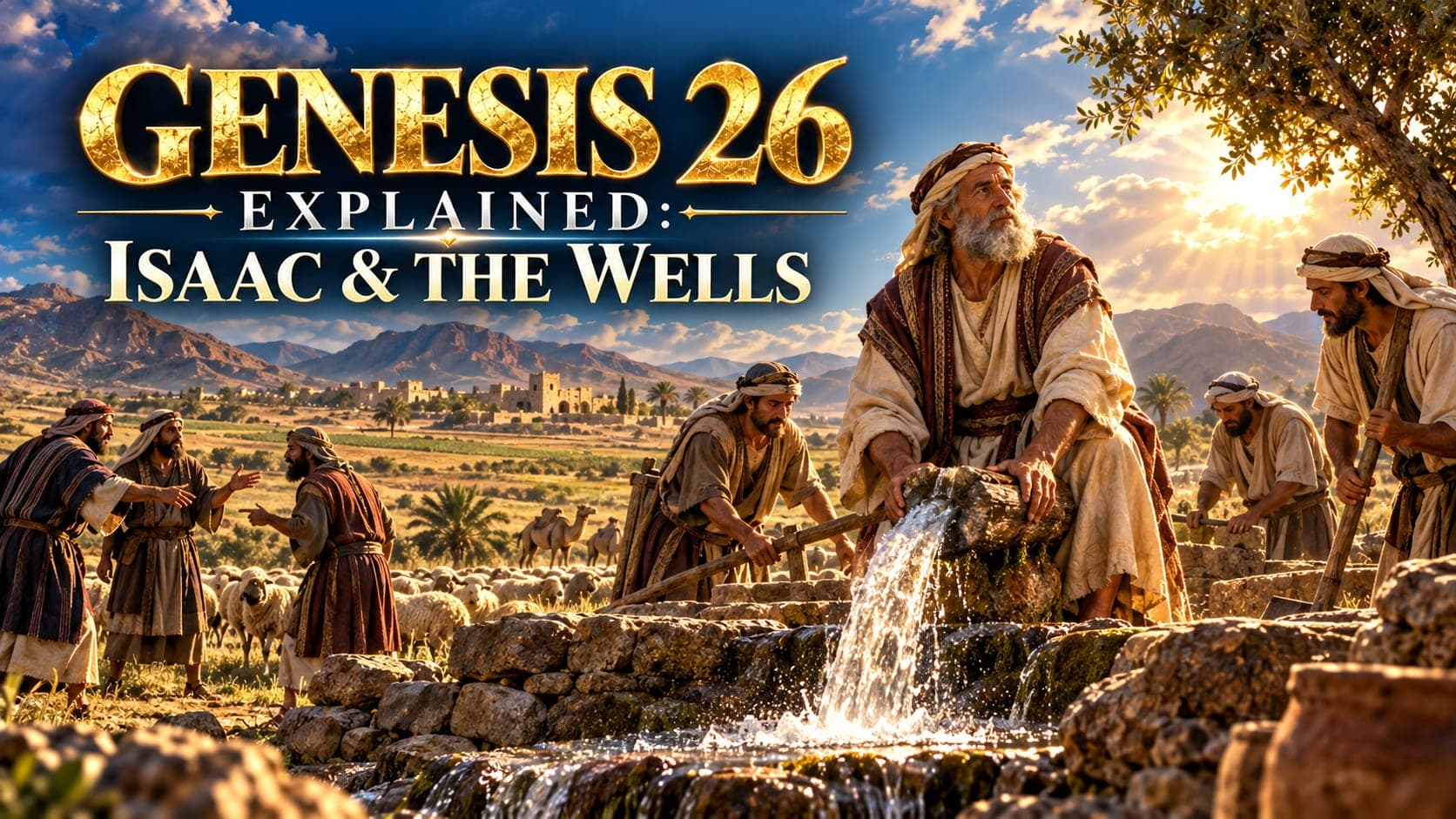
4. Three Wells: Esek, Sitnah, and Rehoboth (verses 17 to 22)
Isaac moves to the valley of Gerar and starts by reclaiming what already belonged to his family.
"And Isaac digged again the wells of water, which they had digged in the days of Abraham his father; for the Philistines had stopped them after the death of Abraham: and he called their names after the names by which his father had called them."
💡 Isaac is not digging new ground. He is reopening water his father already found decades earlier, work that should not have needed redoing at all if the Philistines had simply left it alone.
The next well is new, and it does not go peacefully either.
"And Isaac's servants digged in the valley, and found there a well of springing water. And the herdmen of Gerar did strive with Isaac's herdmen, saying, The water is ours: and he called the name of the well Esek; because they strove with him."
"And they digged another well, and strove for that also: and he called the name of it Sitnah."
📌 Esek means contention. Sitnah means hostility or opposition, the same Hebrew root behind the word satan. Isaac names his own hard experiences honestly instead of glossing over them. Twice he digs, twice local herdmen claim the water is theirs, and twice Isaac simply walks away rather than fight over it, even though the wells are legitimately his.
The third well finally goes uncontested.
"And he removed from thence, and digged another well; and for that they strove not: and he called the name of it Rehoboth; and he said, For now the LORD hath made room for us, and we shall be fruitful in the land."
📌 Rehoboth means room, wide open space. Isaac credits the LORD directly for the relief, not his own persistence. He gave up two legitimate claims rather than fight for them, and God still brought him to open ground in the end. Contention and hostility do not get the last word in this chapter. Room does.
5. Beersheba: The Promise Renewed Again, and Peace With a Former Enemy (verses 23 to 33)
Isaac moves on to Beersheba, and God meets him there before anyone else does.
"And the LORD appeared unto him the same night, and said, I am the God of Abraham thy father: fear not, for I am with thee, and will bless thee, and multiply thy seed for my servant Abraham's sake."
💡 "Fear not" answers the very fear that opened this whole chapter, the fear that made Isaac lie about his own wife in the first place. God speaks to that fear directly, a second time, still tying the promise back to Abraham rather than to anything Isaac has proven on his own.
Isaac responds the same way his father always did when God spoke to him.
"And he builded an altar there, and called upon the name of the LORD, and pitched his tent there: and there Isaac's servants digged a well."
Then the same king who told Isaac to leave shows up looking for him.
"Then Abimelech went to him from Gerar, and Ahuzzath one of his friends, and Phichol the chief captain of his army."
"And Isaac said unto them, Wherefore come ye to me, seeing ye hate me, and have sent me away from you?"
"And they said, We saw certainly that the LORD was with thee: and we said, Let there be now an oath betwixt us, even betwixt us and thee, and let us make a covenant with thee;"
📌 Isaac asks the honest question out loud instead of pretending the history between them does not exist. Abimelech does not deny it. He simply names the real reason he came: he can see the LORD is with Isaac, and he would rather have a treaty with that kind of favor than stand against it. The same title, Abimelech, and the same officer, Phichol, appear generations earlier when Abraham made a nearly identical covenant with the Philistines at this same location in Genesis 21, which fits a royal title passed down rather than one man living across two patriarchs' lifetimes.
"And he made them a feast, and they did eat and drink. And they rose up betimes in the morning, and sware one to another: and Isaac sent them away, and they departed from him in peace."
"And it came to pass the same day, that Isaac's servants came, and told him concerning the well which they had digged, and said unto him, We have found water. And he called it Shebah: therefore the name of the city is Beersheba unto this day."
💡 Beersheba can mean either "well of the oath" or "well of seven," and this chapter is the second time Genesis explains the name, echoing the covenant Abraham made at the same place. The peace treaty and the fresh water arrive the same day, one settling the conflict with people, the other confirming God's provision, right next to each other in the same verse.
6. Esau's Marriages, and a Grief Left Sitting at the End (verses 34 and 35)
After a chapter this full of God's faithfulness, the closing verses land on something unresolved.
"And Esau was forty years old when he took to wife Judith the daughter of Beeri the Hittite, and Bashemath the daughter of Elon the Hittite: Which were a grief of mind unto Isaac and to Rebekah."
📌 Genesis ends this chapter on grief, not victory. Esau, already carrying the weight of a traded birthright from the chapter before this one, now marries two Hittite women from the very culture Abraham warned against back when he sent his servant to find Rebekah among his own kindred rather than the Canaanites. Isaac and Rebekah's grief over this marriage sits quietly at the end of a chapter otherwise full of blessing, and it is the seed of the family conflict the next chapter is about to bring to a head.

Hard Questions Genesis 26 Raises
Why does Isaac repeat his father's exact lie, in the exact same place? The text does not explain whether Isaac consciously copied Abraham's old strategy or simply defaulted to the same fear his father once felt. What it does show plainly is that fear passed down through a family can repeat itself almost word for word, even when the son never witnessed the original failure firsthand.
Was this really a third version of the same incident, or did Genesis reuse a story by mistake? Genesis records it as a separate event, in a different generation, with a different king's response and a different resolution. Reading it as the same pattern recurring across two generations fits the text better than reading it as confused repetition, since the details, Isaac's own confession of fear rather than Abraham's half truth about Sarah, are genuinely different.
Why does God bless Isaac so visibly right after Isaac lied about his wife? Genesis 26:12 places the hundredfold harvest after the lie is already exposed and resolved, not as a reward for the lie itself. The blessing flows from the covenant renewed in verses 3 to 5, tied to Abraham's obedience, not from anything Isaac did right in the verses just before it.
Why record three separate well disputes in this much detail? The names themselves carry the point: contention, hostility, and finally room. Genesis is not padding the chapter with farming logistics. It is showing exactly how Isaac responded to being wronged twice, by giving up a legitimate claim rather than fighting for it, and what God did once Isaac stopped contesting the ground others wanted.
Is Isaac weak for walking away from the first two wells instead of standing his ground? The text never calls it weakness. It records Isaac choosing not to fight over water that was legally his, and it records God bringing him to open, uncontested ground immediately after. Genesis lets the outcome speak for whether that restraint was wisdom rather than stating a verdict outright.
Practical Tips From Isaac's Famine and Wells
Genesis 26 is quiet, but it is full of ordinary decisions worth learning from.
- Notice which fears you inherited instead of chose. Isaac's lie was not original to him. Ask honestly whether a fear driving your own decisions actually belongs to you or was simply handed down.
- Let a promise stand even when you have not personally earned it yet. God renewed His covenant with Isaac before Isaac had proven anything on his own. You are not disqualified from God's faithfulness just because your own story is still unfinished.
- Expect envy to follow visible blessing. Isaac did nothing wrong and still lost his welcome once his prosperity became obvious. Do not assume conflict means you have sinned; sometimes it simply means you have been blessed in front of people who resent it.
- Give up a fight that is not worth having. Isaac walked away from two wells that were legally his rather than escalate the conflict, and God still brought him to open ground.
- Name your hard seasons honestly instead of hiding them. Isaac called two wells Contention and Hostility rather than pretend the conflict never happened. Naming a hard season honestly does not mean staying stuck in it.
- Build the altar before you settle the treaty. Isaac worshipped at Beersheba before Abimelech ever arrived asking for peace. Put your relationship with God first, not last, when trouble with people is still unresolved.
Top 4 Bible Verses From Genesis 26
1. Genesis 26:3 and 4
"Sojourn in this land, and I will be with thee, and will bless thee; for unto thee, and unto thy seed, I will give all these countries, and I will perform the oath which I sware unto Abraham thy father; And I will make thy seed to multiply as the stars of heaven, and will give unto thy seed all these countries; and in thy seed shall all the nations of the earth be blessed;"
The first time God speaks the Abrahamic covenant directly to Isaac himself, in the same words used over his father, before Isaac has done a single thing to earn it.
2. Genesis 26:12
"Then Isaac sowed in that land, and received in the same year an hundredfold: and the LORD blessed him."
A harvest this size, in a famine year, on land that was not his, credited directly to God rather than Isaac's own skill as a farmer.
3. Genesis 26:22
"And he removed from thence, and digged another well; and for that they strove not: and he called the name of it Rehoboth; and he said, For now the LORD hath made room for us, and we shall be fruitful in the land."
The relief that finally comes after two conflicts Isaac chose not to fight for, credited to God rather than to Isaac finally standing his ground.
4. Genesis 26:24
"I am the God of Abraham thy father: fear not, for I am with thee, and will bless thee, and multiply thy seed for my servant Abraham's sake."
God answers the exact fear that drove Isaac to lie about Rebekah at the start of the chapter, directly and by name, before Isaac ever asks Him to.
Frequently Asked Questions About Genesis 26
What does Genesis 26 mean?
It records a famine in Isaac's time, God renewing the Abrahamic covenant with Isaac personally, Isaac repeating his father's lie about his wife being his sister, his growing prosperity and the conflict it causes with the Philistines, three well disputes, and a peace treaty made at Beersheba.
Why did Isaac say Rebekah was his sister?
Genesis 26:7 says he feared the men of Gerar would kill him to take Rebekah, since she was fair to look upon. He gives no other justification, unlike Abraham, who claimed a technical half truth about Sarah in Genesis 20.
Is this the same story as Genesis 12 and Genesis 20?
No. Genesis presents all three as separate events: Abraham and Sarah in Egypt in Genesis 12, Abraham and Sarah with Abimelech of Gerar in Genesis 20, and now Isaac and Rebekah with a king also called Abimelech in the same city, a generation later.
Who was Abimelech in Genesis 26?
Genesis calls him king of the Philistines at Gerar, the same title held by the king Abraham dealt with decades earlier. Since Phichol, the same named chief captain from Genesis 21, also appears here, many readers take Abimelech as a royal title passed down rather than one man reigning across two patriarchs' lifetimes.
What do the well names Esek, Sitnah, and Rehoboth mean?
Genesis 26:20 to 22 gives the meanings directly: Esek means contention, Sitnah means hostility or opposition, and Rehoboth means room, the wide open space God finally gave Isaac after two contested wells.
Why did the Philistines stop up Isaac's wells?
Genesis 26:14 and 15 says they envied Isaac's growing wealth and filled in wells his father's servants had already dug, forcing Isaac to redo work Abraham had completed years before.
Was Isaac punished for lying about his wife?
Genesis 26 does not record any punishment. Abimelech rebukes him directly and then protects Rebekah with a death threat against anyone who touches her, the same pattern Genesis records after Abraham's two similar lies.
Why did Esau's marriages grieve Isaac and Rebekah?
Genesis 26:34 and 35 says only that his two Hittite wives were a grief of mind to his parents, without stating the exact reason, though it fits the same concern Abraham raised sending his servant to find Rebekah from his own kindred rather than a Canaanite family.
Why is Beersheba mentioned again in this chapter?
Genesis 26:33 explains the name a second time in Genesis, tied here to Isaac's own well and treaty with Abimelech, echoing the covenant Abraham made at the same location in Genesis 21.
What is the lesson of Genesis 26 for today?
That old family fears can resurface a generation later, that visible blessing can provoke envy rather than gratitude, and that giving up a fight you could legally win is sometimes exactly what makes room for what God already intends to give you.
Final Thoughts
Genesis 26 never raises its voice, and it still has something real to say to you.
📌 A family's old fears can resurface a generation later, almost word for word. Isaac never watched Abraham lie about Sarah, and he still reached for the same excuse under the same kind of pressure.
📌 God's promise does not wait for you to earn it first. The covenant was renewed to Isaac on Abraham's obedience, not his own, before Isaac had proven anything at all.
📌 Giving up a fight you could win is sometimes how room finally gets made. Isaac walked away from Esek and Sitnah, and God brought him straight to Rehoboth.
You may be carrying a fear that is older than you are, or fighting for ground that is not worth the fight.
So here is your one next step.
Name whatever fear keeps repeating in your own life the way Isaac's did, and bring it honestly to God the way Isaac finally heard "fear not" spoken straight at him.