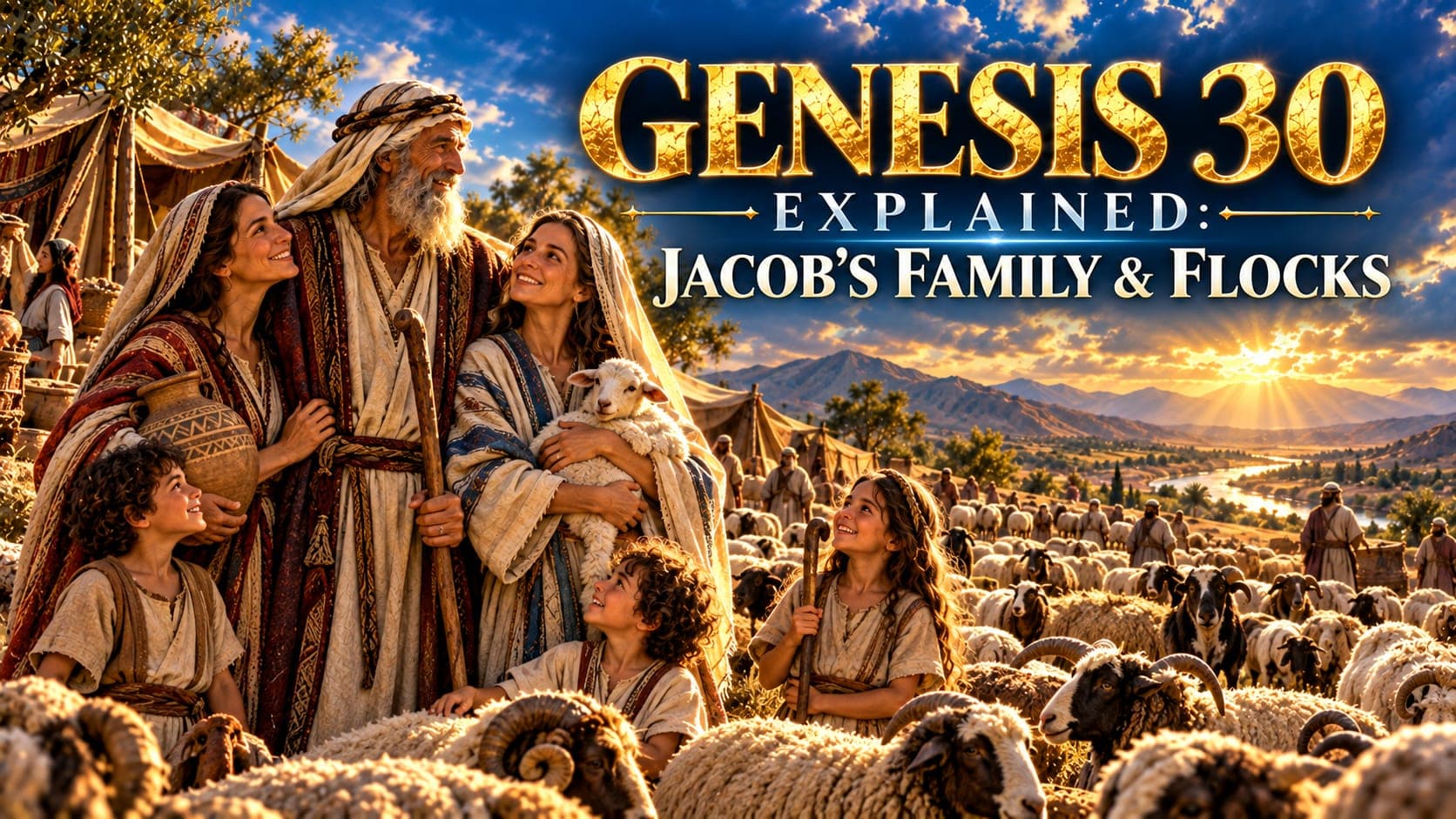
📖 Genesis 30 Explained: Rachel, Leah, and Jacob's Growing Flocks
Two sisters run out of patience within a few verses of each other, and both reach for the same solution: hand their own servant to the same husband and count the child as their own.
Genesis 30 explained is the chapter where Jacob's family stops growing one birth at a time and grows all at once. Eight children arrive by the end of it, born out of envy, a bargain struck over a plant, and finally, after years of waiting, a prayer God actually answers. By the last verse, eleven of the twelve sons who become the tribes of Israel have already been born, and only one is still to come.
Maybe you have watched two people compete for something neither of them can control, using whatever leverage they had left.
- ❓ Why did Rachel and Leah hand their own servants over to be Jacob's wives?
- ❓ Did a plant called mandrakes really have anything to do with who got pregnant?
- ❓ Was Jacob's trick with the peeled sticks real breeding skill, or something else?
- ❓ How many of Jacob's sons have now been born, and who is still missing?
📌 Nobody in this chapter gets praised for how they got what they wanted. Genesis just keeps recording who ends up with it anyway.
This walkthrough goes through the whole chapter in order: Rachel's bargain for a son through her maid, Leah's answer through her own maid, the mandrakes trade that leads to two more sons, the prayer God finally answers for Rachel, Jacob's wage negotiation with Laban, and the flock trick that makes Jacob wealthy on his way out the door.
Watch how much of this chapter is two households counting children like currency, while God quietly decides who actually receives one.
What Happened Just Before This Chapter
Genesis 29 ended with Leah, the wife Jacob never planned to marry, bearing him four sons in a row: Reuben, Simeon, Levi, and Judah. Rachel, the wife he loved and worked fourteen years to have, had not conceived at all. Genesis named the reason plainly. The LORD saw that Leah was hated and opened her womb, while Rachel stayed barren.
📌 Genesis 30 opens with that imbalance still sitting in the same household. One sister has four sons and a husband who loves someone else more. The other has a husband's love and nothing to show for it. Both of them are about to do something about it.
Genesis 30 Explained Verse by Verse
1. Rachel's Bargain: Bilhah's Two Sons (verses 1 to 8)
Rachel breaks first.
"And when Rachel saw that she bare Jacob no children, Rachel envied her sister; and said unto Jacob, Give me children, or else I die."
"Give me children, or else I die" is not really a request. It is aimed at the one person in the room who cannot actually deliver it. Jacob's answer makes that plain.
"And Jacob's anger was kindled against Rachel: and he said, Am I in God's stead, who hath withheld from thee the fruit of the womb?"
⚠️ Jacob's reply is sharp, almost defensive. He reminds Rachel, correctly, that children come from God, not from a husband's effort alone. It does not calm her down. Rachel reaches for a solution already familiar to this family, offering her maid the same way Sarah once offered Hagar to Abraham in Genesis 16.
"And she said, Behold my maid Bilhah, go in unto her; and she shall bear upon my knees, that I may also have children by her."
💡 "Bear upon my knees" describes a real custom in the ancient world. A child born to a servant under this arrangement counted, formally, as the mistress's own son, not the servant's. Bilhah's body carries the child. Rachel's name goes on him. Jacob agrees without recorded objection, and Bilhah conceives.
"And Rachel said, God hath judged me, and hath also heard my voice, and hath given me a son: therefore called she his name Dan."
📌 "God hath judged me" plays on the meaning behind Dan, judged or vindicated. Rachel treats one birth, through another woman's body, as God finally ruling in her favor. Bilhah conceives a second time.
"And Rachel said, With great wrestlings have I wrestled with my sister, and I have prevailed: and she called his name Naphtali."
Naphtali carries the sense of wrestling, the exact word Rachel uses for her fight with her sister. Two sons in, and Rachel is still measuring her worth against Leah, not against anything else.
2. Leah Answers With Zilpah's Two Sons (verses 9 to 13)
Leah does not wait to see whether Rachel will catch up. She reaches for the same tool, handing her own maid Zilpah to Jacob the moment she notices she has stopped conceiving herself.
"And Leah said, A troop cometh: and she called his name Gad."
Gad carries the sense of fortune or a troop arriving. Leah frames the birth as good luck landing in her favor, not as a direct word from God the way Rachel named Dan.
"And Leah said, Happy am I, for the daughters will call me blessed: and she called his name Asher."
📌 Asher means happy, and this is the first naming from either sister with no mention of Jacob at all. Leah says other women will call her blessed, not that her husband will love her more. Four sons now stand between two maids in eight verses, and neither sister has stopped counting.
3. The Mandrakes, and Two More Sons for Leah (verses 14 to 21)
The next scene is smaller and stranger than a birth. It starts with a boy bringing his mother a plant.
"And Reuben went in the days of wheat harvest, and found mandrakes in the field, and brought them unto his mother Leah. Then Rachel said to Leah, Give me, I pray thee, of thy son's mandrakes. And she said unto her, Is it a small matter that thou hast taken my husband? and wouldest thou take away my son's mandrakes also? And Rachel said, Therefore he shall lie with thee to night for thy son's mandrakes."
💡 Mandrakes were widely believed in the ancient world to help with fertility, though the text never says whether they worked. What it does record clearly is the price: a night with Jacob, paid by Rachel to Leah, using the very find that might have helped Rachel herself.
⚠️ Notice the accusation buried in verse 15. Leah's first words are not about the plant. They are about Jacob: "is it a small matter that thou hast taken my husband." Years into this marriage, the wound between the sisters has not closed.
"And Leah said, God hath given me my hire, because I have given my maiden to my husband: and she called his name Issachar."
Leah's own reason for the name Issachar does not point to the mandrakes at all. She ties it to giving Zilpah to Jacob, not to the trade she just made with Rachel, even though the two events sit right beside each other in the text. Whatever conceived this son, Genesis credits God hearkening to Leah, not a plant.
"And Leah said, God hath endued me with a good dowry; now will my husband dwell with me, because I have born him six sons: and she called his name Zebulun."
📌 Zebulun carries the sense of dwelling. By her sixth son, Leah is still naming a child around the hope that Jacob will finally settle with her, the same hope she named her first three sons after in Genesis 29, right after she had already reached a place of pure praise by naming Judah. Old hope can resurface even after it seemed settled.
A daughter, Dinah, follows, with no stated reason for her name, the only child in this list Genesis names without explaining why. She is the only daughter of Jacob's children the text ever names.
4. God Remembers Rachel: Joseph Is Born (verses 22 to 24)
After six sons for Leah through two women, and two more for Rachel through Bilhah, the text finally turns to Rachel herself.
"And God remembered Rachel, and God hearkened to her, and opened her womb. And she conceived, and bare a son; and said, God hath taken away my reproach:"
📌 The text uses a specific word for what happens to Rachel: remembered. Not a new plan invented on the spot. A promise God already held, finally acted on.
"And she called his name Joseph; and said, The LORD shall add to me another son."
💡 Joseph's name carries two meanings in one birth. "Taken away my reproach" looks back at years of shame over her barrenness. "The LORD shall add" looks forward, and Rachel is right to look forward. One more son, Benjamin, is still coming, though she will not live to raise him.
Eleven of the twelve sons who become the tribes of Israel have now been born, seven of them inside this single chapter. Only Benjamin is still to come.
5. Jacob Asks to Leave, and Strikes a Deal With Laban (verses 25 to 34)
Fourteen years of labor are finished, and Jacob asks for exactly what was agreed: his own family, and permission to go home.
"And it came to pass, when Rachel had born Joseph, that Jacob said unto Laban, Send me away, that I may go unto mine own place, and to my country. Give me my wives and my children, for whom I have served thee, and let me go: for thou knowest my service which I have done thee."
Laban does not want to lose the source of his own prosperity, and he says as much before naming a wage of his own.
"For it was little which thou hadst before I came, and it is now increased unto a multitude; and the LORD hath blessed thee since my coming: and now when shall I provide for mine own house also?"
📌 Jacob's case is simple and provable. Laban owned little before Jacob arrived and much afterward, and Jacob says so to his face. He is not asking for charity. He is naming a debt, and pointing out that he still has nothing set aside for his own house after fourteen years of building someone else's.
"I will pass through all thy flock to day, removing from thence all the speckled and spotted cattle, and all the brown cattle among the sheep, and the spotted and speckled among the goats: and of such shall be my hire. So shall my righteousness answer for me in time to come, when it shall come for my hire before thy face: every one that is not speckled and spotted among the goats, and brown among the sheep, that shall be counted stolen with me."
💡 Jacob's proposed wage sounds generous on the surface, only the speckled, spotted, and dark colored animals born from this point forward, nothing from the current flock. What he does not say out loud yet is that those markings do not simply vanish from a bloodline just because Laban removes every currently marked animal.
6. The Rods, the Flocks, and Jacob's Increase (verses 35 to 43)
Laban moves fast to protect his side of the deal, separating the marked animals himself and putting three days of distance between his flocks and Jacob's.
"And Jacob took him rods of green poplar, and of the hazel and chestnut tree; and pilled white strakes in them, and made the white appear which was in the rods. And he set the rods which he had pilled before the flocks in the gutters in the watering troughs when the flocks came to drink, that they should conceive when they came to drink. And the flocks conceived before the rods, and brought forth cattle ringstraked, speckled, and spotted."
⚠️ Peeled branches propped in front of drinking animals is not a scene Genesis explains. Some read it as a genuine, if crude, breeding practice from the period. Others read it as Jacob hedging his own promise with a folk method, trusting the trick as much as he trusted God. Genesis 31:10 to 12, in the very next chapter, settles the question from Jacob's own account: the offspring came out marked because God showed him a dream and did it, not because of anything the peeled sticks accomplished on their own.
"But when the cattle were feeble, he put them not in: so the feebler were Laban's, and the stronger Jacob's. And the man increased exceedingly, and had much cattle, and maidservants, and menservants, and camels, and asses."
📌 Whatever Jacob believed about his own method, the text does not hesitate to name the actual outcome. The man who left his father's house fourteen years earlier with nothing but a walking stick now has flocks, servants, and camels of his own.

Hard Questions Genesis 30 Raises
Why did Rachel and Leah give their own servants to Jacob as wives? This reflects a real custom of the period, already seen when Sarah gave Hagar to Abraham in Genesis 16. A servant's child could be legally counted as the mistress's own, giving a barren or overshadowed wife a way to grow her household. Genesis records the practice without endorsing the rivalry that drove it here.
Did the mandrakes actually cause Rachel to conceive? The text never says so. Genesis 30:17 credits Leah's very next conception to God hearkening to her, not to the plant she gave up. Rachel's own conception in verse 22 is credited plainly to God remembering her. The mandrakes sit at the center of the scene, but Genesis never gives them the credit.
Was Jacob's trick with the peeled rods real breeding science, or superstition? Genesis 30 itself leaves the mechanism unexplained. Genesis 31:10 to 12 answers it directly from Jacob's own retelling: an angel showed him in a dream that the ringstraked and speckled offspring were God's doing, not the result of branches propped in a watering trough.
Does this chapter present the sisters' rivalry as God's design for marriage? No. Genesis narrates the competition, the naming pattern that keeps score of it, and the toll it takes on both women, without a single verse calling it good. The one thing the chapter does affirm plainly is that God kept building the family He had promised through the mess these two households made trying to force it.
Practical Tips From Genesis 30
This chapter has real, uncomfortable lessons for anyone competing for something they cannot fully control.
- Notice when you are competing instead of trusting. Rachel and Leah spent this whole chapter counting sons against each other. Measuring your life against someone else's rarely produces peace, only more counting.
- Watch what you are willing to trade for something you want. Leah's mandrakes for a night with her own husband is a strange, sad kind of bargain. Notice when wanting something badly starts to cost you more than it is worth.
- Old hope can resurface after it seemed settled. Leah had already moved to pure praise by the time she named Judah, and by Zebulun she was hoping for Jacob's love again. Growth is rarely a straight line, and that is not failure.
- Give credit to the right source before claiming your own method worked. Jacob's rods got the credit at the time. His own later account in Genesis 31 puts the credit back where it belonged. Check your own explanations for your successes the same way.
- State what you are owed plainly, the way Jacob did with Laban. He did not hint or hope Laban would notice his labor. He named the years and the increase out loud.
- Waiting years does not mean being forgotten. Rachel watched her sister have six children through two women before God remembered her. The delay was real. So was the answer, when it came.
Top 5 Bible Verses From Genesis 30
1. Genesis 30:1
"And when Rachel saw that she bare Jacob no children, Rachel envied her sister; and said unto Jacob, Give me children, or else I die."
The line that sets the whole chapter in motion, a demand aimed at a husband who has no power to grant it, and the start of a rivalry that shapes eight births.
2. Genesis 30:22
"And God remembered Rachel, and God hearkened to her, and opened her womb."
One of the shortest, most direct statements in the chapter, after years of waiting, that God had not forgotten what He was going to do.
3. Genesis 30:24
"And she called his name Joseph; and said, The LORD shall add to me another son."
A name that looks backward at shame and forward toward hope in the same breath, spoken over the son whose story will eventually carry this entire family into Egypt.
4. Genesis 30:27
"And Laban said unto him, I pray thee, if I have found favour in thine eyes, tarry: for I have learned by experience that the LORD hath blessed me for thy sake."
Even a man who will go on to deceive Jacob admits, plainly, that God's blessing on Jacob has already spilled over into his own household.
5. Genesis 30:43
"And the man increased exceedingly, and had much cattle, and maidservants, and menservants, and camels, and asses."
The chapter closes on the same theme it opened with, increase, only this time it belongs to the man who arrived in Haran with nothing but a blessing and a destination.
Frequently Asked Questions About Genesis 30
What does Genesis 30 mean?
It records the birth of eight of Jacob's children through Rachel, Leah, and their two maidservants, the mandrakes trade between the sisters, God finally opening Rachel's womb to give her Joseph, and Jacob's wage negotiation with Laban that makes him wealthy through a flock of speckled and spotted animals.
Why did Rachel and Leah give their maids to Jacob as wives?
Genesis 30:3 and 9 show both sisters using a custom already seen in Genesis 16, where a servant's child could count legally as the mistress's own son. It let a wife who could not conceive, or who felt she was losing a rivalry, grow her household through another woman's body.
What do the names Dan, Naphtali, Gad, and Asher mean?
Genesis 30:6, 8, 11, and 13 tie each name directly to the mother's own words at the birth: Dan to being judged or vindicated, Naphtali to wrestling with her sister, Gad to fortune arriving, and Asher to happiness.
What are mandrakes, and did they really help Rachel get pregnant?
Mandrakes were a plant widely believed in the ancient world to aid fertility. Genesis 30 never confirms they caused anything. Leah's conception right after the trade is credited to God hearkening to her in verse 17, and Rachel's later conception is credited to God remembering her in verse 22, not to the plant either woman handled.
Why doesn't Leah mention the mandrakes when she names Issachar?
Genesis 30:18 ties the name to giving her maid Zilpah to Jacob, an event from earlier in the chapter, rather than to the mandrakes trade that happens right before this birth. The text lets the two events sit close together without connecting them directly.
Did Jacob's trick with the peeled rods actually work?
Genesis 30:39 records the flocks producing marked offspring after Jacob set up the rods, but Genesis 31:10 to 12 later has Jacob explain that the marked pattern came from a dream in which God showed him it was His own doing, not the rods.
Who was Dinah, and why is she the only daughter named?
Genesis 30:21 names her as Leah's daughter with no explanation given for her name, unlike every son listed around her. She is the only daughter of Jacob's children the Bible names, and her story continues later in Genesis 34.
How many of Jacob's twelve sons have been born by the end of Genesis 30?
Eleven. Reuben, Simeon, Levi, and Judah were born to Leah in Genesis 29. Dan, Naphtali, Gad, Asher, Issachar, Zebulun, and Joseph are all born within Genesis 30. Only Benjamin, born to Rachel in Genesis 35, is still to come.
Why did Laban agree to Jacob's wage proposal?
Genesis 30:34 says Laban agreed readily, likely because speckled and spotted animals were uncommon at the time, making Jacob's proposed wage sound small. Laban even removed the currently marked animals himself in verse 35 to limit what Jacob could claim.
How does Genesis 30 connect to the rest of the Bible?
The sons born here become the twelve tribes of Israel, with Joseph's story leading the whole family into Egypt a few chapters later and Judah's line, already named in Genesis 29, eventually reaching Jesus. Genesis 31:10 to 12 also returns directly to the flock trick in this chapter, revealing what was really behind it.
Final Thoughts
Genesis 30 is crowded and uncomfortable, and it is easy to lose the point underneath all the counting.
📌 God's timing rarely matches human counting. Rachel watched her sister have six children through two women before God remembered her at all.
📌 Credit tends to go to whoever is standing closest when something works. Jacob's rods got the credit at the time. His own account in the next chapter puts it back where it belonged.
📌 Competition and bargaining could not stop the bigger plan from moving forward. Eleven sons and a daughter, born out of envy, rivalry, and one strange trade over a plant, and every one of them still ends up inside the family God promised to build.
You may be counting what someone else has and you do not, the way Rachel counted Leah's sons.
So here is your one next step.
Ask God to show you what He has already remembered about you, even while you are still waiting on it.