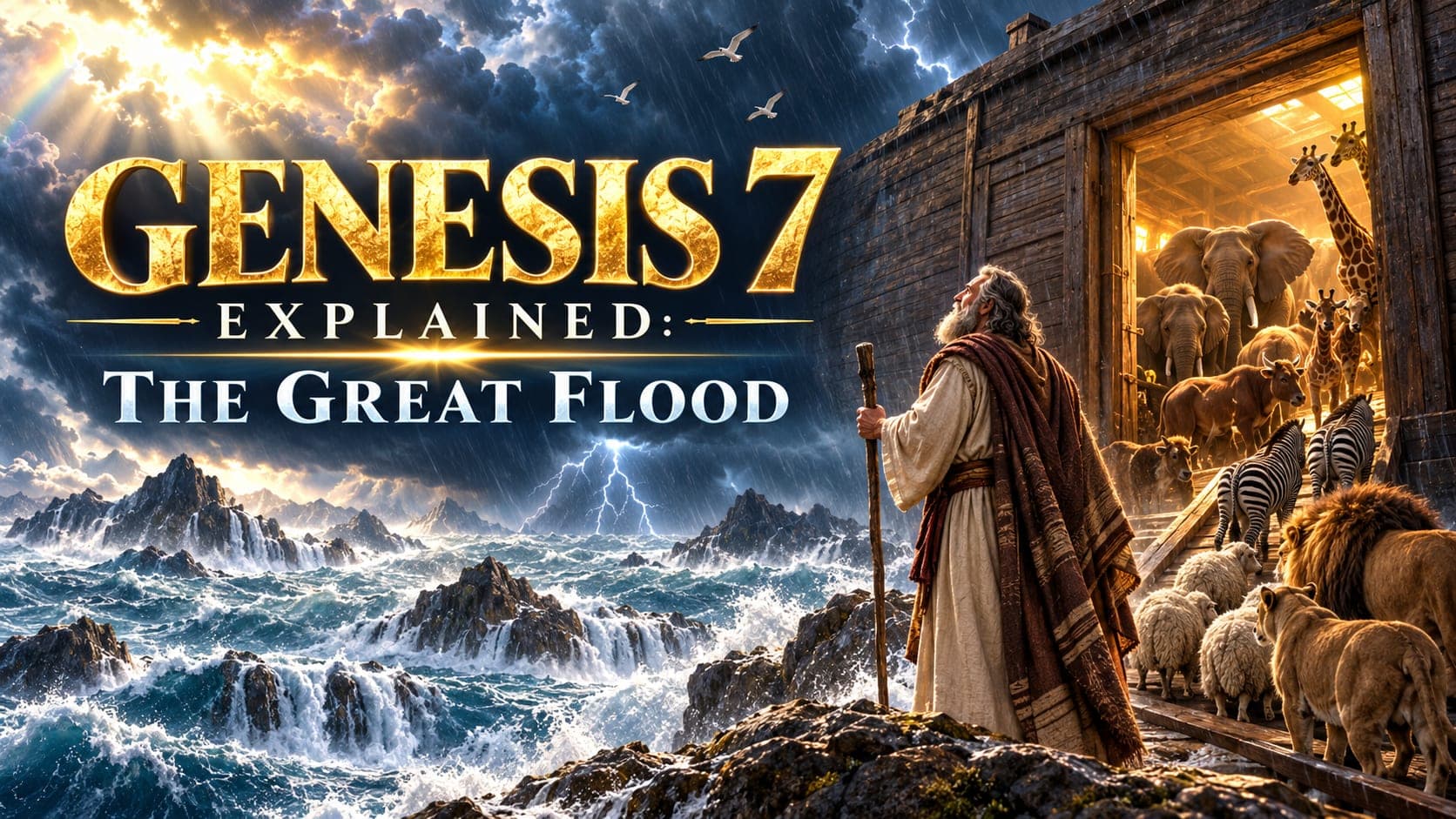
📖 Genesis 7 Explained: The Flood Begins and the Ark Door Shuts
Seven days of warning left. Then one door closes, and nobody on the outside opens it again.
Genesis 7 explained is the chapter where everything Genesis 6 set up finally gets used. The ark stops being a strange project Noah's neighbors laughed at and becomes the only dry ground left on earth.
Maybe you have wondered what actually happened once Noah walked through that door.
- ❓ How did two of every animal on earth end up inside one boat?
- ❓ Why does God ask for sevens of some animals and only twos of others?
- ❓ Who actually shut the door once everyone was inside?
- ❓ Did anyone outside the ark survive what came next?
📌 Noah does not shut himself in. Genesis 7 says the LORD does it for him.
This walkthrough goes through the whole chapter in order: the last personal invitation before the flood, the sevens and twos of the animals, the door only God could close, and the water that erased everything except one floating family.
This is the chapter where all of Noah's waiting finally ends.
What Happened Just Before This Chapter
Genesis 6 ended with an ark finished to exact measurements, sealed with pitch inside and out, and a covenant already promised to keep Noah and his family alive through the coming flood.
That chapter closed on a single line about Noah's character: he did everything God commanded him, exactly as commanded. Genesis 7 is where that obedience stops being words on a page and starts being tested for real.
📌 Genesis 6 was preparation. Genesis 7 is arrival. The blueprint becomes a boarding, and the boarding becomes a flood.
Genesis 7 Explained Verse by Verse
1. "Come Thou Into the Ark" (verses 1 to 4)
The chapter opens with a personal word from the LORD to Noah, not a general command shouted at the world.
"And the LORD said unto Noah, Come thou and all thy house into the ark; for thee have I seen righteous before me in this generation."
📌 Notice the verb. "Come thou," not "go thou." God does not point Noah toward the ark from a distance. He speaks as though He is already there, inviting Noah into a space where He is present. "Seen righteous before me in this generation" measures Noah against the people around him, not against a standard of sinless perfection.
Then comes a detail Genesis 6 never mentioned.
"Of every clean beast thou shalt take to thee by sevens, the male and his female: and of beasts that are not clean by two, the male and his female. Of fowls also of the air by sevens, the male and the female; to keep seed alive upon the face of all the earth."
Genesis 6:19 only said two of every sort. Here God adds a refinement: seven of every clean animal, and two of every unclean one. Most readers take "by sevens" as seven pairs, fourteen animals total, since each unit is already described as "the male and his female."
💡 "Clean" and "unclean" show up here centuries before Moses ever writes the food laws in Leviticus. Genesis 7 does not explain how Noah knew which animals counted as clean, only that the category already existed. Extra clean animals also explain how Noah has anything left to sacrifice once the ark empties out in the next chapter, without wiping out an entire kind in the process.
The warning then comes with an exact number attached.
"For yet seven days, and I will cause it to rain upon the earth forty days and forty nights; and every living substance that I have made will I destroy from off the face of the earth."
Seven days to finish loading. Then forty days and forty nights of rain, a number that shows up again and again in Scripture wherever testing is underway. This chapter alone repeats "forty" five separate times.
2. Six Hundred Years Old, and Obedient (verses 5 to 9)
The text pauses to mark exactly how old Noah is when the countdown starts.
"And Noah did according unto all that the LORD commanded him. And Noah was six hundred years old when the flood of waters was upon the earth."
"And Noah went in, and his sons, and his wife, and his sons' wives with him, into the ark, because of the waters of the flood. Of clean beasts, and of beasts that are not clean, and of fowls, and of every thing that creepeth upon the earth, There went in two and two unto Noah into the ark, the male and the female, as God had commanded Noah."
📌 The phrase "commanded him" or "commanded Noah" appears three separate times in this one chapter, in verses 5, 9, and again later at the door. Scripture is not letting the reader forget whose instructions are being followed here.
Notice also who moves toward whom. The animals "went in unto Noah," not the other way around. Noah does not spend these verses chasing creatures across the earth. Hebrews later says he acted "moved with fear," preparing the ark by faith in a warning he could not yet see, which fits a man who trusted God to bring the animals rather than one who tried to control every detail himself. That same trust is what earns Noah a place among the small handful of men Scripture describes as walking with God.
3. The Fountains and the Windows (verses 10 to 12)
Seven days pass exactly as promised, and the text marks the date with unusual precision.
"And it came to pass after seven days, that the waters of the flood were upon the earth. In the six hundredth year of Noah's life, in the second month, the seventeenth day of the month, the same day were all the fountains of the great deep broken up, and the windows of heaven were opened. And the rain was upon the earth forty days and forty nights."
The seventeenth day of the second month, in Noah's six hundredth year, is the exact year the math in Genesis 5's genealogy already pointed toward.
📌 Two separate sources of water break loose at once: fountains from below and windows from above. Genesis 1 described God dividing the waters, some under a firmament He called Heaven and some above it.
"And God made the firmament, and divided the waters which were under the firmament from the waters which were above the firmament: and it was so."
Genesis 7:11 reads like that ordering coming undone. The boundary God set on day two of creation gives way, and the world that emerged from water in the beginning starts sliding back into it.
4. The LORD Shuts the Door (verses 13 to 16)
The whole household and every kind of creature finish boarding on the very day the rain starts.
"In the selfsame day entered Noah, and Shem, and Ham, and Japheth, the sons of Noah, and Noah's wife, and the three wives of his sons with them, into the ark; They, and every beast after his kind, and all the cattle after their kind, and every creeping thing that creepeth upon the earth after his kind, and every fowl after his kind, every bird of every sort."
"And they went in unto Noah into the ark, two and two of all flesh, wherein is the breath of life. And they that went in, went in male and female of all flesh, as God had commanded him: and the LORD shut him in."
📌 Six words end this section, and they carry the whole chapter's weight: "and the LORD shut him in." Not Noah pulling a bolt across the door out of caution. God Himself closes it.
⚠️ Once that door shuts, nothing more is left for Noah to do either way. Whatever safety the ark offered was already sealed in place before the first drop of rain fell, entirely out of Noah's hands from that point forward.
5. The Ark Lifted Above the Mountains (verses 17 to 20)
With the door shut, the text turns from the people inside to the water rising outside.
"And the flood was forty days upon the earth; and the waters increased, and bare up the ark, and it was lift up above the earth. And the waters prevailed, and were increased greatly upon the earth; and the ark went upon the face of the waters."
"And the waters prevailed exceedingly upon the earth; and all the high hills, that were under the whole heaven, were covered. Fifteen cubits upward did the waters prevail; and the mountains were covered."
📌 Fifteen cubits, roughly twenty two feet, over the highest ground Noah could see. That is enough depth to leave nothing showing anywhere on the horizon, not a partial flood leaving dry patches for anyone to escape to.
How wide that horizon reached is the same question already raised in Genesis 6, and Genesis 7 does not settle it either. What this verse adds is not the flood's geography but its depth: wherever the water reached, it reached completely.
6. Only Noah Remained (verses 21 to 24)
The chapter closes with the starkest language in it, stated three separate ways.
"And all flesh died that moved upon the earth, both of fowl, and of cattle, and of beast, and of every creeping thing that creepeth upon the earth, and every man: All in whose nostrils was the breath of life, of all that was in the dry land, died. And every living substance was destroyed which was upon the face of the ground, both man, and cattle, and the creeping things, and the fowl of the heaven; and they were destroyed from the earth: and Noah only remained alive, and they that were with him in the ark."
"Died," then "died" again, then "destroyed" twice more. Scripture rarely repeats itself this many times in three verses. The point is not variety of vocabulary. It is that no reader walks away thinking anyone was spared outside that one boat.
💡 Count the people named across this chapter, Noah, his wife, his three sons, and their three wives, and the number comes to eight. Peter later calls Noah exactly that:
"Which sometime were disobedient, when once the longsuffering of God waited in the days of Noah, while the ark was a preparing, wherein few, that is, eight souls were saved by water."
Eight people, saved through water rather than from it. Peter goes on to call that water a picture of baptism, the same pattern of judgment and rescue arriving together that has run through every chapter since the garden.
"And the waters prevailed upon the earth an hundred and fifty days."
Forty days of rain, then a hundred and fifty days of water still standing over the earth before anything begins to recede. The waiting Noah did before the flood was matched by a long wait still ahead of him inside it.

Hard Questions Genesis 7 Raises
Could every land animal on earth really fit inside one ark? Genesis 6 already gave the ark's size, roughly 450 feet long, and Genesis 7 does not add new dimensions. What it does add is that the animals are gathered by "kind," a broader category than a modern species classification, which means far fewer distinct groups needed boarding than a full list of every animal alive today. Genesis 7 states what came aboard. It does not give a total count, so any specific figure beyond that is an estimate, not the text.
Why sevens of clean animals but only two of unclean, before Moses ever wrote down which animals counted as which? The text assumes Noah already understood the distinction without explaining where it came from. What is clear from the numbers themselves is a practical reason: seven of a kind leaves animals left over for sacrifice and future food once the flood ends, while two of a kind preserves a species without spare individuals to lose.
Did literally no one outside the ark survive? Verse 23 states it as plainly as Scripture states anything: "Noah only remained alive, and they that were with him in the ark." Jesus later describes the people outside as going about ordinary life, "eating and drinking, marrying and giving in marriage," right up until the flood came and "took them all away." Nothing in either passage leaves room for other survivors.
Top 5 Bible Verses From Genesis 7
1. Genesis 7:1
"And the LORD said unto Noah, Come thou and all thy house into the ark; for thee have I seen righteous before me in this generation."
A personal invitation, not a distant command. God speaks as though He is already inside the ark, calling Noah toward His presence rather than simply away from danger.
2. Genesis 7:5
"And Noah did according unto all that the LORD commanded him."
The same obedience already praised at the end of Genesis 6, now repeated right as the real test of that obedience begins.
3. Genesis 7:16
"And the LORD shut him in."
Six words carrying the weight of the whole chapter. Noah's safety was sealed by God's own hand, not by anything Noah did to secure the door himself.
4. Genesis 7:23
"And every living substance was destroyed which was upon the face of the ground, both man, and cattle, and the creeping things, and the fowl of the heaven; and they were destroyed from the earth: and Noah only remained alive, and they that were with him in the ark."
The starkest sentence in the chapter, and the clearest picture of how completely one family was set apart from the judgment falling on everyone else.
5. Genesis 7:24
"And the waters prevailed upon the earth an hundred and fifty days."
The forty days of rain get most of the attention, but the flood actually stood over the earth nearly four times that long before the water even began to go down.

Frequently Asked Questions About Genesis 7
What happens in Genesis 7?
Noah and his family board the ark with the animals God sends to them, the LORD shuts the door, and the flood covers the earth for forty days of rain and a hundred and fifty days of standing water, destroying every living thing outside the ark.
How old was Noah when the flood came?
Genesis 7:6 states his age directly: six hundred years old, on the seventeenth day of the second month of that year, according to verse 11.
How many of each animal went into the ark?
Two of every unclean animal, male and female, and seven of every clean animal, most likely seven pairs. Genesis 6:19 first gave the general command of two by two; Genesis 7:2 adds the clean and unclean distinction.
Why did God want seven of the clean animals but only two of the unclean?
Scripture does not explain the reasoning directly, but the extra clean animals line up with what happens next in Genesis 8, where Noah offers burnt sacrifices once the flood ends. Two would have left nothing to sacrifice without ending the species entirely.
Who shut the door of the ark?
Genesis 7:16 says plainly that the LORD shut Noah in, not Noah himself. It is one of the clearest pictures in the Old Testament of safety that depends on God rather than on human effort.
How long did it rain during the flood in Genesis 7?
Forty days and forty nights, stated in verses 4 and 12. The rain was only the beginning; the water it produced stayed high for far longer than the rain itself lasted.
How long did the floodwaters stay high?
Genesis 7:24 gives the number directly: a hundred and fifty days, well beyond the forty days of actual rainfall.
What does "the fountains of the great deep" mean?
It describes a second source of water rising up from below the earth, breaking loose at the same moment the "windows of heaven" opened above. Together they reverse the separation of waters God set in place on the second day of creation in Genesis 1:7.
Could Noah really fit every land animal on earth into one ark?
Genesis 7 describes animals gathered by broader "kind" rather than by every individual species known today, and does not give a total number. The ark's size was already described in Genesis 6 as roughly 450 feet long with three levels, but Genesis 7 itself leaves exact capacity unstated.
How many people survived the flood?
Eight: Noah, his wife, his three sons, and their three wives. 1 Peter 3:20 confirms the same count, calling them "eight souls saved by water."
Did anyone outside the ark survive the flood?
Genesis 7:23 states that Noah and those with him in the ark were the only ones left alive. Matthew 24:38 and 39 describe everyone else going about ordinary life until the flood came and took them all away, with no mention of any other survivors.
Final Thoughts
Genesis 7 is not really about weather. It is about what it looks like when a promise finally comes due.
📌 God's invitation was personal, not distant. "Come thou" sounds like Someone already present, calling Noah toward Him rather than merely warning him away from danger.
📌 Noah's safety was sealed by God's hand, not his own. The LORD shut the door. Nothing Noah did afterward could have made him any safer, and nothing outside could get in.
📌 Total judgment fell, and eight people floated safely on top of it. The same water that destroyed everything else was the very thing keeping the ark, and everyone in it, alive.
You are not on an ark waiting for rain. But you know what it feels like to wait on a promise that has not landed yet.
So here is your one next step.
Read Genesis 7:16 again, slowly, and let "the LORD shut him in" be the picture you carry into whatever you are waiting on right now.