📖 Joshua 3 Explained: Crossing the Jordan on Dry Ground
A flooded river stands between Israel and the land God promised them. Nobody has a boat.
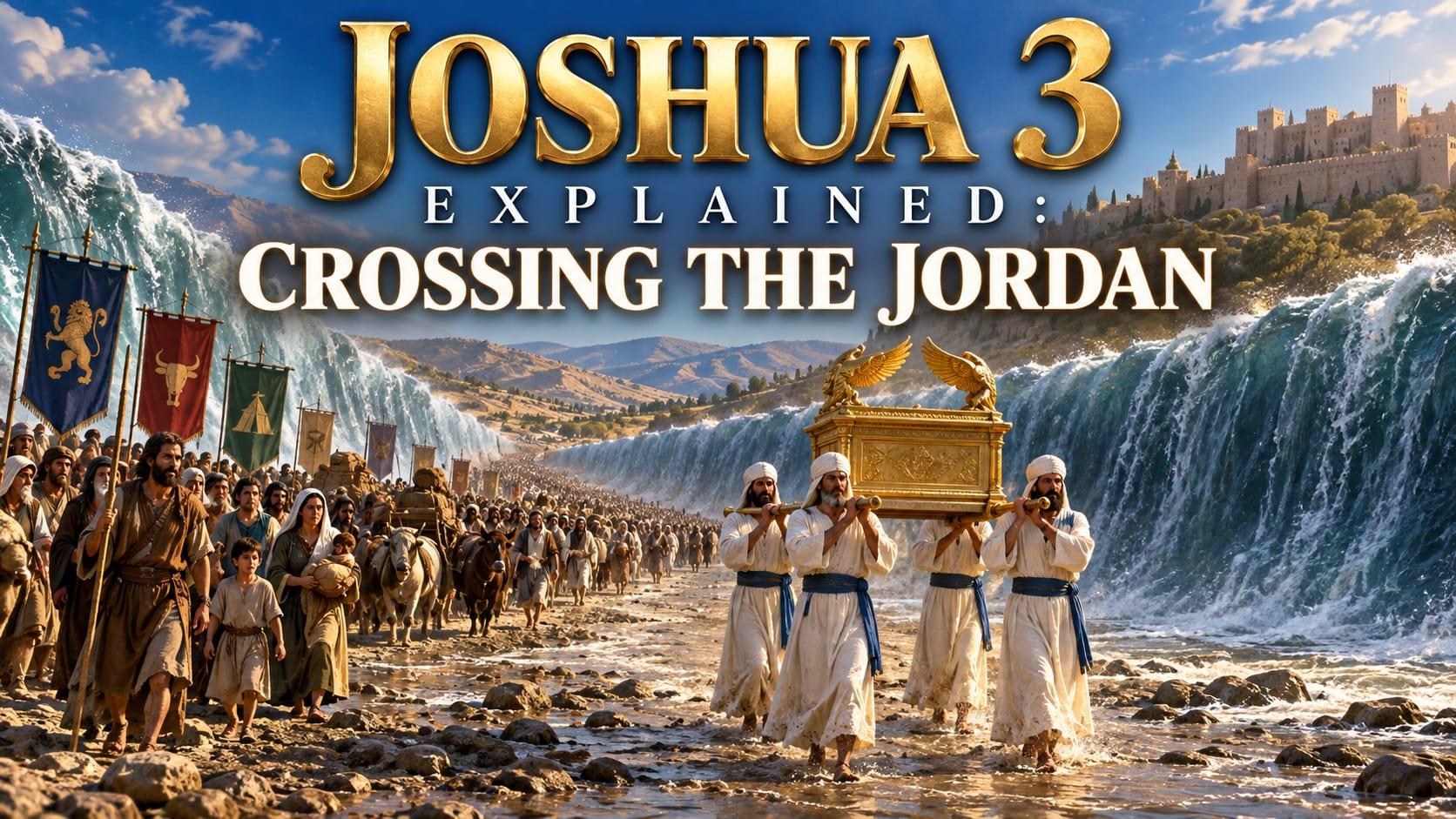
Joshua 3 explained is the chapter where Israel finally crosses the Jordan, and the way it happens is not quiet or ordinary. The river is at flood stage. The ark of the covenant goes first, carried by priests who have to actually stand in the water before anything changes. And the whole nation watches a river stop moving in front of them.
Maybe you have a Jordan of your own right now, something flooded that nobody can simply wade through.
- ❓ Why did God wait for the river to flood instead of crossing when it was low?
- ❓ Why did the people have to stay two thousand cubits back from the ark?
- ❓ Is this the same miracle as the Red Sea, or something different?
- ❓ Why does the chapter stop to pick twelve men before the crossing even finishes?
📌 Every detail in this chapter is aimed at one thing: making sure Israel knows this was God, not good timing or a lucky sandbar.
This walkthrough goes through the whole chapter: the three days of waiting, the instructions about the ark, the command to sanctify themselves, and the moment the water actually stops.
Read slowly. This is the chapter where a new generation gets its own reason to trust God, instead of just hearing about their parents' reasons.
What Happened Just Before This Chapter
Joshua 2 ended with two spies slipping back across the Jordan into the camp at Shittim, carrying a report that had nothing to do with armies or walls. A Canaanite woman named Rahab had already told them the LORD had given Israel the land, and the spies came back repeating her own words as Israel's official intelligence: the people of the land are already faint with fear.
Before that, Joshua 1 had God commissioning Joshua directly after Moses' death, promising him the same presence Moses had, and ending with the whole nation vowing to obey him. The spies were sent out and had come back. The promise had been repeated. Everything up to this point has been preparation. Joshua 3 is the moment the preparation turns into movement.

Joshua 3 Explained Verse by Verse
1. Three Days at the River's Edge (verses 1 to 4)
The chapter opens with the whole nation on the move, but not yet across.
"And Joshua rose early in the morning; and they removed from Shittim, and came to Jordan, he and all the children of Israel, and lodged there before they passed over."
Shittim to the Jordan was not a long march, but the text is specific that Israel lodged at the river rather than crossing the same day. The three day deadline Joshua had already given back in his first order as leader is now running out, and the next verse confirms it.
"And it came to pass after three days, that the officers went through the host; And they commanded the people, saying, When ye see the ark of the covenant of the LORD your God, and the priests the Levites bearing it, then ye shall remove from your place, and go after it."
📌 The marching order is simple and total: watch the ark, then follow it. No map, no scouted route, no column order based on tribe or rank. The entire nation's movement is reduced to one visible object.
"Yet there shall be a space between you and it, about two thousand cubits by measure: come not near unto it, that ye may know the way by which ye must go: for ye have not passed this way heretofore."
Two thousand cubits is roughly a thousand yards, a distance meant to keep the ark clearly visible to the whole camp while keeping everyone well clear of it. The reason given is twofold: reverence for what the ark represents, and plain necessity, since nobody in this generation has ever walked this ground before.
2. Sanctify Yourselves (verse 5)
Before any instructions about movement, Joshua gives one about the heart.
"And Joshua said unto the people, Sanctify yourselves: for to morrow the LORD will do wonders among you."
💡 Joshua announces the miracle before it happens. This is not a vague hope that God might show up. He tells the people, out loud, a day ahead of time, that wonders are coming.
Sanctifying themselves meant the kind of ritual preparation Israel's law required before encountering God directly, the same posture Israel took before receiving the law at Sinai. 📌 What is about to happen is treated as an encounter with God Himself, not just a river crossing that happens to go well.
3. The Ark Goes First, and God Explains Why (verses 6 to 8)
Joshua gives the priests their part, then God tells Joshua what the whole day is really about.
"And Joshua spake unto the priests, saying, Take up the ark of the covenant, and pass over before the people. And they took up the ark of the covenant, and went before the people."
"And the LORD said unto Joshua, This day will I begin to magnify thee in the sight of all Israel, that they may know that, as I was with Moses, so I will be with thee."
📌 God repeats, almost word for word, the exact promise He already gave Joshua in Joshua 1:5. That promise was spoken in private, between God and Joshua alone. Today it is about to be proven in public, in front of every single person in the camp.
Then comes the actual order the priests will carry out.
"And thou shalt command the priests that bear the ark of the covenant, saying, When ye are come to the brink of the water of Jordan, ye shall stand still in Jordan."
⚠️ Notice what the priests are told to do, and what they are not told. Nobody tells them the water will stop first and then they should step in. They are told to walk to the edge of a flooded river and stand still in it, with no promise yet visible that anything will change. The obedience comes before the proof.

4. "The Living God Is Among You" (verses 9 to 11)
Before anyone moves toward the water, Joshua stops the whole nation to explain what they are about to watch.
"And Joshua said unto the children of Israel, Come hither, and hear the words of the LORD your God."
"And Joshua said, Hereby ye shall know that the living God is among you, and that he will without fail drive out from before you the Canaanites, and the Hittites, and the Hivites, and the Perizzites, and the Girgashites, and the Amorites, and the Jebusites."
Those seven names were not scattered tribes picked at random. Together they stood for the whole population already living in Canaan, the complete list of who Israel would have to face to take the land. Naming all seven before the river even moves is Joshua telling Israel plainly: this crossing is proof for everything still ahead, not just for today.
📌 "The living God" is the point of the whole demonstration. Not a God who once acted at the Red Sea and then went quiet for forty years. A God active right now, in this generation, about to do something nobody in this camp has personally seen Him do before.
"Behold, the ark of the covenant of the LORD of all the earth passeth over before you into Jordan."
5. Twelve Men Are Chosen Before the Crossing Finishes (verse 12)
Right in the middle of the buildup, the chapter pauses for one short instruction that will not pay off until the next chapter.
"Now therefore take you twelve men out of the tribes of Israel, out of every tribe a man."
💡 Joshua 3 never explains what these twelve men are for. The chapter simply sets them apart, one from each tribe, and moves on. Whatever job they have been chosen for is left completely open until the memorial they build becomes the whole subject of the next chapter.
6. The Water Stops, and Israel Crosses on Dry Ground (verses 13 to 17)
Joshua tells the people exactly what sign to watch for, before it happens.
"And it shall come to pass, as soon as the soles of the feet of the priests that bear the ark of the LORD, the LORD of all the earth, shall rest in the waters of Jordan, that the waters of Jordan shall be cut off from the waters that come down from above; and they shall stand upon an heap."
The trigger is specific: the moment the priests' feet actually touch the water, not a moment before. Nothing happens on command from a safe distance. Someone has to step into a flooded river first.
"And it came to pass, when the people removed from their tents, to pass over Jordan, and the priests bearing the ark of the covenant before the people; And as they that bare the ark were come unto Jordan, and the feet of the priests that bare the ark were dipped in the brim of the water, (for Jordan overfloweth all his banks all the time of harvest,)"
📌 The chapter stops its own action to make sure you notice the parenthetical: the Jordan was at flood stage. This was not a dry season crossing at a shallow ford. Harvest time in this region meant the river was swollen with melted snow from the north, at its widest and fastest all year. God did not pick an easy moment and call it a miracle afterward. He picked the hardest one on the calendar.
"That the waters which came down from above stood and rose up upon an heap very far from the city Adam, that is beside Zaretan: and those that came down toward the sea of the plain, even the salt sea, failed, and were cut off: and the people passed over right against Jericho."
The "city Adam" here is a place name, a town beside Zaretan upstream from where Israel stood, not a reference to the first man in Genesis. The water backed up far enough north to clear the whole crossing point, while the water downstream toward the Dead Sea drained away and left the riverbed open, directly across from Jericho itself, the very city Israel would face next.
"And the priests that bare the ark of the covenant of the LORD stood firm on dry ground in the midst of Jordan, and all the Israelites passed over on dry ground, until all the people were passed clean over Jordan."
💡 The priests do not cross and then wait on the far bank. They stand in the middle of the riverbed, holding their position, for as long as it takes every single Israelite to pass. The miracle is not a brief flash. It holds steady for the whole length of the crossing.

Hard Questions Joshua 3 Raises
Why did God have Israel cross when the river was flooded, instead of waiting for low water? What the text says: Joshua 3:15 specifically points out that the Jordan overflows its banks during harvest, right as it describes the crossing happening anyway. How it has been read: crossing at the hardest possible moment removes any room to credit good timing, a shallow season, or a lucky ford. A flooded river parting is unmistakably different from a shallow river being waded across.
Why did the people have to stay two thousand cubits from the ark? What the text says: Joshua 3:4 gives two reasons, visibility for the whole camp and simple unfamiliarity with the route. What the rest of Scripture adds: the ark represented God's own presence, and Israel's law already warned that even the Levites assigned to carry sacred objects could die if they touched the wrong thing at the wrong time. The distance was reverence built into the architecture of the crossing itself, long before anyone learned the cost of treating the ark carelessly, the way Israel later would in Numbers 4.
Is the Jordan crossing the same miracle as the Red Sea? What the text says: the language is close enough to be deliberate, waters standing up as a heap and the people walking through on dry ground. What is different: the generation that saw the Red Sea part had almost entirely died in the wilderness, the judgment described back in Numbers 14. Joshua 3 is not a replay for people who already believed. It is a brand new generation getting its own undeniable reason to trust the same God.
Top Verses From Joshua 3
1. Joshua 3:17
"And the priests that bare the ark of the covenant of the LORD stood firm on dry ground in the midst of Jordan, and all the Israelites passed over on dry ground, until all the people were passed clean over Jordan."
The verse the whole chapter has been building toward. A flooded river stays parted for as long as it takes an entire nation to walk through it.
2. Joshua 3:7
"And the LORD said unto Joshua, This day will I begin to magnify thee in the sight of all Israel, that they may know that, as I was with Moses, so I will be with thee."
A private promise from Joshua 1 becomes a public proof here. What God told Joshua alone is about to be seen by every person in the camp.
3. Joshua 3:13
"And it shall come to pass, as soon as the soles of the feet of the priests that bear the ark of the LORD, the LORD of all the earth, shall rest in the waters of Jordan, that the waters of Jordan shall be cut off from the waters that come down from above; and they shall stand upon an heap."
The sign was announced before it happened. Someone still had to step into the water first for the promise to mean anything.
4. Joshua 3:5
"And Joshua said unto the people, Sanctify yourselves: for to morrow the LORD will do wonders among you."
Joshua announces the miracle a full day ahead of time, treating the crossing as an encounter with God, not just a logistics problem solved.

5. Joshua 3:10
"And Joshua said, Hereby ye shall know that the living God is among you, and that he will without fail drive out from before you the Canaanites, and the Hittites, and the Hivites, and the Perizzites, and the Girgashites, and the Amorites, and the Jebusites."
The crossing is explicitly tied to everything still ahead. A God who can stop a flooded river today can drive out seven nations tomorrow.
Frequently Asked Questions About Joshua 3
What does Joshua 3 mean?
Joshua 3 records Israel crossing the flooded Jordan River on dry ground, led by priests carrying the ark of the covenant. The waters upstream stood up as a heap while the water downstream drained away, opening a dry path directly across from Jericho.
How did Israel cross the Jordan River in Joshua 3?
Priests carried the ark of the covenant to the river first and stood in the water. The moment their feet touched it, the water flowing down from upstream stopped and piled up near a town called Adam, leaving the riverbed dry so the whole nation could walk across.
Why was the Jordan flooded when Israel crossed?
Joshua 3:15 notes that the Jordan overflows its banks during harvest time, which was exactly when Israel crossed. Choosing that moment rather than a dry season removed any question about whether the crossing was simply good timing on a shallow river.
Why did the people have to stay two thousand cubits from the ark?
Joshua 3:4 gives a practical reason, keeping the ark visible to the whole camp since nobody had traveled this route before, alongside a reverent one: the ark represented God's own presence, and Israel's law already treated it as something to approach carefully, not casually.
Is the Jordan crossing the same miracle as the Red Sea?
The two events share deliberate similarities, including water standing up as a heap and the people walking through on dry ground. But the generation crossing the Jordan had mostly never seen the Red Sea part, since the wilderness generation had died off. This crossing gave a new generation its own direct proof.
Who were the Canaanites, Hittites, Hivites, Perizzites, Girgashites, Amorites, and Jebusites?
Together these seven names covered the whole population already living in the land of Canaan. Naming all seven in Joshua 3:10 was Joshua telling Israel that the same God who could stop a flooded river could also remove every nation still standing between them and the promised land.
Why were twelve men chosen in Joshua 3?
Joshua 3:12 sets apart one man from each of the twelve tribes but does not say why yet. Their purpose, building a memorial from stones taken out of the Jordan riverbed, is explained in the chapter that follows.
Where exactly did Israel cross the Jordan?
Joshua 3:16 places the crossing directly across from Jericho, with the water piling up far upstream near a town called Adam, beside Zaretan. The dry ground opened at the exact point Israel needed to reach the city they would face next.
What does it mean that God would "magnify" Joshua?
In Joshua 3:7, God says the crossing will begin to magnify Joshua in the sight of all Israel, meaning the nation will visibly see that Joshua carries the same presence Moses once did. It was never about making Joshua look impressive for his own sake.
Why did the priests have to stand in the water before it stopped?
Joshua 3:13 makes the priests' feet touching the water the trigger for the waters being cut off, not something that happened before they stepped in. The obedience of walking toward a flooded river came before any visible sign that it would work.
Final Thoughts
Joshua 3 is a short chapter, and almost every verse in it is aimed at removing one excuse: that this was anything less than God.
📌 God chose the hardest version of the crossing, not the easiest one. A flooded river at harvest time leaves no room to credit good timing instead of God.
📌 Obedience came before the proof, not after it. The priests had to stand in the water with nothing yet visibly changed. Faith here looked like a wet first step.
📌 A new generation needed its own reason to believe. Hearing about the Red Sea secondhand was never going to carry Israel into Canaan. They needed the Jordan parted in front of their own eyes.
You probably have a flooded river of your own right now, something that will not simply dry up because you wait long enough.
So here is your one next step.
Read Joshua 3:13 again, and ask whether you are willing to take the first step toward it before you see anything change.