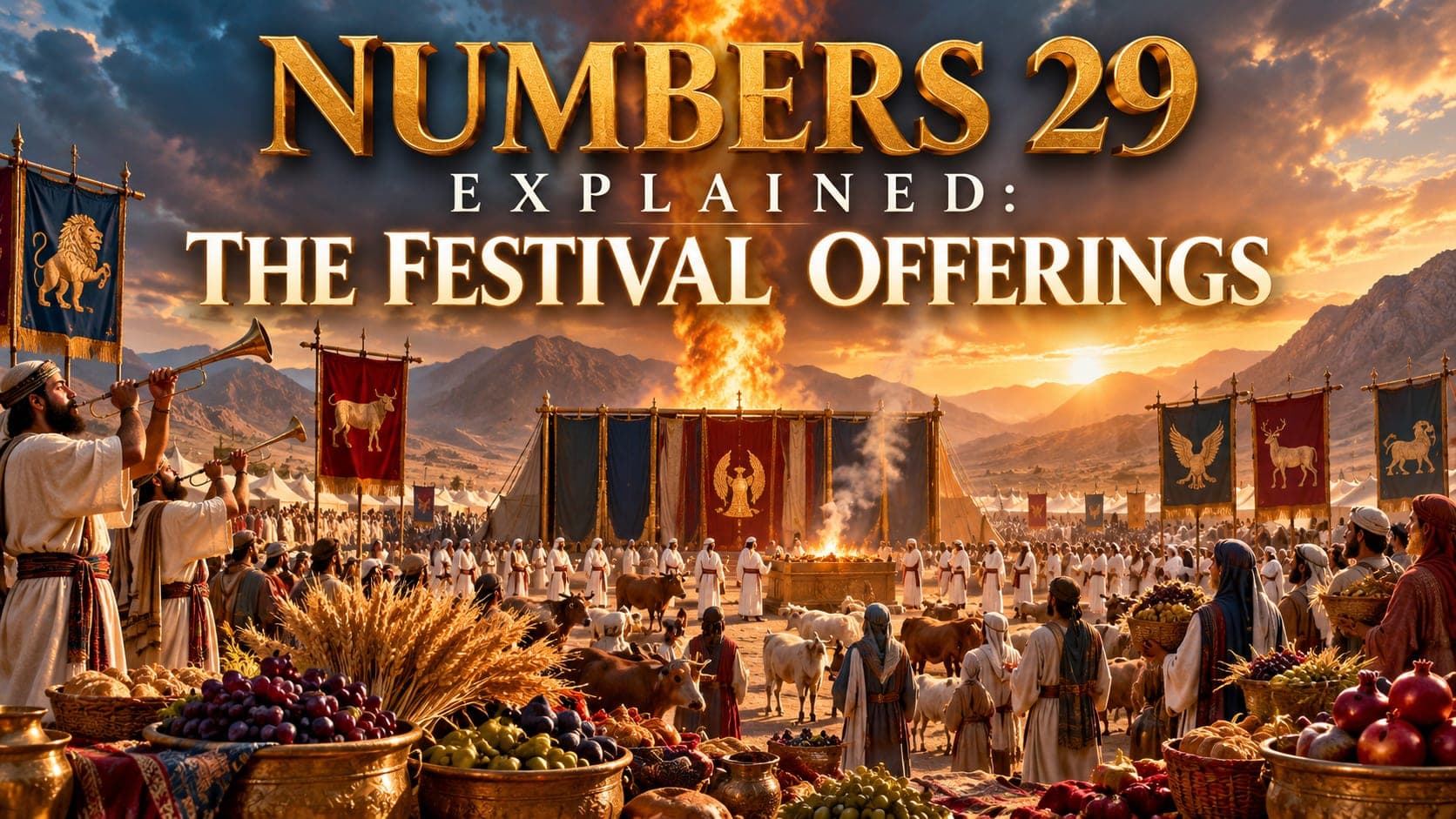
📖 Numbers 29 Explained: The Busiest Month on Israel's Calendar
Israel's whole year runs on a steady rhythm. Then one month breaks the pattern completely.
Numbers 29 explained covers that one month, the seventh, packed with more required worship than any other forty days in Israel's calendar. A trumpet blast that opens it. The one day a year nobody is allowed to work at all. Then seven straight days of a feast that calls for more animals than any single event in the whole chapter before it, followed by an eighth day nobody saw coming.
Maybe you have lived through a season that stacked everything at once, with no room to catch your breath.
- ❓ Why does a trumpet blast open the busiest month of the year?
- ❓ Why is the Day of Atonement the one day Israel is forbidden to work at all, not just told to rest?
- ❓ Why does the required offering shrink by exactly one bullock every day of the feast of tabernacles?
- ❓ Why does an eighth day get added right after a seven day feast already ended?
📌 The month opens and closes with the exact same small offering, and everything enormous happens in between.
This walkthrough goes through the whole chapter in order: the feast of trumpets, the day of atonement, the seven escalating days of the feast of tabernacles, the solemn eighth day, and the one closing verse that ties the entire sacrificial calendar together.
Forty verses, and together they ask for more worship than any other chapter in this book.
What Happened Just Before This Chapter
Numbers 28 laid out what Israel owed God on an ordinary day, an ordinary Sabbath, an ordinary new moon, and during Passover week and the day of firstfruits. It covered five different occasions in thirty one verses and still left one stretch of the year completely untouched.
That stretch is the seventh month, and Numbers 29 exists to fill in exactly what it costs. The narrative pause that began in Numbers 28, three chapters of law before the fighting against Midian resumes in Numbers 31, continues here. Nothing in this chapter moves the story of Moses, Joshua, or the march toward Canaan forward by a single verse. It simply tells Israel what the most crowded month of their year requires of them, down to the last lamb.
Numbers 29 Explained Verse by Verse
1. The Feast of Trumpets Opens the Month (verses 1 to 6)
The seventh month does not ease in quietly. It opens with a command to stop everything and listen.
"And in the seventh month, on the first day of the month, ye shall have an holy convocation; ye shall do no servile work: it is a day of blowing the trumpets unto you."
Leviticus 23 had already set this day apart as a memorial of trumpets. Numbers 29 does not repeat the reason for it, only the cost of keeping it.
"And ye shall offer a burnt offering for a sweet savour unto the LORD; one young bullock, one ram, and seven lambs of the first year without blemish:"
💡 Scripture never names the instrument used for this blast. Later Jewish practice used the shofar, a ram's horn, but the text itself only says "trumpets" and leaves the detail there. What the text does make unmistakably clear is how the offering stacks.
"Beside the burnt offering of the month, and his meat offering, and the daily burnt offering, and his meat offering, and their drink offerings, according unto their manner, for a sweet savour, a sacrifice made by fire unto the LORD."
📌 The first day of the seventh month is also a new moon, so three offerings land on the same morning: the continual daily offering, the new moon offering Numbers 28 already described, and this feast's own offering on top of both. Nothing in this chapter ever replaces what came before it. Every single layer keeps running underneath whatever gets added.
2. The Day of Atonement, the One Day Nobody Works (verses 7 to 11)
Nine days later, the tone of the month changes completely.
"And ye shall have on the tenth day of this seventh month an holy convocation; and ye shall afflict your souls: ye shall not do any work therein:"
"Afflict your souls" is Scripture's own phrase for this day, and Leviticus 16 explains why it carries that weight.
"For on that day shall the priest make an atonement for you, to cleanse you, that ye may be clean from all your sins before the LORD."
⚠️ Every other holy day in this calendar bans "servile work." This is the only one that bans work of any kind, with no exception named anywhere in the law. Leviticus 23 spells out exactly how seriously that line was taken.
"And whatsoever soul it be that doeth any work in that same day, the same soul will I destroy from among his people."
Numbers 29 adds the same quiet layering already seen at the feast of trumpets, a sin offering riding beside the burnt offering, beside the daily offering that never stops.
"One kid of the goats for a sin offering; beside the sin offering of atonement, and the continual burnt offering, and the meat offering of it, and their drink offerings."
💡 The writer of Hebrews later points to this exact day, once a year, one priest, going where no one else could go, as the clearest picture in the Old Testament of what Christ's death would finally finish.
"But into the second went the high priest alone once every year, not without blood, which he offered for himself, and for the errors of the people:"
"Nor yet that he should offer himself often, as the high priest entereth into the holy place every year with blood of others; For then must he often have suffered since the foundation of the world: but now once in the end of the world hath he appeared to put away sin by the sacrifice of himself."
📌 Israel repeated this atonement every single year for the next thousand years. Hebrews says Christ did it once, and it never needs repeating again. The repetition in Numbers 29 is part of the point. A sacrifice that has to come back every year is admitting, by its own calendar, that it never finished the job for good.
3. The Feast of Tabernacles Begins at Full Scale (verses 12 to 16)
Five days after the fast, the mood flips again, and this time it stays flipped for a solid week.
"And on the fifteenth day of the seventh month ye shall have an holy convocation; ye shall do no servile work, and ye shall keep a feast unto the LORD seven days:"
"And ye shall offer a burnt offering, a sacrifice made by fire, of a sweet savour unto the LORD; thirteen young bullocks, two rams, and fourteen lambs of the first year; they shall be without blemish:"
📌 Thirteen bullocks on one single morning. No other day anywhere in this book, trumpets, atonement, Passover, new moons, asks for anywhere close to that number. This feast opens at a scale nothing before it in the seventh month has matched, and verse 16 adds the same goat for sin and the same continual offering underneath it that every day so far has carried.
4. Six More Days, and a Number That Falls by One Each Time (verses 17 to 34)
The rams and lambs hold steady through the whole week, two rams and fourteen lambs every day without change. The bullocks do not.
"And on the second day ye shall offer twelve young bullocks, two rams, fourteen lambs of the first year without spot:"
"And on the seventh day seven bullocks, two rams, and fourteen lambs of the first year without blemish:"
Lined up day by day, the drop is exact and never skips a number.
- 📖 Day 1: thirteen bullocks
- 📖 Day 2: twelve bullocks
- 📖 Day 3: eleven bullocks
- 📖 Day 4: ten bullocks
- 📖 Day 5: nine bullocks
- 📖 Day 6: eight bullocks
- 📖 Day 7: seven bullocks
💡 Add that list up and the seven days of the feast call for seventy bullocks total, on top of ninety eight lambs, fourteen rams, and seven goats for sin, and that is before counting the two daily lambs offered every single morning and evening of that same week. The text never explains why the number steps down instead of staying level or climbing. Later Jewish teaching connected the number seventy to the seventy nations listed in Genesis 10, though that reading comes from later rabbinic tradition rather than anything Numbers 29 states outright.
Every one of these seven days repeats the same instruction almost word for word, "shall be according to their number, after the manner," which is Scripture's own way of saying the meat offering and drink offering simply scale with however many animals that day requires. The chapter would rather repeat a formula seven times than leave any day's requirement unclear.
This feast is the one Leviticus 23 had already tied to living in booths, remembering the wilderness itself.
"Ye shall dwell in booths seven days; all that are Israelites born shall dwell in booths:"
"That your generations may know that I made the children of Israel to dwell in booths, when I brought them out of the land of Egypt: I am the LORD your God."
📌 The most expensive week on Israel's whole calendar was spent living in temporary shelters, not permanent houses. The richest celebration of the year was built around a reminder of the camp they had just come from, not an escape from it. Centuries later, this same feast is still running when Jesus goes up to Jerusalem.
"Now the Jews' feast of tabernacles was at hand."
"In the last day, that great day of the feast, Jesus stood and cried, saying, If any man thirst, let him come unto me, and drink."
💡 John does not explain the connection in so many words, but the timing is hard to miss. In the middle of the one feast built entirely around remembering a thirsty, homeless wilderness, Jesus stands up and offers living water.
5. The Eighth Day Closes the Circle (verses 35 to 40)
The seven days end, and the chapter still is not finished.
"On the eighth day ye shall have a solemn assembly: ye shall do no servile work therein:"
"But ye shall offer a burnt offering, a sacrifice made by fire, of a sweet savour unto the LORD: one bullock, one ram, seven lambs of the first year without blemish:"
📌 One bullock, one ram, seven lambs, one goat for sin. That is the exact same count, animal for animal, as the feast of trumpets on day one and the day of atonement on day ten. After thirteen bullocks on day fifteen and a count that fell every day for a week straight, the month closes by stepping back down to the smallest offering it ever asked for, the same small offering it opened with.
Then one final verse ties the entire chapter, and the three before it, together in a single sentence.
"These things ye shall do unto the LORD in your set feasts, beside your vows, and your freewill offerings, for your burnt offerings, and for your meat offerings, and for your drink offerings, and for your peace offerings."
💡 That one word, "beside," is doing the same work it has done through the whole chapter. Nothing listed here, not trumpets, not atonement, not the seven days of tabernacles, replaces a vow or a freewill gift someone already owed God on their own. Required worship and personal devotion run on two separate tracks, and this chapter only ever covers the first one.
⚠️ Hard Questions Numbers 29 Raises
Why does the bullock count fall by exactly one every day of tabernacles instead of staying level? Numbers 29 never states a reason. What is certain is that the pattern is deliberate, thirteen falling to seven in a straight, unbroken line across seven days, repeated with identical wording each time. Any explanation of why it falls rather than stays level goes beyond what the text itself says.
Is the Day of Atonement the same thing later Judaism calls Yom Kippur? Yes. "Yom Kippur" is simply the Hebrew name for the day Numbers 29:7 and Leviticus 16 describe as the day of atonement, the tenth day of the seventh month. The name changed across the centuries. The day and its requirements did not.
Why is work banned completely on the Day of Atonement but only "servile work" on the other feast days? The text is consistent about this distinction every time it comes up. Leviticus 23:28 and 23:30 use language found nowhere else in this calendar, banning work of any kind and naming destruction as the penalty for ignoring it. The other holy days ban only servile labor, which left room for necessary tasks like food preparation. Atonement alone gets the stricter standard.
Why does the eighth day get its own separate convocation instead of simply being the feast of tabernacles' last day? Numbers 29:35 marks it with its own holy convocation, distinct from the seven days already completed in verse 34, and gives it its own smaller offering rather than continuing the week's falling count. The text treats it as its own occasion tacked onto the end of the feast, not simply day seven repeated.
Does the seventy bullocks across the week of tabernacles really connect to seventy nations, the way some teachers say? Genesis 10 does list seventy named nations descending from Noah's sons, and the arithmetic in Numbers 29 does add up to seventy bullocks across the feast. Numbers 29 itself never draws that connection. It is a later rabbinic reading of the number, worth knowing about, not a claim this chapter makes for itself.

Top Verses From Numbers 29
1. Numbers 29:1
"And in the seventh month, on the first day of the month, ye shall have an holy convocation; ye shall do no servile work: it is a day of blowing the trumpets unto you."
The month that carries the heaviest list of required worship in the whole book opens with nothing more than a trumpet blast and a command to stop everything and listen.
2. Numbers 29:7
"And ye shall have on the tenth day of this seventh month an holy convocation; and ye shall afflict your souls: ye shall not do any work therein:"
The one day a year with no exception written into the work prohibition at all, set apart for an atonement nothing else on the calendar could provide.
3. Numbers 29:13
"And ye shall offer a burnt offering, a sacrifice made by fire, of a sweet savour unto the LORD; thirteen young bullocks, two rams, and fourteen lambs of the first year; they shall be without blemish:"
The largest single day's offering in the entire chapter, opening a feast that will ask for seventy bullocks before the week is finished.
4. Numbers 29:36
"But ye shall offer a burnt offering, a sacrifice made by fire, of a sweet savour unto the LORD: one bullock, one ram, seven lambs of the first year without blemish:"
The exact same small offering the month opened with, closing a chapter that spent a whole week climbing to thirteen bullocks and back down again.
5. Numbers 29:39
"These things ye shall do unto the LORD in your set feasts, beside your vows, and your freewill offerings, for your burnt offerings, and for your meat offerings, and for your drink offerings, and for your peace offerings."
The closing line that ties this chapter to Numbers 28 before it, making clear that none of this required calendar ever replaced what someone personally owed God on their own.
Frequently Asked Questions About Numbers 29
What is Numbers 29 about?
Numbers 29 lists every offering Israel owed God during the seventh month: the feast of trumpets on day one, the day of atonement on day ten, the seven day feast of tabernacles starting on day fifteen, and the solemn eighth day that follows it. It is the busiest single chapter in Israel's sacrificial calendar.
What was the feast of trumpets?
Numbers 29:1 calls it a holy convocation marked by the blowing of trumpets on the first day of the seventh month. Leviticus 23:24 had already established it as a memorial day. Later Judaism calls this same day Rosh Hashanah.
What happened on the Day of Atonement?
Numbers 29:7 to 11 describe the required offerings for that day, while Leviticus 16 describes the high priest entering the most holy place once a year to make atonement for the nation's sin. It was the one day with no exception to the ban on work.
How long did the feast of tabernacles last?
Seven days, from the fifteenth to the twenty first day of the seventh month, according to Numbers 29:12 and Leviticus 23:34. An eighth day of solemn assembly followed immediately after, described separately in Numbers 29:35.
Why did the number of bullocks decrease each day of tabernacles?
Numbers 29:13 to 32 record the bullock count falling from thirteen on day one to seven on day seven, one fewer each day, while the rams and lambs stay constant. The chapter records the pattern without explaining the reason behind it.
What is Shemini Atzeret, the eighth day?
It is the name later Judaism gave to the eighth day described in Numbers 29:35 to 38, a solemn assembly immediately following the seven days of tabernacles, with its own holy convocation and its own offering.
Why does Numbers 29 keep repeating "beside the continual burnt offering"?
Because none of the feast day offerings in this chapter ever replaced the twice daily offering described in Numbers 28. Every single addition in Numbers 29, from trumpets to the eighth day, stacks on top of that offering rather than standing in for it.
Is the Day of Atonement the same as Yom Kippur?
Yes. Yom Kippur is simply the Hebrew name for the day Numbers 29 and Leviticus 16 call the day of atonement, observed on the tenth day of the seventh month.
How does Numbers 29 connect to Jesus?
John 7 records Jesus attending the feast of tabernacles and offering living water on its last day. Hebrews 9 points to the day of atonement's yearly, repeated sacrifice as a picture of what Christ's one time sacrifice finally finished for good.
Why does the eighth day offer the exact same animals as trumpets and atonement?
Numbers 29:2, 29:8, and 29:36 all list one bullock, one ram, and seven lambs. The text never explains why, but the effect is that the month's smallest offering opens it, closes it, and marks its one required day of rest from sin in between.
Final Thoughts
Numbers 29 is a crowded month written down as a list, and the order of that list is not an accident.
📌 A trumpet comes before a fast, and a fast comes before a feast. Israel was called to attention first, made right with God second, and only then invited to the biggest celebration of the year. Joy in this calendar never came before the atonement that made it possible.
📌 The month opens and closes on the exact same small offering. Everything enormous, thirteen bullocks, a week that never repeats the same number twice, sits bracketed between two days that ask for almost nothing by comparison.
📌 Required worship never canceled personal devotion. Numbers 29:39 says plainly that every vow and freewill offering still stood, beside everything this chapter already demanded.
You are probably not counting bullocks this week either. But you likely have your own version of this month, a season crowded with more than usual, where everything feels urgent at once.
So here is your one next step.
Before you celebrate whatever is next on your own calendar, ask whether you have actually settled what still needs atoning for first, the way day ten came before day fifteen here.