📖 Proverbs 4 Explained: Get Wisdom, Guard Your Heart
Two verses in this chapter you have probably heard your whole life.
The other twenty five explain where they actually came from.
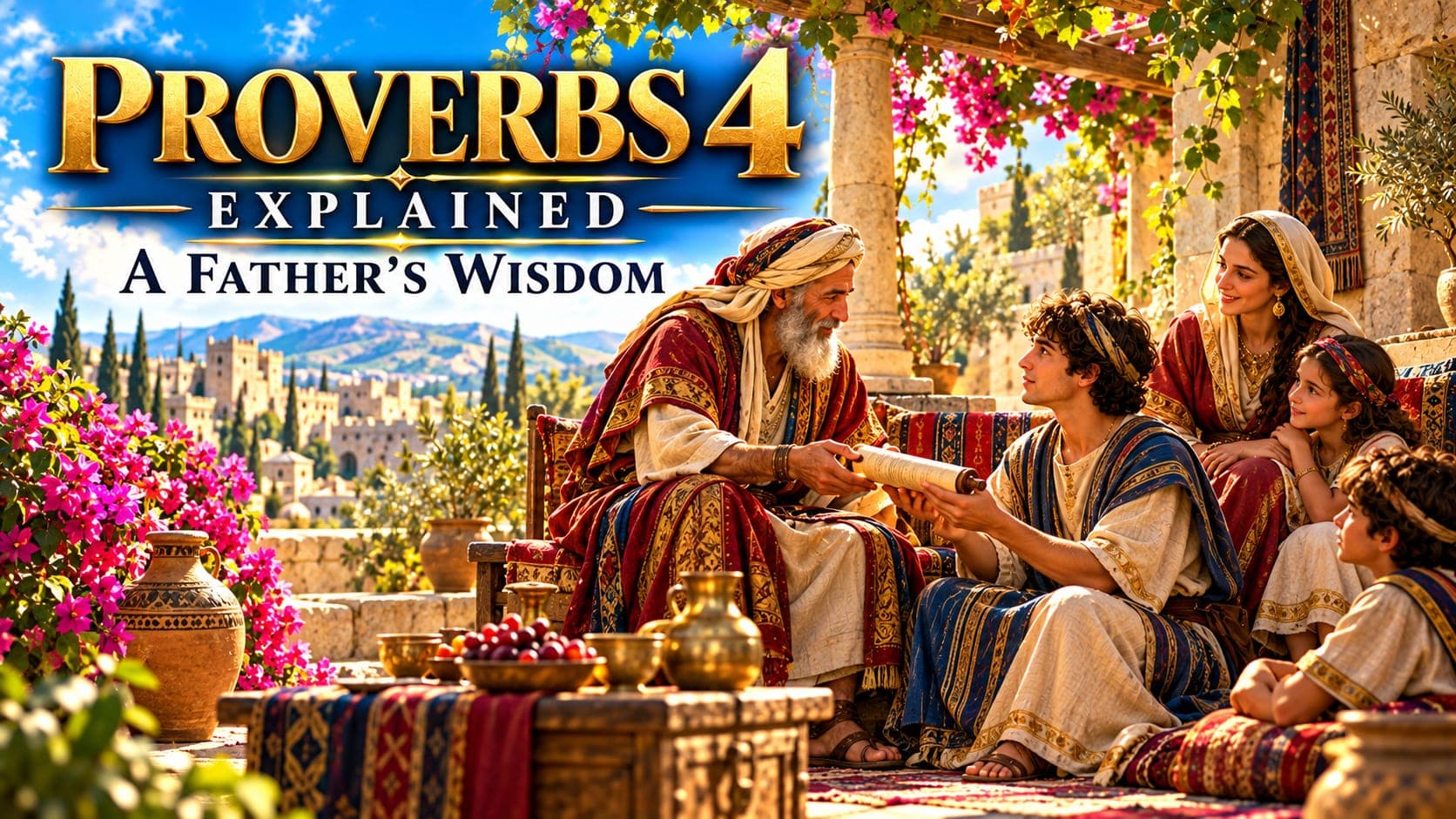
Proverbs 4 explained is the chapter where Solomon stops speaking only as a father and starts speaking as a son too. Before he tells his own children to get wisdom, he tells them exactly where he got it: sitting under his own father's instruction, being handed the same command he is about to hand down again.
Maybe you know what it feels like to stand between two generations like that.
- ❓ Why does Solomon suddenly start talking about his own childhood?
- ❓ What does it actually mean that wisdom is "the principal thing"?
- ❓ Why can't the wicked in this chapter sleep at night?
- ❓ What does it really take to guard your heart, when the text never explains how?
📌 Proverbs 4 is not a chapter about ideas. It is a father proving, with his own life, that what he is asking his son to do already worked on him first.
This walkthrough goes through the whole chapter in order: the wisdom Solomon received from David before he ever became king, the price tag he puts on wisdom, the two paths laid out in stark contrast, and the one verse about your heart that outlasts every other line in the chapter.
Read it the way Solomon meant it: not a list of unconnected sayings, but one man handing you what was handed to him.
What Happened Just Before This Chapter
Proverbs 3 closed on instructions about neighbors: give when you are able, do not delay a good you can do today, do not envy people who get ahead by hurting others. It ended on a single line about pride and humility, the same line quoted twice more later in the New Testament.
Proverbs 4 does not open on a new topic. It opens on a new voice. For three chapters, Solomon addressed his son the way a teacher addresses a class, with no explanation of how he came to know any of this himself. Chapter 4 finally answers that question, before it adds anything new.
📌 Solomon is not inventing wisdom teaching from nothing. He is repeating, almost word for word in places, what his own father once taught him. That detail changes how the rest of the chapter should be read.
Proverbs 4 Explained Verse by Verse
1. A Father's Wisdom, Handed Down Twice (verses 1 to 4)
Solomon opens this chapter differently than the two before it. Instead of jumping straight into commands, he pauses to explain where his own instruction came from.
"Hear, ye children, the instruction of a father, and attend to know understanding. For I give you good doctrine, forsake ye not my law."
Children here is plural. Solomon widens who he is speaking to, from the single son addressed across chapters 1 through 3 to however many sons and daughters were listening. "Good doctrine" is not a phrase he uses casually. He is telling his own children that what follows has already been tested, not freshly invented for the occasion.
"For I was my father's son, tender and only beloved in the sight of my mother. He taught me also, and said unto me, Let thine heart retain my words: keep my commandments, and live."
📌 This is Solomon naming his source directly. The "father" giving instruction in verse 1 turns out to have once been a son receiving the exact same kind of instruction from David. And the command David gave him, "let thine heart retain my words," is the very command Solomon is about to give his own children two verses later.
His mother was Bathsheba, the same woman David's sin against Uriah cost so much to marry. Whatever complicated history surrounded Solomon's birth, this verse describes a home where wisdom was still deliberately passed down, not abandoned to the mess of what came before it.
2. Get Wisdom, Whatever It Costs (verses 5 to 9)
Having established where the lesson came from, Solomon quotes David's actual words.
"Get wisdom, get understanding: forget it not; neither decline from the words of my mouth. Forsake her not, and she shall preserve thee: love her, and she shall keep thee."
💡 Wisdom is pictured as someone to hold onto, the same way chapters 2 and 3 already pictured her. David's command is simple to state and hard to treat casually: do not forget, do not decline, do not forsake. Three warnings aimed at the same failure, drifting away slowly instead of walking away all at once.
"Wisdom is the principal thing; therefore get wisdom: and with all thy getting get understanding."
📌 This is the verse most people already know from this chapter, even if they have never read the eight verses around it. "Principal" means first in rank, not first in a sequence. Whatever else a person spends their life acquiring, this verse ranks wisdom above every other acquisition, not merely alongside it.
"Exalt her, and she shall promote thee: she shall bring thee to honour, when thou dost embrace her. She shall give to thine head an ornament of grace: a crown of glory shall she deliver to thee."
The ornament and crown echo the same image Proverbs 1:9 used for a father and mother's own instruction. Solomon is showing that the reward promised back in chapter 1 is not abstract. It is the direct result of doing what verses 5 through 7 describe.
3. The Years and the Steps Wisdom Buys You (verses 10 to 13)
Solomon returns to the singular "my son," the address used through chapters 1 to 3.
"Hear, O my son, and receive my sayings; and the years of thy life shall be many."
"I have taught thee in the way of wisdom; I have led thee in right paths. When thou goest, thy steps shall not be straitened; and when thou runnest, thou shalt not stumble."
📌 "Straitened" means cramped or hemmed in. Solomon is not promising an easy life free of effort. He pictures walking and running, both real exertion, and promises only that the path itself will not trip up the person walking wisely on it.
"Take fast hold of instruction; let her not go: keep her; for she is thy life."
⚠️ Notice how far the language has moved since verse 1. Instruction was once something to hear. Now it is something to hold, with both hands, and refuse to release. Solomon is describing a grip that tightens the longer wisdom proves itself, not a lesson learned once and set down.
4. Avoid the Path of the Wicked (verses 14 to 17)
Solomon turns from what to hold onto, to what to actively stay away from.
"Enter not into the path of the wicked, and go not in the way of evil men. Avoid it, pass not by it, turn from it, and pass away."
Four separate commands in one breath: avoid, do not pass by, turn, pass away. Solomon does not tell his son to walk carefully near this path. He tells him to actively route around it, the same urgency chapter 1 used for the violent gang his son might be invited to join.
"For they sleep not, except they have done mischief; and their sleep is taken away, unless they cause some to fall. For they eat the bread of wickedness, and drink the wine of violence."
📌 This is one of the most striking pictures in the whole book. Solomon is not describing people who occasionally do wrong. He is describing people for whom wrongdoing has become as necessary as food and as automatic as breathing, restless until they have caused someone else to fall. The same pattern shows up in Cain's own line by the end of Genesis 4, where one generation's anger curdles into open boasting about violence.
5. Two Roads, Two Kinds of Light (verses 18 and 19)
Two verses, and Solomon lays the whole chapter's choice out in one contrast.
"But the path of the just is as the shining light, that shineth more and more unto the perfect day. The way of the wicked is as darkness: they know not at what they stumble."
💡 The just walk a path that keeps getting brighter, described almost like a sunrise moving toward noon: gradual, but always moving toward more light, never less. The wicked walk in darkness so complete that they cannot even identify what is tripping them.
📌 Notice the difference is not that one group avoids all stumbling and the other does not. It is that one group can see what they are walking toward, and the other cannot see what is already under their feet. Wisdom does not promise an obstacle free path. It promises light to actually see the obstacles that are there.
6. Guard Your Heart Above All Else (verses 20 to 23)
Solomon repeats language from earlier in the chapter almost word for word before he hands over its most famous line.
"My son, attend to my words; incline thine ear unto my sayings. Let them not depart from thine eyes; keep them in the midst of thine heart. For they are life unto those that find them, and health to all their flesh."
Attend, incline, keep. Solomon is making sure his son has actually been listening before he adds anything new.
"Keep thy heart with all diligence; for out of it are the issues of life."
📌 This is the most quoted verse in the chapter, and for good reason. "Heart" in this book means the whole inner person, mind, will, and conscience together, not only feeling. "Issues" means the outflow, everything that eventually comes out of a person in word and action. Solomon is saying the source matters more than any single decision downstream of it. A father who wants his children to live well does not only correct their actions one at a time. He tries to shape what those actions are flowing from.
7. Watch Your Mouth, Your Eyes, and Your Feet (verses 24 to 27)
Having named the heart as the source, Solomon spends the last four verses naming exactly what flows out of it.
"Put away from thee a froward mouth, and perverse lips put far from thee."
"Let thine eyes look right on, and let thine eyelids look straight before thee. Ponder the path of thy feet, and let all thy ways be established. Turn not to the right hand nor to the left: remove thy foot from evil."
📌 Mouth, eyes, and feet, three concrete parts of the body, closing a chapter that began with something as invisible as the heart. Solomon will not let wisdom stay abstract. He walks it all the way down to where a person is actually looking and where their feet are actually headed. Guarding a wandering eye or a careless word is not a separate discipline from guarding the heart. It is what guarding the heart looks like in practice.

Hard Questions Proverbs 4 Raises
Was Solomon really his mother's only child? Almost certainly not in a literal sense. 1 Chronicles 3:5 lists four sons born to David and Bathsheba, including Solomon. "Tender and only beloved" more likely describes special affection, being singled out and cherished, the same way Scripture elsewhere calls a favored child "only" without meaning a literal only child.
Does calling wisdom "the principal thing" rank wisdom above God? No. Proverbs 1:7 already anchored the whole book in the fear of the LORD. Wisdom's rank above every other possession does not compete with God. It flows directly from taking Him seriously in the first place.
Does verse 16 mean the wicked literally cannot fall asleep unless they have sinned that day? Read as a medical claim, this overreads a deliberately extreme picture. Solomon is describing a compulsion, how completely doing evil has come to define a person's daily rhythm, not a literal case of insomnia.
Does "keep thy heart with all diligence" put the whole responsibility on the person, with no room for God's help? Nothing in this verse rules out relying on God, but the command is addressed to the son directly. Active vigilance is expected of him, not something to simply wait for. The rest of Proverbs and the Psalms make clear this vigilance runs alongside dependence on God, not instead of it.
Does "turn not to the right hand nor to the left" mean a person should never change plans? Read after twenty six verses about moral direction, this is about staying faithful to the right path, not a rule against ever adjusting a decision or a job. The picture is a traveler staying on the road, not someone forbidden from changing course.
Practical Tips From Proverbs 4
This chapter is not only a father's speech. It is a checklist he built from what actually worked on him.
- Pass on what actually worked on you first. Solomon does not ask his children to trust wisdom in the abstract. He tells them plainly that David's instruction shaped his own life before he ever repeated it.
- Rank wisdom above whatever else you are chasing. Verse 7 does not say wisdom is one good thing among many. Ask honestly what you are actually spending the most effort acquiring this year.
- Refuse to merely avoid the wrong path. Actively route around it. Verses 14 and 15 use four separate verbs for staying away from evil. Passive caution is not what this verse asks for.
- Notice when wrongdoing starts to feel necessary instead of occasional. Verses 16 and 17 describe people who cannot rest without it. Catch that shift in your own life long before it reaches that point.
- Guard your heart before you try to fix your actions. Verse 23 names the heart as the source, not the destination. Correcting behavior without addressing what is underneath it rarely lasts.
- Watch your mouth, your eyes, and your direction as one discipline. Verses 24 through 27 treat all three as evidence of what is happening in the heart. Guard the whole self, not just the parts that are easiest to notice.
- Expect the path to get brighter, not easier. Verse 18 promises increasing light, not decreasing difficulty. Do not confuse a harder season with a wrong path if you can still see where you are going.
Top 5 Bible Verses From Proverbs 4
1. Proverbs 4:7
"Wisdom is the principal thing; therefore get wisdom: and with all thy getting get understanding."
The verse most people already know from this chapter. Whatever else you spend your life acquiring, this verse ranks wisdom first, not merely alongside everything else.
2. Proverbs 4:23
"Keep thy heart with all diligence; for out of it are the issues of life."
The hinge of the whole chapter. Every action Solomon names afterward, speech, sight, and direction, is described as flowing out of whatever this verse is guarding.
3. Proverbs 4:18
"But the path of the just is as the shining light, that shineth more and more unto the perfect day."
A picture of gradual, growing light rather than a sudden, easy path. Wisdom brightens the way forward instead of removing every obstacle from it.
4. Proverbs 4:14 and 15
"Enter not into the path of the wicked, and go not in the way of evil men. Avoid it, pass not by it, turn from it, and pass away."
Four separate commands for the same one danger. Solomon does not ask his son to walk carefully near evil. He tells him to actively route around it.
5. Proverbs 4:26 and 27
"Ponder the path of thy feet, and let all thy ways be established. Turn not to the right hand nor to the left: remove thy foot from evil."
The chapter's closing instruction, brought all the way down to something as ordinary as where your next step lands.
Frequently Asked Questions About Proverbs 4
What is Proverbs 4 about?
Solomon explains that his own father David once taught him to get wisdom above everything else, then passes that same instruction on to his own children, ending on the command to guard the heart because everything else in life flows from it.
Who is the father speaking in Proverbs 4?
Solomon is the speaker throughout, but in verses 3 and 4 he quotes his own father, David, recalling the exact instruction David once gave him as a son.
What does "keep thy heart with all diligence" mean?
It means guarding the whole inner person, mind, will, and conscience, since Proverbs 4:23 says every outcome in life flows out of the heart rather than starting somewhere else.
Why does Solomon say "wisdom is the principal thing"?
"Principal" means first in rank. Solomon is telling his children that whatever else they acquire in life, wisdom should outrank every other pursuit, not simply join the list alongside it.
What does "the path of the just is as the shining light" mean?
It pictures a life shaped by wisdom as a light that grows steadily brighter, like sunrise moving toward noon, in contrast to the wicked, who walk in darkness so complete they cannot see what trips them.
Why can't the wicked sleep in Proverbs 4:16?
The verse describes a compulsion rather than a literal medical condition. Solomon pictures wrongdoing as something these people cannot rest without doing, showing how completely it has taken over their daily life.
Was Solomon really an only child?
Almost certainly not. 1 Chronicles 3:5 names several sons born to David and Bathsheba. "Tender and only beloved" in verse 3 more likely describes deep affection than a literal only child.
How does Proverbs 4 connect to the rest of the Bible?
It repeats and builds on themes from Proverbs 1 through 3, including the ornament and crown imagery from chapter 1 and the fear of the LORD that Proverbs 1:7 already set as wisdom's foundation.
Final Thoughts
Proverbs 4 is not two famous verses. It is a father proving his own case with his own life.
📌 Wisdom is not invented fresh in each generation. It is received, tested, and handed down. Solomon quotes David before he ever adds a word of his own.
📌 Wisdom is not one good pursuit among many. It is the principal thing. Whatever else you are chasing this year, verse 7 asks where wisdom actually ranks against it.
📌 Everything traces back to the heart. Mouth, eyes, and feet are all named in this chapter as evidence of what is happening underneath them.
So here is your one next step.
Name one thing you are guarding less carefully than your own heart right now, and ask honestly why.