📖 What Is the Feast of the Immaculate Conception? Catholic Beliefs Explained
Your Catholic friend mentions the Immaculate Conception, and you nod along, assuming she means the virgin birth of Jesus.
She does not. She is talking about her own mother, in a manner of speaking. Or rather, about Mary's mother, and the moment Mary herself was conceived.
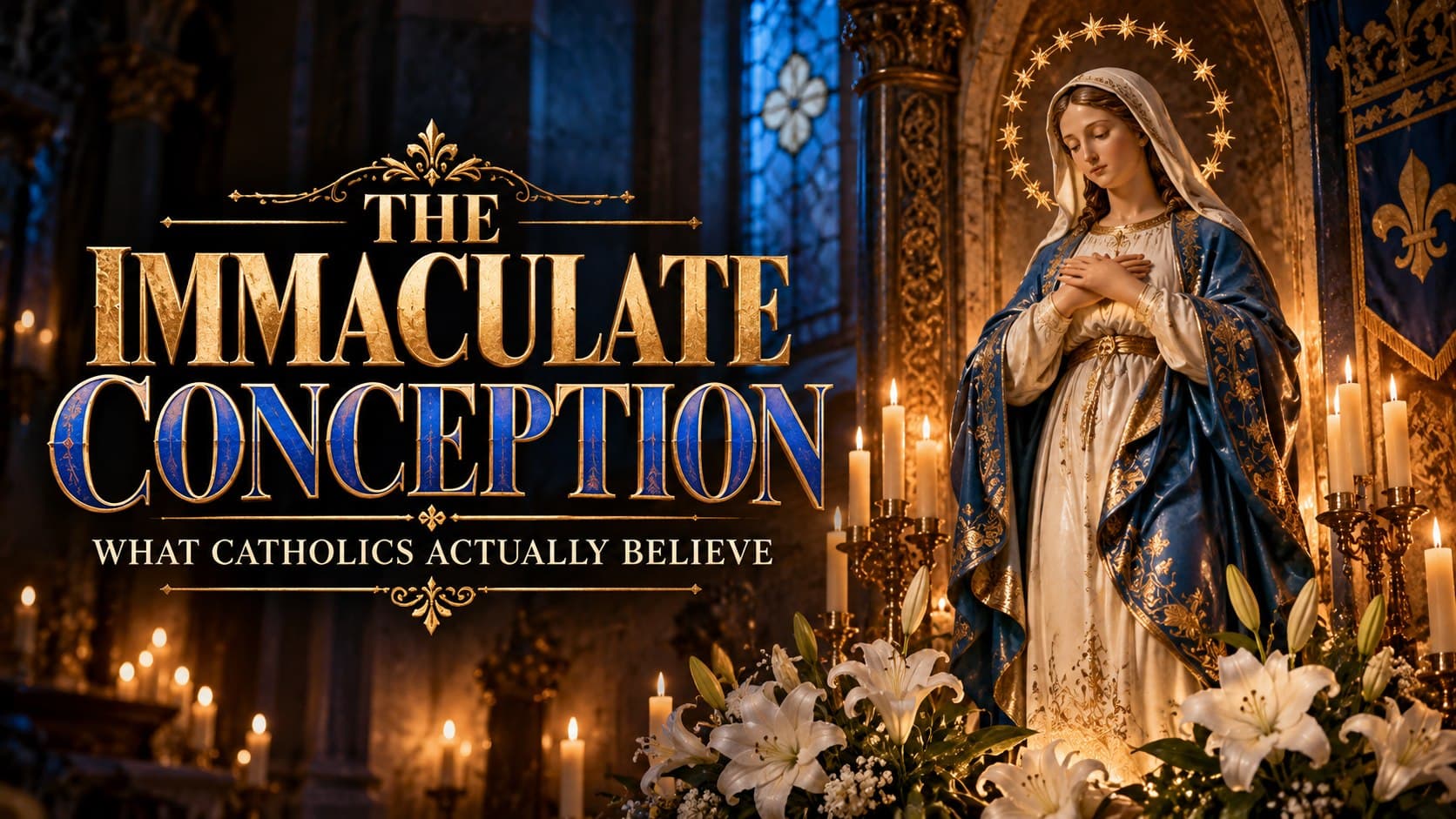
📌 Here is the plain answer. The Immaculate Conception has nothing to do with how Jesus was conceived. It is the Catholic teaching that Mary, the mother of Jesus, was conceived by her own parents in the ordinary way, but was preserved by God's grace from the moment of that conception from the stain of original sin that every other human being inherits. Pope Pius IX declared it an official Catholic dogma on December 8, 1854, and Catholics keep that date every year as a holy day.
That one sentence is doing a lot of work, and most people who have heard the phrase have never had it explained.
This guide walks through what the Catholic Church actually claims, the medieval argument between two famous theologians that split a church in half for centuries before this was ever made official, how Pope Pius IX settled it in 1854, what Scripture is actually cited on both sides, and exactly where and why Protestants land somewhere else.
Every historical and doctrinal claim below links back to a named source, so you can go check it yourself.
Why This Matters for Your Faith
It would be easy to file this away as a trivia question about a name that confuses people. It is actually a question about something much bigger.
⚠️ What you believe about this one doctrine touches the biggest question the whole Bible is actually about. Who needs a Savior, and why.
Catholics and Protestants both confess that every human being needs rescuing from sin. Where they part ways is whether God made exactly one exception, for exactly one person, so that His own Son could be born through her. This is also one of the six days every year Catholics in the United States are bound to attend Mass for, so a huge number of Christians you know personally are living this question out, not just debating it.
💡 However you land on it, this is a conversation worth having carefully, because both sides are trying to protect something true. Catholics are protecting the idea that God can do something extraordinary to prepare the way for His Son. Protestants are protecting the idea that nobody, not even Mary, gets to skip the line at the cross.
What the Immaculate Conception Actually Teaches
1. First, Clear Up the Name
Start with the confusion, because almost everyone who has heard this phrase has heard it wrong.
The United States Conference of Catholic Bishops addresses this directly on its own page for the day. The feast, it says, concerns Mary's own conception, free from original sin, rather than Christ's virginal conception and birth. Mary was conceived the normal way, by her own parents, traditionally named Joachim and Anne in later Christian writing. What makes this conception immaculate, meaning spotless, is not how it happened biologically. It is what God did to her soul the moment it happened.
📌 Say it the other way around and it gets clearer. The virgin birth is about Jesus and is universally accepted by Christians who hold to the historic faith. The Immaculate Conception is about Mary, and only Catholics, along with some Orthodox and Anglican Christians, hold to it.
2. What Original Sin Has to Do With It
To understand what Catholics believe was prevented, you have to understand what they believe everyone else inherits.
"Wherefore, as by one man sin entered into the world, and death by sin; and so death passed upon all men, for that all have sinned:"
Catholic teaching, in agreement with the rest of historic Christianity, holds that every human being born after Adam inherits a sinful nature, sometimes called original sin, apart from any personal sin they go on to commit themselves. King David said something close to the same thing centuries earlier.
"Behold, I was shapen in iniquity; and in sin did my mother conceive me."
The Catechism of the Catholic Church, in the Vatican's own text, states the dogma this way: by the grace of God, Mary remained free of every personal sin her whole life. The same section calls her "the All Holy," a title Eastern Christians have long used, and says she was enriched by God from the first instant of her conception with the splendor of an entirely unique holiness.
💡 The claim, in plain words, is narrow and specific. Not that Mary never needed God. Not that she was somehow not fully human. Only that the one inherited stain everyone else is born carrying was, in her case, prevented from the very start.
3. The Medieval Argument That Split Theologians for Centuries
This was not always settled Catholic teaching. For hundreds of years, it was one of the most heated arguments inside the Church itself.
According to the detailed history on Wikipedia's Immaculate Conception entry, a feast honoring Mary's conception already existed in the Eastern Church by the seventh century and reached England by the eleventh. When an English monk named Eadmer defended the idea around the year 1100, two of the biggest names in Christian theology pushed back hard. Bernard of Clairvaux and later Thomas Aquinas both objected that if Mary had never needed redeeming from sin in the first place, Christ's redemption of her would not mean anything.
⚠️ That objection is the same one most Protestants still raise today, almost word for word. A theologian trained in the strictest logic of the medieval Church got there first.
A Franciscan friar named Duns Scotus answered it around the year 1300 with an idea called preservative redemption. Mary was not redeemed after falling into sin, the way everyone else is. She was redeemed in advance, preserved from ever falling into it at all, because of the same cross that saves everyone else. His own summary of the argument became famous in Latin: potuit, decuit, ergo fecit. God could do it, it was fitting that He would, so He did.
The disagreement became a genuine rift. Wikipedia's account describes Franciscans who followed Scotus and Dominicans who followed Aquinas splitting into what one historian calls a virtual civil war inside the Church. It got serious enough that Pope Sixtus IV, himself a Franciscan, added a feast honoring the Immaculate Conception to the Roman calendar in 1477, then had to step in twice more, in 1481 and 1483, to forbid either side from preaching against the other or calling the other side heretics.
4. How Pope Pius IX Made It Official in 1854
The argument simmered, unresolved as formal dogma, for nearly four more centuries. The Council of Trent, meeting in the 1500s, never issued a formal ruling on it either way, though it did exempt Mary by name from its own decree on how universal original sin is.
Pope Pius IX finally moved to settle it. New Advent's full text of his constitution Ineffabilis Deus records that on February 2, 1849, writing from Gaeta, he sent a letter to every Catholic bishop in the world asking two things: how devoted their own people already were to the idea, and whether they themselves wanted it formally defined. The bishops, the document says, replied with one voice asking for exactly that. Pius IX then set up a special commission of cardinals and theologians to study the question before deciding.
📌 On December 8, 1854, from St. Peter's in Rome, he made the declaration that still stands today. The United States Conference of Catholic Bishops quotes the defining sentence directly: "We declare, pronounce and define that the doctrine which asserts that the Blessed Virgin Mary, from the first moment of her conception, by a singular grace and privilege of almighty God, and in view of the merits of Jesus Christ, Saviour of the human race, was preserved free from every stain of original sin, is a doctrine revealed by God and, for this reason, must be firmly and constantly believed by all the faithful."
That is the whole claim, in the Church's own chosen words. Revealed by God, not invented by a committee, and binding on every Catholic from that day forward.
5. The Feast Day Today, and Why It Falls in Advent
Every December 8, Catholics mark the Solemnity of the Immaculate Conception. The USCCB's own page for the day calls Mary the Patroness of the United States of America under this exact title, and lists it as a holy day of obligation, meaning Catholics are expected to attend Mass, alongside a simple suggested devotion of praying the Hail Mary before meals that day.
It is not a coincidence that this falls inside the Advent season, the weeks leading up to Christmas. Nine months after December 8 lands on September 8, the date Catholic tradition keeps as Mary's own birthday. The Church is marking the moment her own life began, free from the stain she would have otherwise carried, in the same season it prepares to mark the birth of her Son.
6. Where Protestants Land, and Why
Protestant churches, almost without exception, reject this doctrine. The reasoning is worth hearing in full, not as a slogan.
The Christian ministry GotQuestions.org lays out the core objection plainly. Scripture, it says, never actually teaches that Mary was conceived without sin, and it notes that even the Catholic Church itself does not claim this comes from a direct Bible verse. Instead it rests on Romans 3:23.
"For all have sinned, and come short of the glory of God;"
⚠️ GotQuestions points to one more detail that carries real weight. Mary herself calls God her Savior, in her own words, recorded in Luke's Gospel.
"And Mary said, My soul doth magnify the Lord, And my spirit hath rejoiced in God my Saviour."
A person only needs a Savior, the argument goes, if they have something to be saved from. GotQuestions concludes that the Bible gives every reason to believe Mary was, in its own words, an ordinary human female, a godly woman who needed grace like anyone else, not an exception to Romans 3:23.
The other major Protestant objection is about the Bible verse Catholics lean on hardest, the angel Gabriel's greeting to Mary.
"And the angel came in unto her, and said, Hail, thou that art highly favoured, the Lord is with thee: blessed art thou among women."
💡 This single verse carries more weight in this debate than almost any other, and both sides read it differently. Catholic teaching has long read the older Latin translation of this phrase, rendered "full of grace," as a description of a complete, settled state. Wikipedia's summary of the scholarly debate notes that critics argue the underlying Greek word more simply means highly favored or graced, without settling the question of sinlessness either way. Neither side disputes what the angel said. They disagree about how much theological weight one Greek participle can carry.
It is worth being fair to the Catholic answer to the "Mary needed a Savior too" objection, rather than skipping past it. This is exactly the kind of question the Reformation itself was built around answering, and Catholic theology has its own serious response, going back to Duns Scotus. The Catechism of the Catholic Church is explicit that Mary's holiness "flows entirely from Christ's" and that she was redeemed "in a more exalted fashion" because of her Son's own merits, not apart from them. In Catholic teaching, Mary still needed a Savior. The claim is that she received that saving in advance, rather than after the fact. Most Protestant theology does not find that distinction persuasive, since Scripture never describes anyone else being saved that way, but it is a real theological answer, not a denial that Mary needed Christ at all.
Established and Unsettled
✅ What is established
- Pope Pius IX formally defined the Immaculate Conception as Catholic dogma in the apostolic constitution Ineffabilis Deus, issued at St. Peter's in Rome on December 8, 1854.
- The doctrine concerns Mary's own conception by her parents, not Jesus' conception. The USCCB states this plainly on its own page for the feast.
- For centuries before 1854, Catholic theologians were genuinely divided. Thomas Aquinas and the Dominicans objected, Duns Scotus and the Franciscans defended it, and Pope Sixtus IV had to forbid each side from calling the other heretical, in 1481 and 1483.
- Mary describes God as her own Saviour in Luke 1:47.
- Protestant churches have, from the Reformation onward, rejected the doctrine as unscriptural, holding that Mary was a sinner saved by grace like every other believer.
⚠️ What is still uncertain
- Whether the doctrine is actually true. Scripture never states directly that Mary was conceived without original sin, and no verse settles the question either way.
- How much weight Luke 1:28's 'highly favoured,' translated in an older Latin version as 'full of grace,' can actually carry. Catholic and Protestant readers draw different conclusions from the same Greek word.
- Whether Duns Scotus's idea of 'preservative redemption,' preserved from sin in advance rather than cleansed afterward, is a real answer to the objection that a sinless Mary would not need a Savior, or merely a restatement of the same claim in different words. Catholic and Protestant theologians still disagree.
Practical Tips for Talking About This Well
Whichever side of this you land on, here is how to handle the conversation honestly.
- Fix the name confusion first. Before you discuss whether the doctrine is true, make sure you and the person you are talking to agree on what it actually claims. Half of every argument about this online is really just two people arguing past each other about Jesus when one of them means Mary.
- Learn the real Catholic answer before you argue against it. "A sinless Mary would not need a Savior" is a fair question, but Catholic theology already has an answer, preservative redemption, going back seven centuries. Argue with the actual answer, not a version nobody holds.
- Do not treat this as a test of someone's salvation. A Catholic who holds this doctrine and a Protestant who rejects it can both be trusting Christ alone for their own rescue from sin. This is a disagreement about Mary, not about the gospel itself.
- Read Luke 1 for yourself before you repeat either side's talking points. Most people arguing about this have never actually read the chapter the whole debate comes from.
- If a Catholic friend invites you to December 8 Mass, go curious, not combative. You will understand the actual devotion far better sitting in the room than reading about it secondhand.
- Keep the real stakes in view. Both sides in this debate are protecting something true: that God can do extraordinary things, and that nobody skips needing a Savior. Do not let the argument make you lose sight of either truth.
Top 5 Bible Verses About This Debate
These five verses carry almost the entire conversation, on both sides.
1. Luke 1:28
"And the angel came in unto her, and said, Hail, thou that art highly favoured, the Lord is with thee: blessed art thou among women."
The single most argued over verse in this whole debate. Catholic teaching has long read the older translation of this greeting, "full of grace," as pointing toward a completed, lifelong state of grace. Many Protestants read the same Greek word as simply meaning highly favored, without deciding the sinlessness question on its own.
2. Romans 3:23
"For all have sinned, and come short of the glory of God;"
The verse most Protestants bring to this conversation first. If Paul means literally everyone with no exception, the argument goes, Mary cannot be the one person left out.
3. Psalm 51:5
"Behold, I was shapen in iniquity; and in sin did my mother conceive me."
David describing his own conception this way is part of why Catholic theology considers Mary's own conception the specific moment that needed God's intervention. It is also the exact verse Catholic doctrine says Mary alone, among all human beings other than Christ, was spared from.
4. Luke 1:46 and 47
"And Mary said, My soul doth magnify the Lord, And my spirit hath rejoiced in God my Saviour."
Mary names God her own Savior, in her own recorded words. Protestants read this as settling the matter. Catholic theology reads it as entirely compatible with the doctrine, since Scotus's whole argument is that she was saved too, just saved in advance rather than after falling.
5. Genesis 3:15
"And I will put enmity between thee and the woman, and between thy seed and her seed; it shall bruise thy head, and thou shalt bruise his heel."
Catholic apologetics point to this verse, spoken to the serpent right after the fall, as an early hint that one specific woman would stand in direct opposition to sin in a way no other descendant of Eve would. Most Protestant readers take the woman here as a reference to humanity or to Israel in general, not a specific prophecy about Mary's own conception. Both readings are long standing positions, not new arguments invented for this debate.

Frequently Asked Questions About the Immaculate Conception
Is the Immaculate Conception about Jesus or Mary?
Mary. It is the Catholic teaching that Mary herself was conceived by her own parents in the normal way, but preserved from original sin from that first moment. Jesus' conception by the Holy Spirit is a separate doctrine, the virgin birth, which the Immaculate Conception does not describe at all.
When was the Immaculate Conception made official Catholic teaching?
Pope Pius IX defined it as dogma on December 8, 1854, in the apostolic constitution Ineffabilis Deus, after consulting Catholic bishops worldwide and a special commission of cardinals and theologians.
Why do Catholics celebrate the Immaculate Conception on December 8?
December 8 is nine months before September 8, which Catholic tradition keeps as Mary's own birthday. It is also the date Pope Pius IX chose for the 1854 declaration itself, and it is one of the six holy days of obligation on the Catholic calendar in the United States.
Did Thomas Aquinas believe in the Immaculate Conception?
No. Aquinas argued that if Mary had never needed redeeming from sin, Christ's redemption of her would not mean anything. The Franciscan theologian Duns Scotus answered that objection roughly a century later with the idea of preservative redemption, which eventually became the Church's accepted position.
What Bible verse do Catholics use to support the Immaculate Conception?
Mainly Luke 1:28, where the angel Gabriel greets Mary as highly favored, translated in an older Latin version as full of grace. Catholic apologetics also points to Genesis 3:15. Neither verse states the doctrine directly, which is why it rests on Church teaching and tradition as well as Scripture.
Why do Protestants reject the Immaculate Conception?
Mainly because Scripture never states it directly, Romans 3:23 says all have sinned with no stated exception, and Mary herself calls God her Saviour in Luke 1:47, which most Protestants read as proof she needed saving like everyone else.
Does the Immaculate Conception mean Mary never sinned her whole life?
Yes, that is part of the Catholic claim. The doctrine holds that Mary was preserved from original sin at her conception and, by that same grace, committed no personal sin at any point in her life.
Is the Immaculate Conception a holy day of obligation?
Yes. December 8 is one of six days a year, beyond Sunday, when Catholics in the United States are bound to attend Mass.
Is Mary the patron saint of the United States because of the Immaculate Conception?
Yes. The USCCB's own page for the feast names Mary, under the title of the Immaculate Conception, as the Patroness of the United States of America.
If Mary never sinned, did she still need Jesus as her Savior?
Catholic teaching says yes. The Catechism states that Mary's holiness flows entirely from Christ and that she was redeemed in a more exalted way because of her Son's own merits, not apart from them. Most Protestant theologians find that distinction unpersuasive, but it is the Church's actual position, not a denial that Mary needed Christ.
Final Thoughts
Strip away the centuries of argument and three things are left standing.
📌 The name confuses almost everyone who first hears it. This is a claim about Mary's own conception, not about how Jesus was conceived.
📌 This was never a quick or easy question, even inside the Catholic Church itself. Some of history's most careful theologians argued it out for seven centuries before Pope Pius IX settled it as dogma in 1854.
📌 The real disagreement is not about whether Mary mattered. It is about whether Scripture's "all have sinned" really means all, with no exception, and both Catholics and Protestants have real theological reasons for where they land.
You do not have to settle this argument today to take something true from it. Mary herself, in Luke's Gospel, calls God her Saviour and rejoices in Him. Whatever you believe about December 8, that response is worth imitating every day of the year, not just on hers.
📚 Sources
Every claim in this article traces back to one of these. All links checked 31 October 2026.
- Advent: December 8
United States Conference of Catholic Bishops (USCCB)
The source for the feast being a holy day of obligation, Mary's title as Patroness of the United States of America, and the clarification that the feast concerns Mary's own conception, not Christ's.
- Catechism of the Catholic Church, Paragraphs 490 to 493
The Holy See, vatican.va
The Vatican's own text on the dogma of the Immaculate Conception, Mary's holiness flowing from Christ's merits, and the title 'the All Holy' used by Eastern Christians.
- Ineffabilis Deus (Apostolic Constitution on the Immaculate Conception)
Pope Pius IX, New Advent · 1854
The full text of the 1854 declaration, including the December 8 date, the 1849 letter from Gaeta, and the special commission of cardinals and theologians that studied the question first.
- Immaculate Conception
Wikipedia
The source for the medieval history: Eadmer's defense around 1100, the Bernard of Clairvaux and Thomas Aquinas objections, Duns Scotus's preservative redemption, the Franciscan and Dominican dispute, and Pope Sixtus IV's 1477, 1481, and 1483 interventions.
- What Is the Immaculate Conception, and Why Do Catholics Believe It?
GotQuestions.org
The source for the Protestant objection built on Romans 3:23 and Luke 1:47, and the position that Mary was an ordinary, godly woman rather than an exception to universal sinfulness.