📖 Who Was Saint Barbara? The Feast Day and the Cherry Branch Tradition
A father builds a tower to keep his daughter away from the world.
He decides who she sees, what she hears, and what she is allowed to want.
In his own mind, that is love.
Then, while he is away, a window in that tower turns into three. And everything he was trying to lock out finds its way in anyway, through the one door he never thought to guard.
📌 Saint Barbara was a young woman of the early church, shut inside a tower by her own father, who gave her life to the very God he had tried so hard to keep out of it.
Maybe nobody ever built you an actual tower.
But maybe somebody who loved you still decided, on your behalf, exactly how much of the world you were allowed to see.
This is Barbara's story, told the way the church itself tells it. It survives as a legend, not a courtroom record, and the honest version says so plainly from the first page. Here is who she was, what the earliest sources actually claim, and why her name still shows up in a mining tunnel, inside an artillery unit, and on a cherry branch in a German kitchen window every December.
Who Saint Barbara Was
Barbara is remembered as a young Christian woman of the third century, the daughter of a wealthy pagan named Dioscorus.
⚠️ Say the hard part first, because the church's own scholars already have. The Catholic Encyclopedia's entry on Barbara states plainly that "there is no reference to St. Barbara contained in the authentic early historical authorities for Christian antiquity," and that her name does not even appear in the original version of Saint Jerome's martyrology.
What exists instead is a set of legendary Acts of her martyrdom that the same source traces to about the seventh century. Those Acts were folded into a large collection of saints' stories made by the Byzantine writer Symeon Metaphrastes, and from there copied by ninth century Western writers of martyrologies such as Ado and Usuard.
📌 Barbara was venerated publicly in both the Eastern and Western churches well before the ninth century, even though no reliable early record of her actual life survives. That combination, real devotion built on a legend nobody can verify, is the honest starting point for everything that follows.
Even the place of her death is disputed. Some ancient copies name Heliopolis in Egypt. Others, which the historian Cardinal Baronius weighed more heavily, name Nicomedia, in what is now Turkey. Later local traditions moved her story to Tuscany, Rome, or Antioch, which the Catholic Encyclopedia reads as different regions simply adapting a popular cult to their own city.
Here is the story the church has told about her for roughly thirteen centuries.

The Life of Saint Barbara
1. A Tower Built to Keep the World Out
According to the legend, Dioscorus had Barbara shut inside a tower, intending to protect her striking beauty from the eyes of suitors and the influence of the outside world.
It worked, in the sense that nobody reached her. It failed completely in the one way Dioscorus never anticipated.
Watching the world only through a tower window, Barbara began asking who had actually made it. The devotional tradition says that question led her, quietly and on her own, toward the God her father had never introduced her to.
💡 Understand this and the whole story turns: Dioscorus built walls to control what came to Barbara. He never considered that a closed room still leaves room for a mind to think.
Around that same time, according to the legend, Dioscorus arranged a marriage for her. She refused it.
2. Three Windows Instead of Two
Before leaving on a journey, Dioscorus ordered a bath house built near Barbara's quarters, with two windows.
While he was gone, the tradition says, Barbara had the workers cut a third window into the wall instead, as a quiet symbol of the Trinity she had come to believe in.
📌 One extra window is the whole legend in miniature. It is a small, deliberate act, done where her father could not see it, that gave away everything about who she had become.
When Dioscorus came home and asked about the change, Barbara did not deny it or soften it. She told him plainly that she had become a Christian.
3. A Father's Rage
The Catholic Encyclopedia's account says Dioscorus mistreated her on the spot, then brought her before Martinianus, the local prefect, to be dealt with as a Christian under Roman law.
"Think not that I am come to send peace on earth: I came not to send peace, but a sword. For I am come to set a man at variance against his father, and the daughter against her mother, and the daughter in law against her mother in law. And a man's foes shall be they of his own household."
Jesus said that to his own disciples, centuries before Barbara was born, warning them plainly that following him would not keep every household peaceful.
⚠️ Barbara's own father is the household foe in her story. The faith she found looking out of his tower is the exact thing he could not forgive her for keeping.
Martinianus had her tortured and condemned her to death by beheading. The legend adds one more detail that has stayed attached to her name ever since: Dioscorus carried out the execution himself.
4. The Sentence Her Own Father Carried Out
A Christian woman named Juliana was martyred alongside her, the sources say, and a man named Valentinus later buried both of their bodies. The Catholic Encyclopedia notes that healings and comfort were reported at their grave afterward.
"And fear not them which kill the body, but are not able to kill the soul: but rather fear him which is able to destroy both soul and body in hell."
Whatever Barbara actually faced in that final hour, this is the promise the church has always read her story through. Her body was not the part her father could really reach.
📌 This is the hardest part of her legend to read, and the church has never tried to soften it. A daughter's faith cost her father's own hand the thing he was supposedly trying to protect.

5. Fire From Heaven
The legend does not end at the execution. On his way home from carrying it out, the story says, Dioscorus was struck by lightning, and his body was consumed where he fell.
⚠️ Be careful with that detail. No early historical source confirms it happened. It appears only inside the same legendary Acts that the Catholic Encyclopedia already calls unreliable as history. Treat it as the devotional ending medieval Christians told, not as a verified event.
💡 True or not as history, it is the detail that shaped everything that came after. The lightning is why Barbara became the saint people called on against storms and fire, and from there, by analogy, the patron of miners and artillerymen, whose work has always involved sudden fire and sudden death.
A real event centuries later helped cement that reputation. The Catholic Encyclopedia records that in 1448, a man named Henry Kock survived a fire at Gorkum after calling on Barbara by name, and that his account did a great deal to spread devotion to her across Europe.
Lessons From Saint Barbara's Life
1. Protection and control are not the same thing
Dioscorus thought a locked tower would keep his daughter his own.
It only gave her time alone with a question he never wanted her asking.
❓ Is there a room in your own life you have sealed off out of fear rather than love?
2. Faith can grow in the most restricted places
Barbara had no church, no teacher, and no freedom to leave the building.
She still found her way to God through nothing more than a window and a question.
📌 Nobody can lock a mind away from the truth as completely as they think they can.
3. A quiet decision can cost everything, long after it is made
Cutting a third window into a wall seems small.
It is the decision that eventually cost Barbara her life.
⚠️ Watch the small, private choices. They are usually the ones that end up mattering most.
4. Family loyalty was never meant to outrank loyalty to God
Barbara's own father became the one demanding she deny her faith.
She would not trade one loyalty for the other, even facing him.
💡 Most people will never be asked to choose that directly. The principle still applies to every smaller version of the same choice.
Key Verses From Saint Barbara's Story
1. Matthew 10:34 to 36
"Think not that I am come to send peace on earth: I came not to send peace, but a sword. For I am come to set a man at variance against his father, and the daughter against her mother, and the daughter in law against her mother in law. And a man's foes shall be they of his own household."
Jesus warned his disciples that following him could split a household, not just unite one.
📌 Barbara's own legend plays that warning out about as literally as a story can.
2. Matthew 10:37
"He that loveth father or mother more than me is not worthy of me: and he that loveth son or daughter more than me is not worthy of me."
This is not a verse that enjoys family conflict. It simply refuses to rank anything above Christ, even the closest bond a person has.
💡 Barbara's father is the one who forced that ranking into the open.

3. Psalm 27:5
"For in the time of trouble he shall hide me in his pavilion: in the secret of his tabernacle shall he hide me; he shall set me up upon a rock."
David wrote this about his own enemies, long before Barbara's tower existed.
📌 The irony her legend carries is that the actual hiding place, the one that mattered, was never the tower her father built. It was the God she met while looking out of it.
4. Matthew 10:28
"And fear not them which kill the body, but are not able to kill the soul: but rather fear him which is able to destroy both soul and body in hell."
Jesus is preparing his followers for real persecution here, not speaking in metaphor.
💡 The tradition remembers Barbara facing exactly that choice, from the one person who should have protected her instead.
5. Revelation 2:10
"Fear none of those things which thou shalt suffer: behold, the devil shall cast some of you into prison, that ye may be tried; and ye shall have tribulation ten days: be thou faithful unto death, and I will give thee a crown of life."
Jesus wrote this to a church already facing prison and testing for its faith.
📌 It is the promise every martyr legend, Barbara's included, was written to point back to. Not that suffering is good, but that it is not the last word.
Frequently Asked Questions About Saint Barbara
Was Saint Barbara a real person?
Historians cannot confirm it either way. The Catholic Encyclopedia states that no authentic early source mentions her at all, and that her story first appears as a legendary set of Acts around the seventh century. She was genuinely venerated across the early church for centuries, but the detailed story of her life has no verified historical record behind it.
Why was Saint Barbara removed from the Catholic calendar?
Doubts about the factual basis of her legend led to her removal from the official Roman calendar of saints in 1969, according to the New World Encyclopedia's account of her cult. Catholic Culture's own instructions for her feast custom confirm the same change in practice: her day was once universal and is now kept only locally, on December 4, especially where she is honored as a patron.
What is Saint Barbara the patron saint of?
Miners and artillerymen, along with anyone working around sudden fire or explosions. The Catholic Encyclopedia traces this directly to the legend of her father being struck by lightning, which first made her the saint people called on in thunderstorms and fire, and only afterward, by analogy, the patron of those two trades. A patron saint usually grows out of a connection like this one, a real detail in a life or legend that later generations built a whole devotion around.
What is the Barbarazweig, or Barbara branch?
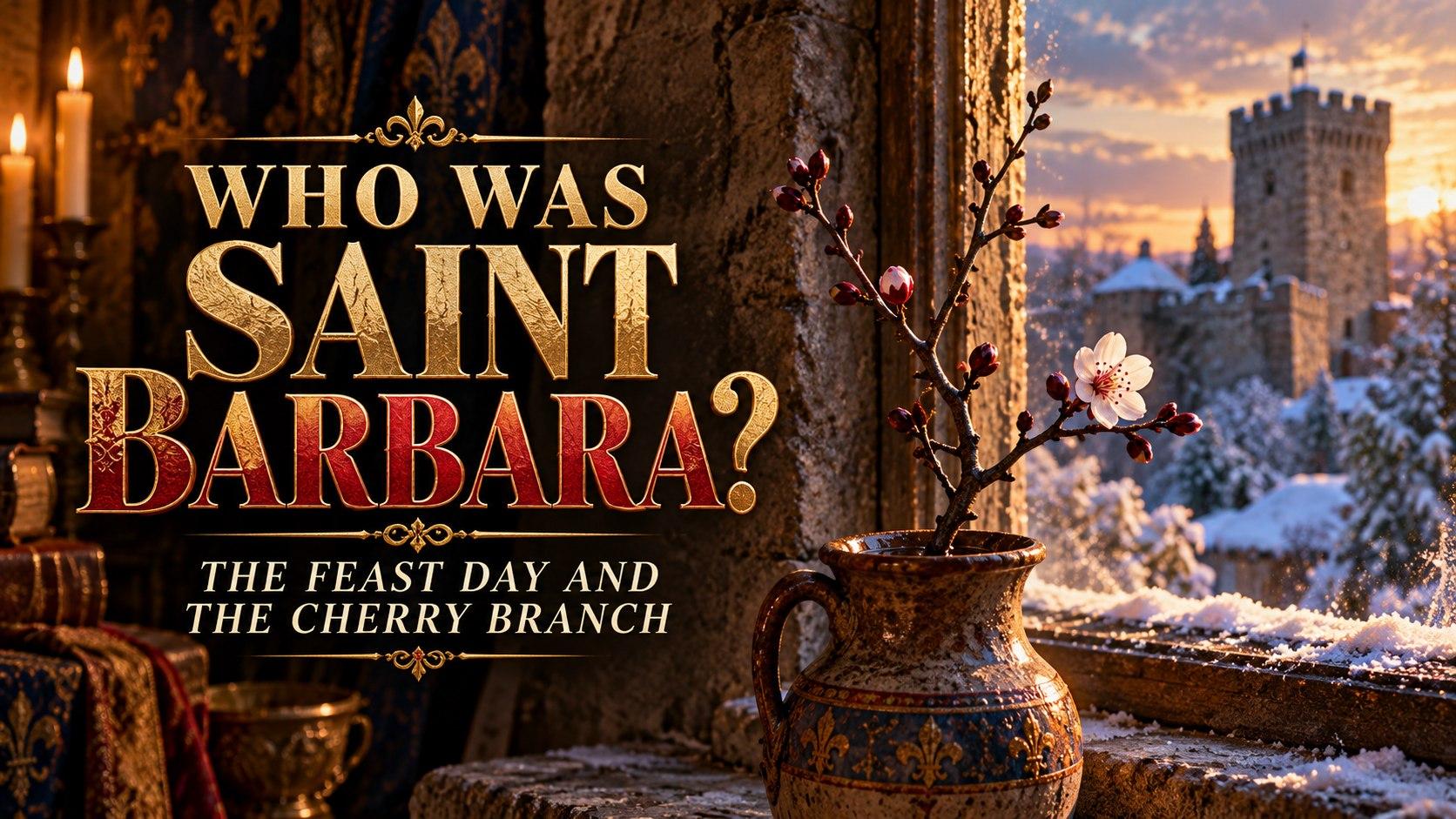
It is a German custom of cutting a flowering branch, cherry most often, on December 4 and placing it in water indoors. Catholic Culture's instructions for the custom have families watch to see whether the branch blooms by Christmas, a small yearly picture of waiting through a dark season for new life to open.

Why is a cherry branch connected to Saint Barbara?
Popular legend ties it to her imprisonment, saying she kept a cut branch alive with water while shut away, and that it bloomed shortly before her death. That detail does not appear in the Catholic Encyclopedia's account of her Acts, so treat it as later folk tradition layered onto her story rather than part of the earliest legend itself.
Why do miners and soldiers still honor Saint Barbara?
Because both trades face sudden, violent death the way lightning and explosions do. Many artillery units and mining communities still mark December 4 with services or ceremonies in her name, a patronage that has outlasted the historical doubts about her own life.
Is Saint Barbara one of the Fourteen Holy Helpers?
Yes. She belongs to a group of saints, called the Fourteen Holy Helpers, whose devotion became especially strong in Germany. Each was believed to carry a particular promise of help for those who honored their memory, which is part of why Barbara's own devotional customs took root so deeply in German speaking lands.
When is Saint Barbara's feast day?
December 4 in the Catholic and Eastern Orthodox calendars today. The Catholic Encyclopedia notes that most ninth century martyrologies instead placed it on December 16, a reminder that even a saint's feast date can shift across history rather than staying fixed from the start.
Do Protestants recognize Saint Barbara?
Almost never as a saint to be invoked, since most Protestant traditions do not practice asking saints to intercede at all. Her story can still be read as history and example, the same distinction the difference between Catholic and Protestant church calendars explains in full.
Why does Saint Barbara's Day fall during Advent?
December 4 simply lands inside the weeks of Advent, so a story about light and faith breaking into a sealed, dark space fits naturally alongside a season built around waiting for exactly that.
Final Thoughts
Strip away the tower, the lightning, and the branch in water, and one plain question is still standing.
📌 Barbara's father tried to decide, by force, what his daughter was allowed to believe. She decided for herself anyway, and it cost her everything he could take.
Her story survives only as legend, and the church that keeps her memory has never pretended otherwise. What the legend was built to say has outlasted the doubts about its details: that a life remembered by the church does not need a perfect record to teach something true, and that a faith found quietly, in a small sealed room, can turn out to be the one thing nobody can wall back in.
❓ What question have you been asking, quietly, in whatever room you have been given?
📌 Keep asking it. The window is enough to start with.
Her feast lands right alongside Saint Lucy's own legend of light breaking into winter darkness, two stories from the same church calendar, both built on more legend than record, and both still pointing somewhere real.
📚 Sources
Every claim in this article traces back to one of these. All links checked 7 November 2026.
- St. Barbara
Johann Peter Kirsch, Catholic Encyclopedia (1907), via New Advent · 1907
The source for Barbara's legend having no genuine early historical basis, the seventh century Acts and their use by Symeon Metaphrastes, the tower, the three windows, her father Dioscorus and the prefect Martinianus, the lightning that killed her father, her patronage of thunderstorms, fire, artillerymen and miners, and the 1448 Gorkum fire account.
- St. Barbara
EWTN (Catholic Encyclopedia text)
A parallel hosting of the same Catholic Encyclopedia entry, confirming the feast date of December 4, the ninth century alternate date of December 16, and the details of her patronage.
- St. Barbara's Twig or Barbarazweig
Catholic Culture
The source for the Barbarazweig custom of placing a cherry or peach branch in water on her feast day to watch it bloom by Christmas, and for her feast being removed as universal in the revised General Roman Calendar while still kept locally on December 4.
- The Feast of St. Barbara
New Liturgical Movement · 2021
The source for Barbara's place among the Fourteen Holy Helpers, that devotion's strength in Germany, her wider patronage of miners, tunnelers, gunners and architects, and the post conciliar suppression of her feast from the General Calendar.
- Saint Barbara
New World Encyclopedia
The source for the exact year, 1969, that doubts about her legend led to her removal from the official Roman calendar of saints, and for her continued veneration in the Roman Catholic, Eastern Orthodox and Oriental Orthodox churches.