📖 Genesis 32 Explained: Jacob Wrestles with God at Peniel
Twenty years and hundreds of miles away, Jacob still cannot outrun the one man he actually fears.
Genesis 32 explained is the chapter where Jacob, finally free of Laban, turns toward home and hears the news he dreaded most: his brother Esau is coming to meet him, and he is bringing four hundred men. Before that meeting ever happens, Jacob spends a night alone at a river crossing, and a stranger shows up to wrestle him until the sun comes up.
Maybe you know what it feels like to finally face the person you wronged, with no more excuses left to buy you time.
- ❓ Why does Jacob send his family and everything he owns ahead of him in waves?
- ❓ Who actually wrestled Jacob at the Jabbok, a man, an angel, or God Himself?
- ❓ Why does God let Jacob win, and then injure him anyway?
- ❓ What does the name change from Jacob to Israel actually mean?
📌 Jacob spends this whole chapter preparing to meet his brother, and God interrupts him with a different fight entirely.
This walkthrough goes through the whole chapter in order: the angels who meet Jacob on the road, the terrifying report about Esau, the prayer Jacob prays before he does anything else, the gift he sends ahead in careful stages, the night he spends alone at the river, the wrestling match that leaves him with a new name and a permanent limp, and the moment he calls a place Peniel because he saw God face to face and lived.
Watch how much of this chapter happens before Jacob ever lays eyes on Esau again.
What Happened Just Before This Chapter
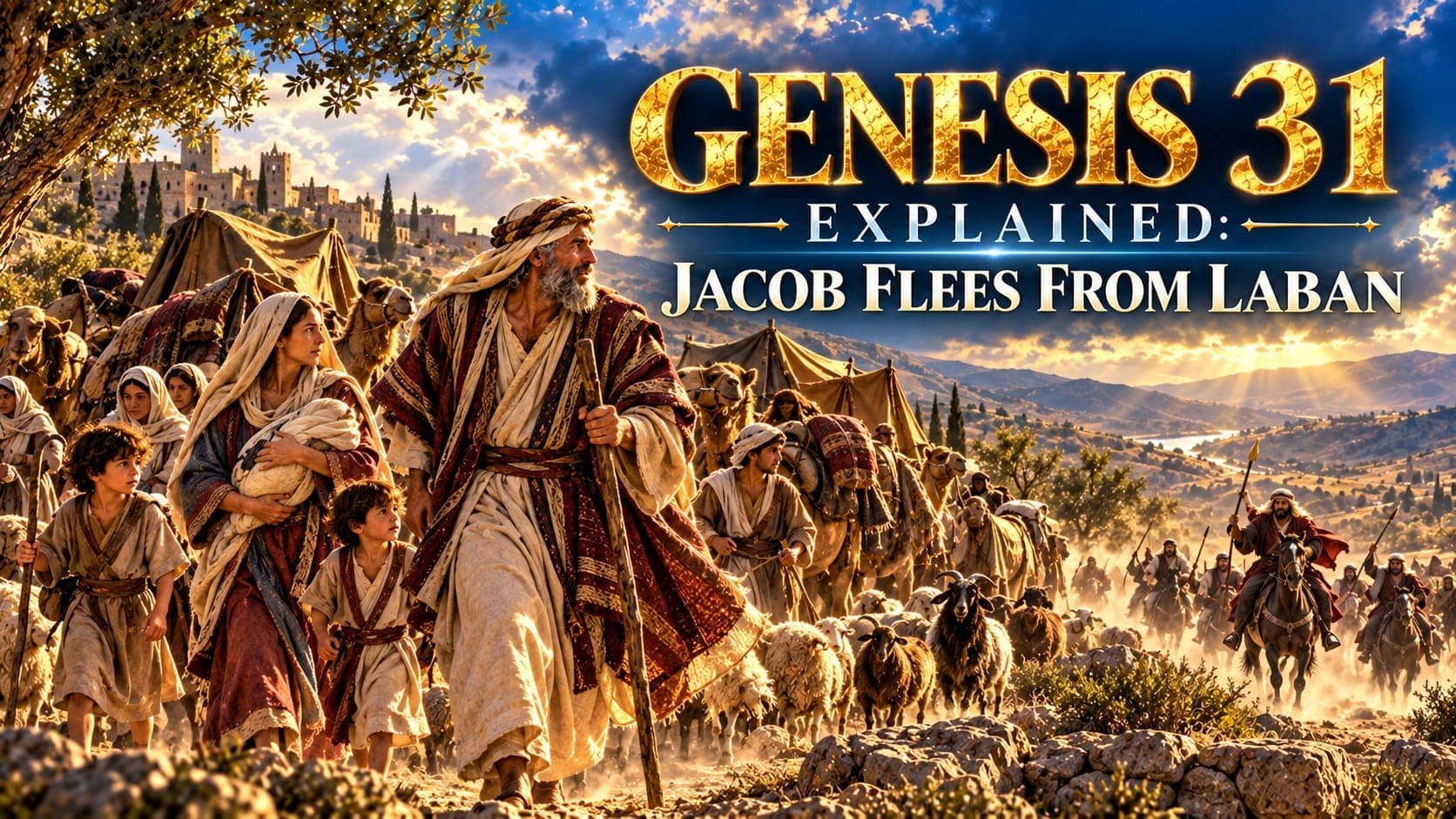
Genesis 31 ended with Jacob and Laban parting ways at a heap of stones called Galeed and Mizpah, a boundary neither man fully trusted the other to keep without God watching between them. Laban kissed his daughters and grandchildren, blessed them, and turned back toward Haran. For the first time in twenty years, nobody is chasing Jacob from behind.
📌 Genesis 32 opens with Jacob facing the opposite direction, toward home, and toward the one relationship he never resolved before he left. Laban was a problem Jacob managed for two decades. Esau is a problem Jacob has not faced since the day he fled for his life.
Genesis 32 Explained Verse by Verse
1. Angels Meet Jacob, and He Sends Word Ahead (verses 1 to 5)
The chapter opens with an encounter Jacob does not go looking for.
"And Jacob went on his way, and the angels of God met him."
"And when Jacob saw them, he said, This is God's host: and he called the name of that place Mahanaim."
💡 Mahanaim means two camps, or two companies. Genesis never says how many angels Jacob saw or what they said to him. It simply records that he named the place on the spot, the same way he named Bethel years earlier after a different encounter with God's messengers in Genesis 28. Before Jacob does anything about Esau, God quietly reminds him that his own household is not the only camp traveling toward Canaan.
With that reminder still fresh, Jacob makes the first move himself.
"And he commanded them, saying, Thus shall ye speak unto my lord Esau; Thy servant Jacob saith thus, I have sojourned with Laban, and stayed there until now:"
"And I have oxen, and asses, flocks, and menservants, and womenservants: and I have sent to tell my lord, that I may find grace in thy sight."
⚠️ Listen to how Jacob talks about himself. He calls Esau "my lord" twice in two verses and calls himself Esau's servant. This is the same Jacob who once traded for Esau's birthright and walked out of his father's tent wearing a stolen blessing meant for the firstborn. Twenty years and a fortune later, he opens the conversation by handing back, in words at least, the very rank he once schemed to take.
2. Four Hundred Men, and Jacob's Terror (verses 6 to 8)
The messengers return, and the report is not reassuring.
"And the messengers returned to Jacob, saying, We came to thy brother Esau, and also he cometh to meet thee, and four hundred men with him."
"Then Jacob was greatly afraid and distressed: and he divided the people that was with him, and the flocks, and herds, and the camels, into two bands;"
📌 Genesis stacks two separate, intense words onto Jacob in one verse, afraid and distressed. This is not ordinary nervousness before an awkward family reunion. Four hundred armed men is the size of a small militia, and the last words Jacob heard about Esau, twenty years earlier, were a promise to kill him.
Jacob's response is entirely practical. He splits his household into two camps so that if Esau attacks one, the other might still escape. It is smart planning, and it is also, on its own, an admission that Jacob does not yet trust God enough to stop there. Fear this specific, over a threat this old, is the kind of moment Scripture speaks to directly, and Jacob does not stay stuck in it. He plans, and then, for the first time in the chapter, he stops planning and prays.
3. Jacob's Prayer at the Jabbok (verses 9 to 12)
What follows is one of the fullest prayers recorded anywhere in Genesis, and it is worth reading slowly.
"And Jacob said, O God of my father Abraham, and God of my father Isaac, the LORD which saidst unto me, Return unto thy country, and to thy kindred, and I will deal well with thee:"
"I am not worthy of the least of all the mercies, and of all the truth, which thou hast shewed unto thy servant; for with my staff I passed over this Jordan; and now I am become two bands."
"Deliver me, I pray thee, from the hand of my brother, from the hand of Esau: for I fear him, lest he will come and smite me, and the mother with the children."
📌 Notice the shape of the prayer. Jacob starts by naming God the way his father and grandfather knew Him, not a stranger he is trying out. He admits, in plain words, that he is not worthy of anything God has already given him. Only after that does he ask for what he actually wants: deliverance from Esau. Confession comes before the request, not after it.
Then Jacob does something few people in Scripture do so directly. He reminds God of His own words.
"And thou saidst, I will surely do thee good, and make thy seed as the sand of the sea, which cannot be numbered for multitude."
💡 Jacob is not inventing a new promise here. The image of offspring like the sand of the sea goes back to what God swore to Abraham in Genesis 22:17, and Jacob applies that same covenant promise to himself, alongside God's own recent word to return home. That is not presumption. It is faith taking hold of an actual promise instead of a vague hope, and asking God to be as good as His word.
4. A Gift Sent Ahead in Waves (verses 13 to 21)
Jacob prays, and then he still acts. The two are not opposites in this chapter.
"Two hundred she goats, and twenty he goats, two hundred ewes, and twenty rams,"
"Thirty milch camels with their colts, forty kine, and ten bulls, twenty she asses, and ten foals."
📌 Five hundred and fifty animals, by the numbers in the text, sent ahead as a present for a brother who once wanted him dead. That is not a token gesture. It is a fortune, handed over before Jacob even knows how Esau will react.
What Jacob does with that gift is as deliberate as the size of it.
"And he delivered them into the hand of his servants, every drove by themselves; and said unto his servants, Pass over before me, and put a space betwixt drove and drove."
"And say ye moreover, Behold, thy servant Jacob is behind us. For he said, I will appease him with the present that goeth before me, and afterward I will see his face; peradventure he will accept of me."
⚠️ Jacob sends the animals in separate waves, spaced apart, each with the same rehearsed message. Esau will not meet one large herd once. He will meet drove after drove after drove, each one announcing the same servant, the same gift, the same request for grace. Jacob is managing this reunion the way he once managed Laban's flocks, carefully, with a plan for every stage. "Peradventure" means perhaps. Even after the prayer, Jacob still is not certain this will work.
5. Alone at the Ford, and a Wrestling Match Until Daybreak (verses 22 to 25)
Everything Jacob owns crosses the brook ahead of him. Then Genesis narrows the whole chapter down to one man, alone, in the dark.
"And he rose up that night, and took his two wives, and his two womenservants, and his eleven sons, and passed over the ford Jabbok."
"And he took them, and sent them over the brook, and sent over that he had."
"And Jacob was left alone; and there wrestled a man with him until the breaking of the day."
📌 Every person Jacob loves and everything he owns is safely across the water. Jacob himself is the one still standing on the near side, alone, when the fight starts. Genesis gives no warning and no introduction. One verse he is sending his family across a river. The next, an unnamed man has hold of him, and neither one will let go for hours.
"And when he saw that he prevailed not against him, he touched the hollow of his thigh; and the hollow of Jacob's thigh was out of joint, as he wrestled with him."
💡 This single verse settles something the rest of the fight leaves open. The man cannot simply overpower Jacob through ordinary strength, and Jacob will not quit. So the man injures him instead, with what the text describes as a single touch, not a blow. Whatever this being is, disabling a human hip with one touch is not a struggle between equals. The fight was never actually close. It was allowed to go on.
6. "I Will Not Let Thee Go, Except Thou Bless Me" (verses 26 to 29)
Injured and outmatched, Jacob still does not release his grip.
"And he said, Let me go, for the day breaketh. And he said, I will not let thee go, except thou bless me."
📌 The one who just dislocated Jacob's hip asks Jacob to let go, and Jacob refuses. That is the whole night in one line. Jacob has spent this chapter afraid of a brother with four hundred men, and here, crippled and alone before someone far stronger than Esau, he clings tighter instead of letting go.
What comes next explains why this night matters for the rest of Jacob's life.
"And he said unto him, What is thy name? And he said, Jacob."
"And he said, Thy name shall be called no more Jacob, but Israel: for as a prince hast thou power with God and with men, and hast prevailed."
💡 Jacob means heel grabber or supplanter, a name he was given at birth for a specific reason. Genesis 25:26 records it plainly:
"And after that came his brother out, and his hand took hold on Esau's heel; and his name was called Jacob: and Isaac was threescore years old when she bare them."
Jacob has spent his whole life living into that name, grabbing at his brother's birthright, grabbing at his father's blessing in Genesis 27, grabbing at wealth and wives and advantage in Laban's house. Israel carries a different sense, one who strives or has power with God. The new name does not erase the old story. It reinterprets it. A man who spent his life grabbing has spent one night finally holding on to the right thing, refusing to let go of God Himself until he received a blessing instead of stealing one.
Jacob presses further, and the answer he gets back is deliberately withheld.
"And Jacob asked him, and said, Tell me, I pray thee, thy name. And he said, Wherefore is it that thou dost ask after my name? And he blessed him there."
⚠️ Jacob just received a new name of his own, yet the one who gave it declines to share His. The blessing still comes, but the mystery of exactly who has been wrestling him all night stays unresolved inside the text itself.
7. Peniel, and a Limp That Never Fully Heals (verses 30 to 32)
As the sun comes up, Jacob names the place, and his own words settle the question he never got a direct answer to.
"And Jacob called the name of the place Peniel: for I have seen God face to face, and my life is preserved."
📌 Peniel means face of God. The stranger never named Himself, but Jacob names the place after exactly who he believes he encountered. Genesis lets Jacob's own conclusion stand as the chapter's answer.
"And as he passed over Penuel the sun rose upon him, and he halted upon his thigh."
"Therefore the children of Israel eat not of the sinew which shrank, which is upon the hollow of the thigh, unto this day: because he touched the hollow of Jacob's thigh in the sinew that shrank."
💡 Jacob walks toward the biggest confrontation of his life limping, not healed. Genesis even notes that this single night produced a lasting dietary custom among his descendants, a small, concrete reminder built right into how Israel ate for generations afterward. The blessing did not undo the injury. Jacob carries both at once into the next chapter, a new name and a permanent limp, walking toward Esau exactly as he is, with nothing left to hide behind.

Hard Questions Genesis 32 Raises
Who actually wrestled Jacob? Genesis 32:24 simply calls him "a man." Jacob himself concludes in verse 30 that he saw God face to face, and Hosea later refers to the same event this way:
"He took his brother by the heel in the womb, and by his strength he had power with God:"
"Yea, he had power over the angel, and prevailed: he wept, and made supplication unto him: he found him in Bethel, and there he spake with us;"
Hosea calls the same figure both God and the angel in consecutive verses, which is exactly the tension Genesis 32 itself leaves open. Many Christians read this as a christophany, an appearance of God the Son before His human birth, since Scripture elsewhere says no one has seen the Father directly. Others read it as an angel acting with God's full authority to speak and act in His name, which was common enough in the Old Testament that being met by such a messenger could honestly be described as meeting God. Genesis itself never resolves which reading is precise. What it does not leave open is that Jacob believed, and named the place accordingly.
Did Jacob really defeat God? Verse 25 answers this on its own. The one wrestling Jacob disables his hip with a single touch, something well beyond what ordinary human strength could resist. Jacob was never actually winning a contest of power. He was refusing to release his grip, and that refusal, not physical strength, is what verse 28 calls prevailing.
Why does God let Jacob prevail if He could have ended the match at any point? Genesis does not explain God's reasoning directly, but the shape of the story suggests an answer. Jacob spent his whole life taking things by his own effort and cleverness. This night gives him something he cannot take. He can only ask for it and refuse to let go until it comes. The blessing has to be received, not seized, for the very first time in his life.
Why injure Jacob at all, instead of simply blessing him? The limp becomes part of the blessing rather than a separate punishment. A man who lived by grabbing and scheming walks out of this night unable to rely on his own strength again, carrying a visible, permanent reminder of the one encounter he could not manage or manipulate his way through.
Practical Tips From Genesis 32
This chapter has real, practical weight for anyone bracing to face a person or a fear they cannot avoid any longer.
- Let fear send you to prayer instead of only to strategy. Jacob planned and prayed. He did not treat the two as opposites, and neither should you when something frightening is actually coming.
- Confess before you ask. Jacob told God plainly that he was not worthy of the mercy already shown him, before he asked for anything more. Start there yourself.
- Remind God of His own promises when you pray. Jacob quoted back exactly what God had already said to him. That is not arrogance. It is faith taking a real promise seriously.
- Some fights are not about winning through your own strength. Jacob never overpowered the man at the Jabbok. He simply refused to let go. Notice which of your own struggles need less striving and more holding on.
- A limp does not cancel a blessing. Jacob walked toward Esau wounded and renamed at the same time. You do not need to be fully healed before you can carry what God has given you.
- Expect to be changed by an honest encounter with God, not left exactly as you were. Jacob got a new name and a different way of walking in the same night. Real encounters with God tend to leave a mark.
Top 5 Bible Verses From Genesis 32
1. Genesis 32:24
"And Jacob was left alone; and there wrestled a man with him until the breaking of the day."
The verse the whole chapter turns on. No introduction, no explanation, only a man left alone in the dark and a fight that will not end until morning.
2. Genesis 32:26
"And he said, Let me go, for the day breaketh. And he said, I will not let thee go, except thou bless me."
One of the most quoted lines in the Old Testament, a wounded man refusing to release his grip on God until he receives an actual blessing instead of letting go empty handed.
3. Genesis 32:28
"And he said, Thy name shall be called no more Jacob, but Israel: for as a prince hast thou power with God and with men, and hast prevailed."
The name change that gives an entire nation its identity, given to a man in the middle of the worst night of his life, not the best one.
4. Genesis 32:30
"And Jacob called the name of the place Peniel: for I have seen God face to face, and my life is preserved."
Jacob's own conclusion about who he had just encountered, and his own astonishment that he survived it at all.
5. Genesis 32:10
"I am not worthy of the least of all the mercies, and of all the truth, which thou hast shewed unto thy servant; for with my staff I passed over this Jordan; and now I am become two bands."
The humility inside Jacob's prayer, a man who left home with nothing but a walking stick, now admitting he never deserved any of what he has been given.

Frequently Asked Questions About Genesis 32
What does Genesis 32 mean?
It records Jacob preparing to meet his brother Esau after twenty years apart, sending a large gift ahead in waves, praying for deliverance, and then wrestling all night with a man at the Jabbok who renames him Israel and injures his hip before blessing him.
Who did Jacob wrestle with at the Jabbok?
Genesis 32:24 calls him simply "a man." Jacob himself concludes in verse 30 that he saw God face to face, and Hosea 12:3 and 4 describes the same event using both the angel and God. Many Christians read the figure as a preincarnate appearance of Christ, while others read him as an angel acting with God's full authority.
Why was Jacob so afraid of Esau?
Genesis 27:41 records Esau planning to kill Jacob after their father died, over the stolen blessing. Twenty years later, Jacob had no way to know whether that anger had cooled, and the report of four hundred men in Genesis 32:6 gave him real reason to fear the worst.
Why did Jacob send his gift to Esau in separate droves instead of all at once?
Genesis 32:16 and 20 show Jacob spacing the animals into waves so that Esau would encounter the gift repeatedly, each time hearing the same message that it came from his servant Jacob. He hoped the sustained impression would soften Esau before the two brothers ever met face to face.
What does the name Israel mean?
Genesis 32:28 ties it to striving or having power with God, in contrast to Jacob, meaning heel grabber or supplanter, the name he received at birth in Genesis 25:26 for taking hold of Esau's heel as they were born.
Why did the man dislocate Jacob's hip?
Genesis 32:25 says it happened because the man could not otherwise prevail against Jacob, who refused to stop wrestling. A single touch was enough to disable him, showing the fight was never really an even contest of strength to begin with.
Why wouldn't the man tell Jacob his name?
Genesis 32:29 records the question turned back on Jacob without a direct answer. Scripture does not explain the refusal, though it leaves the identity of the man to be understood through Jacob's own conclusion in the very next verse rather than through a name spoken outright.
What does Peniel mean, and why did Jacob name the place that?
Peniel means face of God. Genesis 32:30 gives Jacob's own reason for the name: he believed he had seen God face to face and survived it, which in that culture was considered a remarkable, even dangerous, thing to happen to a person.
Why do Jewish dietary customs connect back to this chapter?
Genesis 32:32 explains that Jacob's descendants avoided eating the sinew of the hip because of the injury Jacob received there that night, turning one man's private encounter with God into a lasting, shared practice among his family.
Was Jacob still Jacob after being renamed Israel?
Genesis continues to use both names for him afterward, sometimes in the very same passage. The new name marks a real turning point in Jacob's character and calling, without erasing the man he had been or the story that led him to this night.
Final Thoughts
Genesis 32 is the night everything about Jacob starts to change, before he ever reaches the brother he fears.
📌 Fear sent Jacob to prayer, and prayer did not replace preparation. He planned, gave, and pleaded with God, all in the same chapter, none of it canceling out the others.
📌 The blessing Jacob finally received, he could not take by scheming. He could only hold on and refuse to let go, the opposite of every method that had gotten him this far in life.
📌 A new name and a permanent limp arrived together. God did not simply erase who Jacob had been. He gave him a different way to carry it, walking, not running, toward what came next.
You may be bracing right now to face someone or something you have spent years avoiding.
So here is your one next step.
Before you face it, do what Jacob did first. Stop planning long enough to actually pray, and hold on until you have.