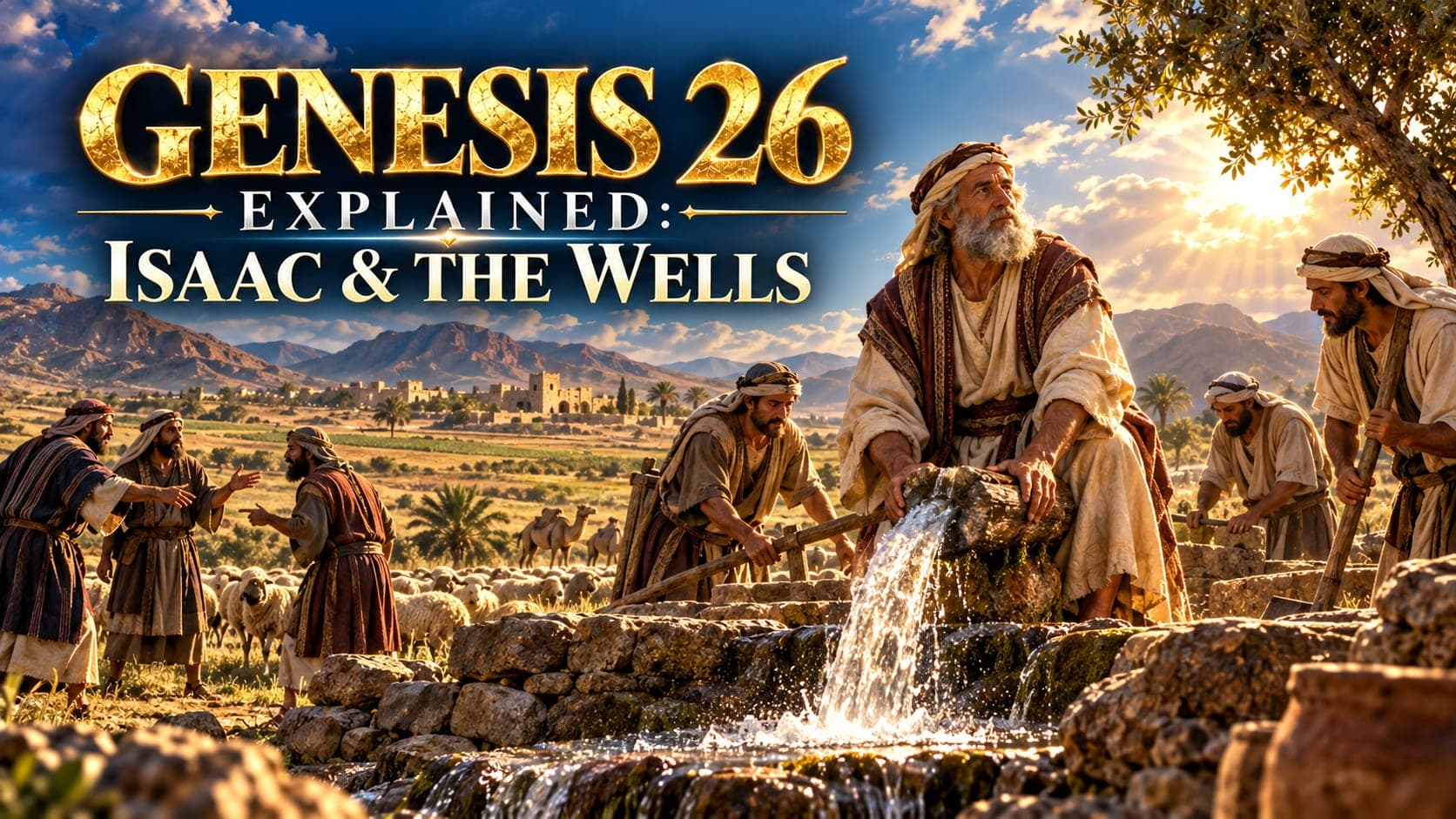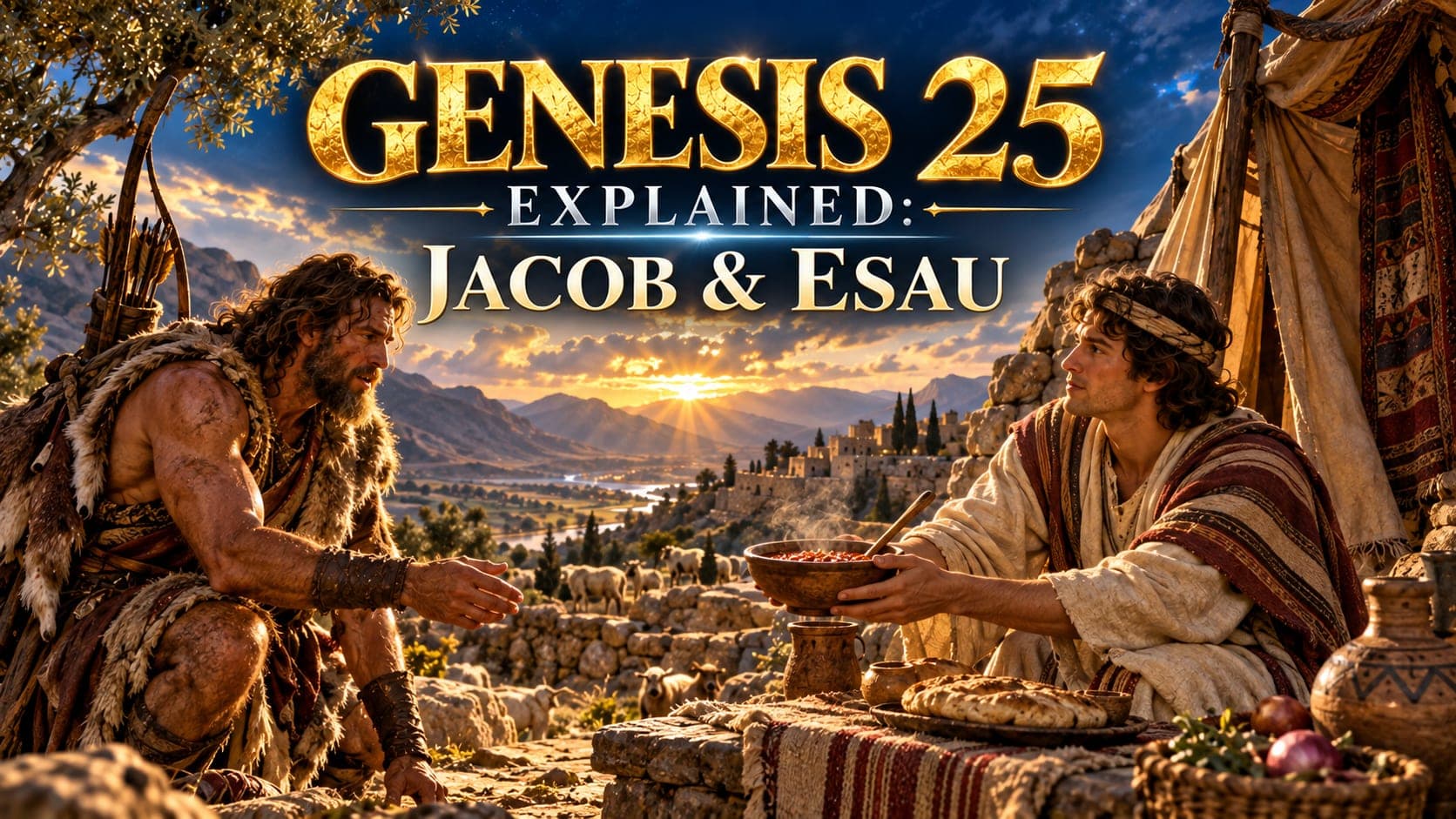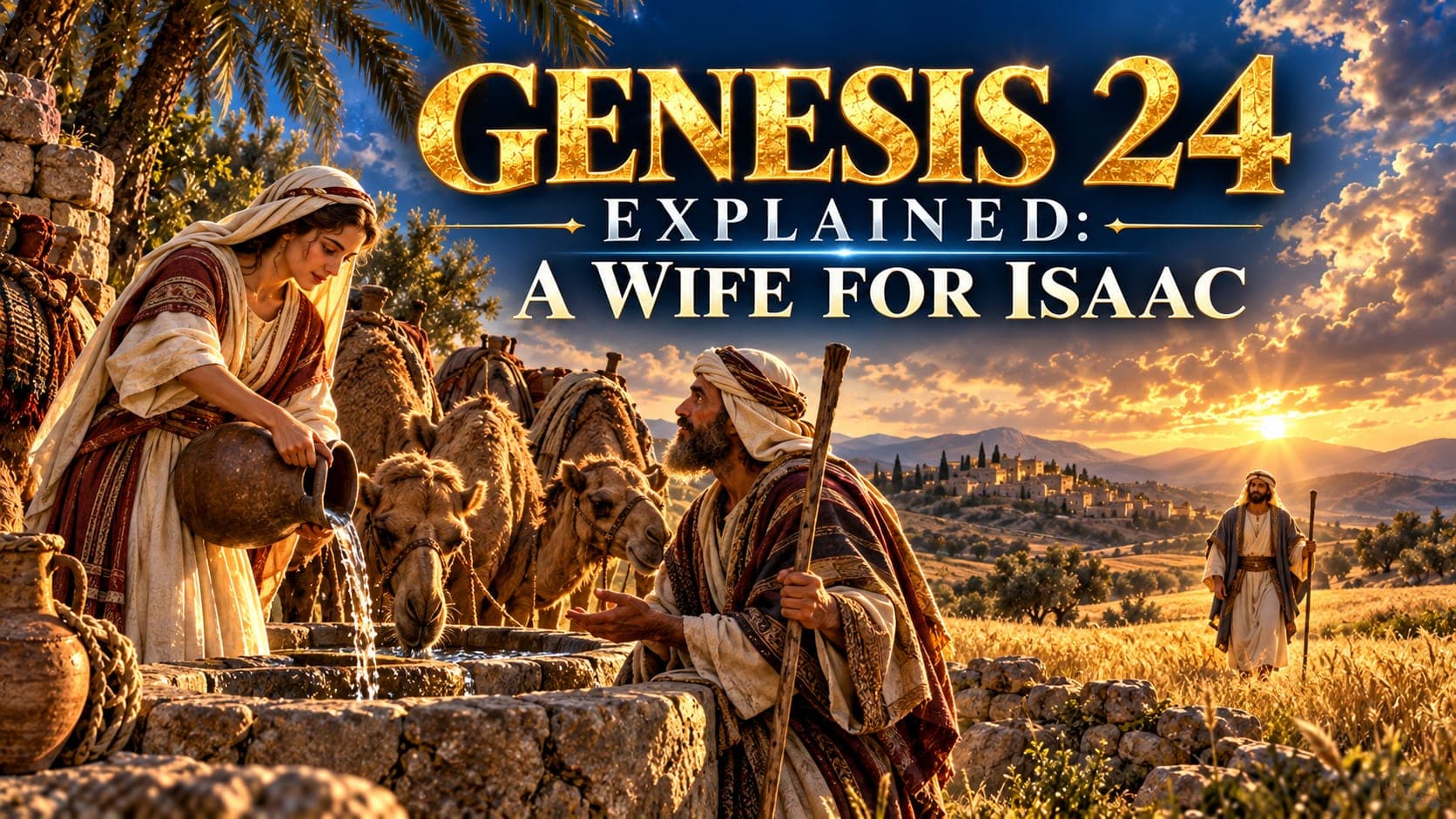
📖 Genesis 24 Explained: The Servant's Prayer and Rebekah at the Well
An old man sends a servant a thousand miles to find a wife for his son, and never once tells him her name.
Genesis 24 explained is the longest chapter in Genesis, sixty seven verses long, and almost none of it is action. Most of it is one servant praying, then telling the same story twice, in front of two different audiences, because he wants everyone at that table to hear exactly how he found the woman standing in front of them.
Maybe you have prayed for a specific answer and then watched it arrive almost too fast to believe.
- ❓ Why does Abraham make his servant swear an oath with his hand under his thigh?
- ❓ Is it right to ask God for a sign the way this servant does at the well?
- ❓ Why does an unnamed servant get more lines in this chapter than Isaac does?
- ❓ And why does Rebekah get asked her own opinion, when nobody else in the chapter is?
📌 Before Rebekah says a single word to the servant, God has already answered his prayer in full.
This walkthrough goes through the whole chapter in order: the oath Abraham demands, the prayer at the well, Rebekah's answer before he even finishes speaking, the gifts and the brother who comes running, the servant's full retelling of his errand, Rebekah's own choice to go, and the field where Isaac meets his wife for the first time.
Watch how much of this chapter is one man simply telling the truth about what God did.
What Happened Just Before This Chapter
Genesis 23 ended with Sarah buried in the cave of Machpelah, the first ground in Canaan Abraham ever legally owned. Isaac had already survived the mountain in Genesis 22, and the same chapter that almost ended his life closed with a quiet birth announcement back home: a girl named Rebekah, born to Abraham's nephew Bethuel, introduced to the reader years before she ever meets Isaac in person.
Genesis 24 picks up with Abraham old, his wife gone, and one piece of unfinished business left before he can rest: his son still has no wife, and the promise God swore over that mountain cannot move forward without the next generation.
📌 Genesis has been building toward this moment since a granddaughter's name was tucked into a genealogy list two chapters ago. Nothing in this chapter is a coincidence to the reader, even though almost every person inside the story is moving without seeing the whole picture.
Genesis 24 Explained Verse by Verse
1. An Oath With a Hand Under the Thigh (verses 1 to 9)
The chapter opens with an old man handing his most important errand to someone else.
"And Abraham was old, and well stricken in age: and the LORD had blessed Abraham in all things."
"And Abraham said unto his eldest servant of his house, that ruled over all that he had, Put, I pray thee, thy hand under my thigh:"
📌 The servant is never named in this chapter. Genesis calls him only "his eldest servant of his house, that ruled over all that he had," a man trusted with more authority than a hired hand would ever get. Placing a hand under the thigh near the place of descendants was a solemn way of swearing an oath tied to the family line itself, not a casual handshake.
"And I will make thee swear by the LORD, the God of heaven, and the God of the earth, that thou shalt not take a wife unto my son of the daughters of the Canaanites, among whom I dwell:"
"But thou shalt go unto my country, and to my kindred, and take a wife unto my son Isaac."
⚠️ Abraham does not forbid a Canaanite wife because of where she was born. His own household already includes people from outside his bloodline. The concern is the covenant line staying with a family who already knows the LORD Abraham left everything to follow, not a wife pulled from the gods and customs Abraham himself walked away from decades earlier.
The servant raises the one obvious problem before he agrees to anything.
"And the servant said unto him, Peradventure the woman will not be willing to follow me unto this land: must I needs bring thy son again unto the land from whence thou camest?"
"And Abraham said unto him, Beware thou that thou bring not my son thither again."
📌 Isaac himself is not allowed to leave the promised land, even to find a wife. Abraham repeats the instruction twice in four verses: bring back a wife, never bring back Isaac. Whatever this errand costs, undoing God's call to live in this land is not on the table.
"The LORD God of heaven, which took me from my father's house, and from the land of my kindred, and which spake unto me, and that sware unto me, saying, Unto thy seed will I give this land; he shall send his angel before thee, and thou shalt take a wife unto my son from thence."
"And if the woman will not be willing to follow thee, then thou shalt be clear from this my oath: only bring not my son thither again."
💡 Abraham releases the servant from the oath in advance if the woman refuses to come. He does not ask for a guaranteed outcome, only faithful effort, and he grounds his own confidence in a promise God had already sworn to him personally, not in anything the servant can control on his own.
2. A Prayer for a Very Specific Sign (verses 10 to 14)
The servant leaves with wealth and a plan, and arrives at exactly the right place at exactly the right time.
"And the servant took ten camels of the camels of his master, and departed; for all the goods of his master were in his hand: and he arose, and went to Mesopotamia, unto the city of Nahor."
"And he made his camels to kneel down without the city by a well of water at the time of the evening, even the time that women go out to draw water."
💡 Ten camels, loaded with goods, is a visible display of wealth traveling with this servant. He is not showing up empty handed to ask a favor. He is arriving with enough to make his master's standing obvious before he says a word.
Before a single woman arrives, the servant stops to pray.
"And he said, O LORD God of my master Abraham, I pray thee, send me good speed this day, and shew kindness unto my master Abraham."
"Behold, I stand here by the well of water; and the daughters of the men of the city come out to draw water:"
"And let it come to pass, that the damsel to whom I shall say, Let down thy pitcher, I pray thee, that I may drink; and she shall say, Drink, and I will give thy camels drink also: let the same be she that thou hast appointed for thy servant Isaac; and thereby shall I know that thou hast shewed kindness unto my master."
📌 The sign he asks for is not random. It tests character, not luck. Watering ten thirsty camels by hand, after drawing water for a stranger, takes real time and real strength. The servant is not praying for a coincidence. He is praying for proof that whichever woman answers this way carries the kind of hospitality and hard work Isaac's household will need.
3. Rebekah Answers Before He Finishes Speaking (verses 15 to 21)
Genesis does not make the reader wait for the answer.
"And it came to pass, before he had done speaking, that, behold, Rebekah came out, who was born to Bethuel, son of Milcah, the wife of Nahor, Abraham's brother, with her pitcher upon her shoulder."
📌 "Before he had done speaking" is the detail the whole chapter turns on. Genesis tells the reader Rebekah's exact family line the instant she appears, so there is no suspense about who she is. Only the servant does not know it yet.
"And the damsel was very fair to look upon, a virgin, neither had any man known her: and she went down to the well, and filled her pitcher, and came up."
"And the servant ran to meet her, and said, Let me, I pray thee, drink a little water of thy pitcher."
"And she said, Drink, my lord: and she hasted, and let down her pitcher upon her hand, and gave him drink."
"And when she had done giving him drink, she said, I will draw water for thy camels also, until they have done drinking."
💡 Rebekah offers to water the camels before the servant asks for it. That detail matters: the sign he prayed for was not something he had to coach her into. It was simply who she already was.
"And she hasted, and emptied her pitcher into the trough, and ran again unto the well to draw water, and drew for all his camels."
"And the man wondering at her held his peace, to wit whether the LORD had made his journey prosperous or not."
⚠️ Even with the exact sign playing out in front of him, the servant does not celebrate right away. He watches in silence, waiting to be sure, a careful man who has just seen his prayer answered and still wants to be certain before he acts on it.
4. Gold, a Question, and a Brother Who Comes Running (verses 22 to 32)
Once the camels finish drinking, the servant moves from watching to acting.
"And it came to pass, as the camels had done drinking, that the man took a golden earring of half a shekel weight, and two bracelets for her hands of ten shekels weight of gold;"
"And said, Whose daughter art thou? tell me, I pray thee: is there room in thy father's house for us to lodge in?"
📌 The gifts come before the question. The servant gives Rebekah real gold, worth far more than a passing thank you for a drink of water, and only then asks who her family is. He is acting on what he has already seen God confirm, not waiting to check her credentials first.
"And she said unto him, I am the daughter of Bethuel the son of Milcah, which she bare unto Nahor."
"And the man bowed down his head, and worshipped the LORD."
"And he said, Blessed be the LORD God of my master Abraham, who hath not left destitute my master of his mercy and his truth: I being in the way, the LORD led me to the house of my master's brethren."
📌 Worship comes before the servant does another single thing. Right there at the well, before meeting the family, before any negotiation, he bows his head. "I being in the way" is his own summary of the whole trip: he simply stayed on the road God set him on, and God did the leading.
Word travels fast once Rebekah gets home.
"And Rebekah had a brother, and his name was Laban: and Laban ran out unto the man, unto the well."
"And it came to pass, when he saw the earring and bracelets upon his sister's hands, and when he heard the words of Rebekah his sister, saying, Thus spake the man unto me; that he came unto the man; and, behold, he stood by the camels at the well."
⚠️ Genesis is careful about what actually moves Laban: he sees the gold first, then hears his sister's account. The text does not accuse him of greed outright here, but it lets the order of what caught his attention speak for itself, a detail worth remembering when Laban reappears later in Genesis as a much harder man to deal with.
"And he said, Come in, thou blessed of the LORD; wherefore standest thou without? for I have prepared the house, and room for the camels."
5. "I Will Not Eat Until I Have Told Mine Errand" (verses 33 to 49)
Food is set in front of him, and the servant refuses to touch it.
"And there was set meat before him to eat: but he said, I will not eat, until I have told mine errand. And he said, Speak on."
📌 He will not eat until the whole truth is out on the table first. What follows is the servant retelling almost the entire chapter again, in his own words, to Laban and Bethuel: Abraham's wealth, the oath, the prayer at the well, and Rebekah's answer, nearly word for word.
"And the LORD hath blessed my master greatly; and he is become great: and he hath given him flocks, and herds, and silver, and gold, and menservants, and maidservants, and camels, and asses."
"And Sarah my master's wife bare a son to my master when she was old: and unto him hath he given all that he hath."
💡 The servant tells this family exactly what is at stake: Isaac is not a minor heir. Everything Abraham owns is already given to him. This is not a small proposal, and the servant makes sure his hosts understand the size of it before Rebekah is asked for an answer.
"And I came this day unto the well, and said, O LORD God of my master Abraham, if now thou do prosper my way which I go:"
"And before I had done speaking in mine heart, behold, Rebekah came forth with her pitcher on her shoulder; and she went down unto the well, and drew water: and I said unto her, Let me drink, I pray thee."
"And now if ye will deal kindly and truly with my master, tell me: and if not, tell me; that I may turn to the right hand, or to the left."
📌 He asks for a plain yes or no. After telling the whole story twice, once in prayer and now out loud to Rebekah's family, the servant does not pressure them. He simply asks them to answer honestly, so he can either move forward or leave without hard feelings either way.
6. "The Thing Proceedeth From the LORD" (verses 50 to 58)
Laban and Bethuel give the servant the plain answer he asked for.
"Then Laban and Bethuel answered and said, The thing proceedeth from the LORD: we cannot speak unto thee bad or good."
"Behold, Rebekah is before thee, take her, and go, and let her be thy master's son's wife, as the LORD hath spoken."
📌 Even Rebekah's own family recognizes this is not really their decision to argue with. The whole account the servant just gave, the timing at the well, the exact sign answered, leaves them nothing to object to. They name it themselves: this came from the LORD.
The servant worships again, gives more gifts, and the household spends the night. The next morning he is ready to leave immediately.
"And he said unto them, Hinder me not, seeing the LORD hath prospered my way; send me away that I may go to my master."
"And they called Rebekah, and said unto her, Wilt thou go with this man? And she said, I will go."
📌 Rebekah is the only person in this entire chapter who gets asked directly for her own answer, and she gives it in three plain words. Abraham does not ask her. Laban and Bethuel do not decide for her without asking. After a family that has just called this decision settled by God, Rebekah still gets a real choice, and she takes it without hesitation.
7. Isaac Meets His Wife in the Field (verses 59 to 67)
Rebekah leaves with a family blessing that echoes a promise made generations earlier.
"And they blessed Rebekah, and said unto her, Thou art our sister, be thou the mother of thousands of millions, and let thy seed possess the gate of those which hate them."
💡 "Possess the gate" is the same language God used blessing Abraham on the mountain in Genesis 22. Rebekah's own family sends her off with words that unknowingly line up with a covenant they were never part of.
"And Isaac went out to meditate in the field at the eventide: and he lifted up his eyes, and saw, and, behold, the camels were coming."
"And Rebekah lifted up her eyes, and when she saw Isaac, she lighted off the camel."
📌 Isaac is out alone in a field at evening, not orchestrating any of this. The son who never left the land, who had no part in the oath, the prayer, or the long journey, simply looks up and sees his future wife arriving. His only action in the whole chapter is meditating and lifting his eyes.
"For she had said unto the servant, What man is this that walketh in the field to meet us? And the servant had said, It is my master: therefore she took a vail, and covered herself."
"And the servant told Isaac all things that he had done."
"And Isaac brought her into his mother Sarah's tent, and took Rebekah, and she became his wife; and he loved her: and Isaac was comforted after his mother's death."
📌 The chapter that opened with an old man's unfinished business closes in his dead wife's tent, with his son finally comforted. Sarah's absence has sat quietly under this whole chapter since Genesis 23, and it is Rebekah, not time alone, that the text credits with easing that grief.

Hard Questions Genesis 24 Raises
Who was this unnamed servant? Genesis 24 never names him. Genesis 15:2 records Abraham once naming his household steward as "Eliezer of Damascus," and many readers connect the two men, but that verse comes from years earlier, before Isaac was even born, and Genesis 24 itself never makes the identification explicit. The text's own silence on his name, while it gives Rebekah's full family line the moment she appears, may be deliberate: this chapter keeps the spotlight on what God did through him, not on who he was.
Is it right to pray for a specific sign the way this servant does? Scripture does not present this prayer as a formula every believer should copy for every decision. What the text does show is a servant asking for a sign tied to character, not luck, and then waiting in careful silence to see it confirmed rather than assuming the first answer that came close. Judges 6 records a different man, Gideon, later asking God for signs of his own in a very different situation, which shows this kind of request was not unheard of in that world, without Genesis 24 turning it into a command for how anyone else should seek guidance.
Why did Abraham forbid a Canaanite wife but insist on his own extended family? Genesis 24:3 and 4 tie the requirement to Abraham's own household and kindred, not to ancestry for its own sake. The concern running underneath the whole oath is keeping the covenant line connected to people who already knew the LORD Abraham had followed out of his own country, at a time when marriage decided which household's faith and customs a family would carry forward.
How old were Isaac and Rebekah when they married? Genesis 24 does not give either age. Genesis 25:20 states it plainly a chapter later:
"And Isaac was forty years old when he took Rebekah to wife, the daughter of Bethuel the Syrian of Padanaram, the sister to Laban the Syrian."
Rebekah's own age is never stated anywhere in Genesis.
Why does Rebekah get asked for her own consent when arranged marriages were normal in this culture? The text does not explain the reasoning, only the fact: her family had already agreed and called the match settled by the LORD, yet Genesis 24:58 still records them calling Rebekah in and asking her directly. Whatever the custom generally allowed, this chapter chooses to preserve her own answer in her own words rather than skip straight from the family's agreement to the journey.
Practical Tips From the Servant's Prayer
Genesis 24 is a long chapter, and almost every verse of it models some part of seeking God honestly.
- Pray before you act, not after you are already stuck. The servant prayed at the well before a single woman arrived, not once things had already gone wrong.
- Ask for what actually matters, not just an easy outcome. The sign he requested tested kindness and hard work, the exact qualities Isaac's household would need most.
- Watch quietly before you celebrate. Even after seeing his prayer answered in detail, the servant held his peace and waited to be sure before acting.
- Tell the whole story honestly, even the parts that took faith. The servant recounted his prayer word for word to strangers, holding nothing back about how uncertain the journey had felt.
- Worship before you move on to the next task. He bowed his head at the well and again at the table, before eating, before negotiating, before anything else.
- Give people a real choice, even when the outcome seems settled. Rebekah's family called the match decided by God, and still asked her directly whether she would go.
Top 5 Bible Verses From Genesis 24
1. Genesis 24:12
"O LORD God of my master Abraham, I pray thee, send me good speed this day, and shew kindness unto my master Abraham."
The first prayer recorded in the Bible asking God for a specific, testable sign, prayed by a servant who wanted to get this errand right.
2. Genesis 24:27
"Blessed be the LORD God of my master Abraham, who hath not left destitute my master of his mercy and his truth: I being in the way, the LORD led me to the house of my master's brethren."
Worship offered at a well, in public, before a single detail of the negotiation has even begun.
3. Genesis 24:50
"Then Laban and Bethuel answered and said, The thing proceedeth from the LORD: we cannot speak unto thee bad or good."
A family with no stake in Abraham's covenant recognizes God's hand in the story anyway, and says so plainly.
4. Genesis 24:58
"And they called Rebekah, and said unto her, Wilt thou go with this man? And she said, I will go."
The one moment in the whole chapter where the decision actually belongs to Rebekah, and she takes it without hesitation.
5. Genesis 24:67
"And Isaac brought her into his mother Sarah's tent, and took Rebekah, and she became his wife; and he loved her: and Isaac was comforted after his mother's death."
The chapter ends where Genesis 23 left off, with grief finally easing, this time through a marriage instead of a grave.

Frequently Asked Questions About Genesis 24
What does Genesis 24 mean?
It records Abraham sending his eldest servant to find a wife for Isaac from his own kindred rather than the Canaanites, the servant's prayer for a sign at a well, Rebekah answering that sign exactly, and her family and Rebekah herself agreeing to send her to marry Isaac.
Why is the servant in Genesis 24 never named?
Genesis 24 calls him only Abraham's eldest servant who ruled over his house. Many readers connect him to Eliezer of Damascus, named as Abraham's steward back in Genesis 15:2, though that identification is not stated directly in this chapter.
Why did Abraham make his servant swear with his hand under his thigh?
Genesis 24:2 and 9 describe this gesture as part of a solemn oath, tied to the place associated with descendants, fitting for a promise specifically about the family line continuing correctly.
Why did Abraham not want Isaac to marry a Canaanite woman?
Genesis 24:3 and 4 ties the requirement to Abraham's own kindred, the family who already knew the LORD he had followed out of his own country, rather than a concern about ethnicity for its own sake.
What was the sign the servant prayed for at the well?
Genesis 24:14 records him asking that the right woman would offer water to him and to his ten camels without being asked, a sign that tested real kindness and hard work rather than random chance.
Was Rebekah related to Abraham?
Yes. Genesis 24:15 identifies her as the daughter of Bethuel, son of Milcah and Nahor, Abraham's own brother, making Rebekah Isaac's cousin once removed through Abraham's side of the family.
Did Rebekah have a choice about marrying Isaac?
Genesis 24:57 and 58 shows her family calling her in and asking directly whether she would go with the servant, and Rebekah answering for herself, "I will go," rather than being sent without being asked.
How old was Isaac when he married Rebekah?
Genesis 25:20 states Isaac was forty years old when he married Rebekah. Genesis never gives her age.
Why does the servant retell the same story twice?
Genesis 24:34 to 49 has him repeating the events at the well to Rebekah's family almost word for word, laying out the full account publicly before asking them for an honest answer about Rebekah marrying Isaac.
What does Isaac "meditating in the field" mean?
Genesis 24:63 records Isaac going out to meditate in the field at evening, the moment he first sees Rebekah's caravan approaching. The text does not describe what he was meditating on, only that he was there, alone, when she arrived.
How does Genesis 24 connect to the rest of the Bible?
It secures the next generation of the covenant line God swore to Abraham in Genesis 22, and introduces Rebekah as the mother through whom that line continues into Jacob and, generations later, the rest of Israel's story.
Final Thoughts
Genesis 24 is long because it wants you to see the whole process, not just the happy ending.
📌 Faithful errands can look ordinary from the outside. A servant watering camels at a well does not look like the hinge of a covenant, and yet this chapter treats it as exactly that.
📌 Worship belongs at the start of good news, not just after it is fully settled. The servant bowed his head at the well itself, before a single detail of the arrangement was worked out.
📌 A real choice and a settled outcome are not opposites. Rebekah's family called this match decided by the LORD, and still asked her to answer for herself.
You may be in the waiting part of your own story, praying at a well with no answer in sight yet.
So here is your one next step.
Pray as specifically and as honestly as this servant did, then watch how quickly you may find yourself telling someone else the whole story of how God answered.