📖 Genesis 28 Explained: Jacob's Ladder and the Vow at Bethel
A man running for his life lies down alone in the open country with a rock for a pillow. He has no tent, no servant, no flock, nothing his father or grandfather ever traveled without. And this is the night God chooses to speak to him first.
Genesis 28 explained is the chapter where Jacob stops being only the son who stole a blessing and becomes a man God speaks to directly. He is leaving everything he has ever known, sent away by his own mother to escape a brother who wants him dead, and he has done nothing yet in this chapter to deserve what happens next.
Maybe you have been in a stretch of life that felt like the wilderness, with no sign God was anywhere near it, only to find out later He was there the whole time.
- ❓ Why does God appear to Jacob now, right after he helped deceive his own father?
- ❓ What was the ladder Jacob actually saw?
- ❓ Why does Jacob turn a stone into a pillar and pour oil on it?
- ❓ Is Jacob's vow a real act of faith, or is he trying to strike a deal with God?
📌 God renews the whole covenant with Jacob before Jacob has done a single thing to earn it.
This walkthrough goes through the whole chapter in order: Isaac's final blessing and charge to Jacob, Esau's attempt to fix what he thinks displeased his father, the dream of the ladder and the LORD standing above it, Jacob's fear the next morning, the pillar and the name Bethel, and the vow Jacob makes before he has taken a single step toward Haran.
Watch how much of this chapter is God speaking before Jacob says a word back.
What Happened Just Before This Chapter
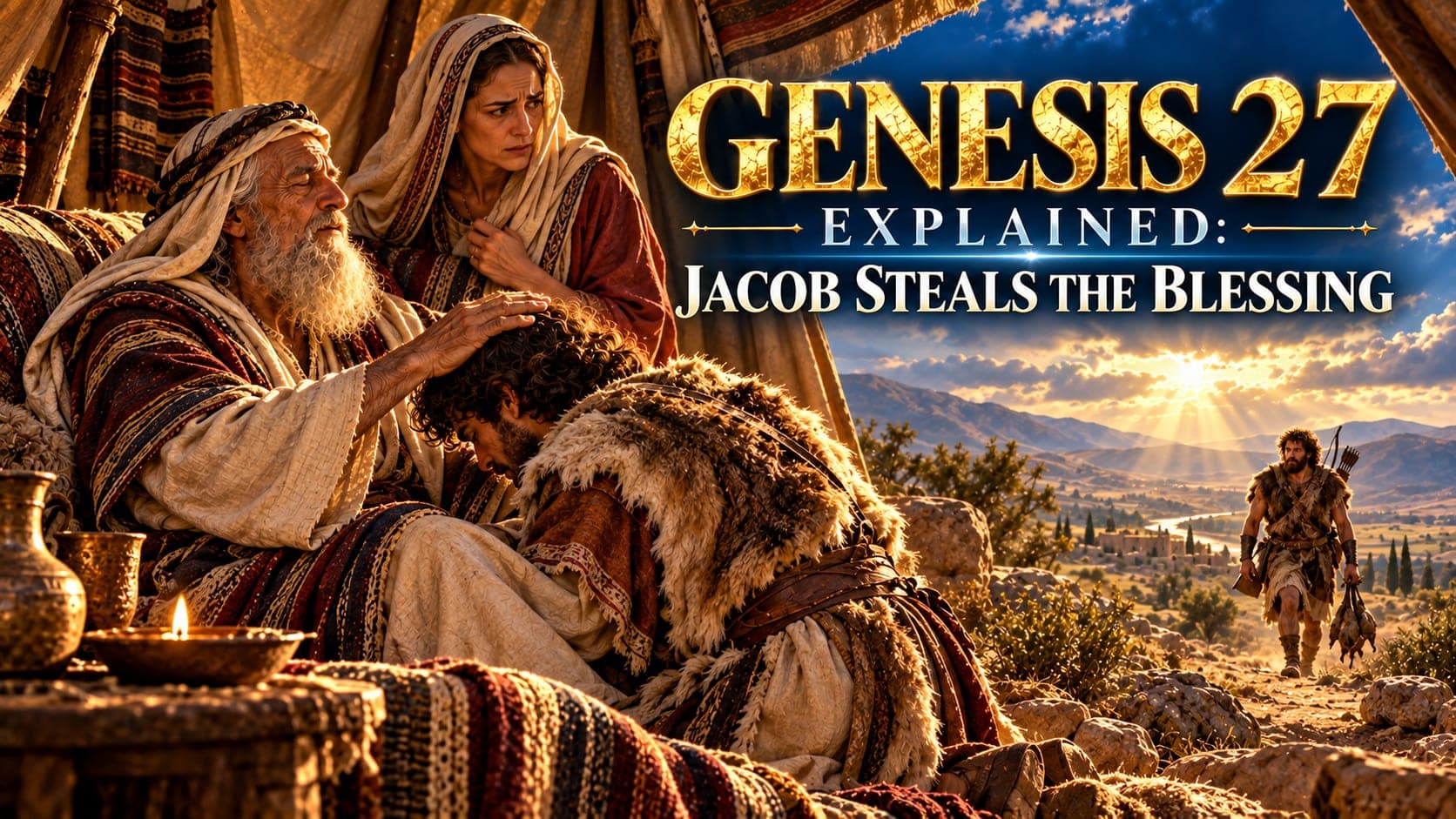
Genesis 27 ended in a household torn in two. Jacob had disguised himself as Esau and walked away with the blessing Isaac meant to give his older son. Esau discovered the trick, wept bitterly, and by the end of the chapter had decided in his heart to kill his brother the moment their father died. Rebekah heard the plan and moved fast, telling Jacob to flee to her brother Laban in Haran, and telling Isaac a different, safer reason: that she could not bear the thought of Jacob marrying a Hittite woman the way Esau had.
📌 Genesis 28 opens with Isaac acting on the reason Rebekah gave him, not the one that was actually true. He has no idea his wife orchestrated the deception that just split his family apart. All he knows is that his son needs a wife from the right family, and that his other son's marriages have already caused him grief.
Genesis 28 Explained Verse by Verse
1. Isaac Blesses Jacob and Sends Him Away (verses 1 to 5)
The chapter opens with Isaac doing, in full knowledge this time, what he had already done by accident in Genesis 27.
"And Isaac called Jacob, and blessed him, and charged him, and said unto him, Thou shalt not take a wife of the daughters of Canaan."
"Arise, go to Padanaram, to the house of Bethuel thy mother's father; and take thee a wife from thence of the daughters of Laban thy mother's brother."
💡 Notice what is missing here. Isaac says nothing about Genesis 27, nothing about the goat skins or the stolen meal or the trembling he felt when Esau walked in too late. Whatever Isaac privately thinks about how Jacob got the blessing, he moves forward as if the matter is settled, sending Jacob to find a wife the same way Abraham once sent a servant to find one for Isaac himself.
Then Isaac does something he did not do in the previous chapter. He speaks the blessing again, out loud, with his eyes open and his mind clear about who is standing in front of him.
"And God Almighty bless thee, and make thee fruitful, and multiply thee, that thou mayest be a multitude of people;"
"And give thee the blessing of Abraham, to thee, and to thy seed with thee; that thou mayest inherit the land wherein thou art a stranger, which God gave unto Abraham."
📌 This is the moment the blessing stops being disputed. Genesis 27 recorded a blessing obtained through deception. Genesis 28:3 and 4 records Isaac giving it again, fully aware, naming it "the blessing of Abraham" and tying it directly to the land promise God first spoke to Abram generations earlier. Whatever the reader thinks of how Jacob first got here, Isaac himself removes all doubt about where the blessing now belongs.
"And Isaac sent away Jacob: and he went to Padanaram unto Laban, son of Bethuel the Syrian, the brother of Rebekah, Jacob's and Esau's mother."
Jacob leaves alone. No servants loaded with gifts the way Abraham once sent his servant to find Rebekah. No caravan. A man who grew up favored and provided for walks out of his father's camp with nothing but a blessing and a destination.
2. Esau Tries to Fix What He Thinks Is the Problem (verses 6 to 9)
Esau is watching all of this, and he draws his own conclusion about why Jacob is suddenly the favored son again.
"When Esau saw that Isaac had blessed Jacob, and sent him away to Padanaram, to take him a wife from thence; and that as he blessed him he gave him a charge, saying, Thou shalt not take a wife of the daughters of Canaan;"
"And Esau seeing that the daughters of Canaan pleased not Isaac his father;"
"Then went Esau unto Ishmael, and took unto the wives which he had Mahalath the daughter of Ishmael Abraham's son, the sister of Nebajoth, to be his wife."
⚠️ Esau reads the situation completely backward. He assumes his father's displeasure with his Canaanite wives is the reason Jacob is favored, so he tries to correct it by adding a third wife, this one from Ishmael's family. It is a real effort to please his parents, and it still misses the actual issue by a wide margin. The blessing was never about which family Jacob married into. It was about a promise God spoke over him before he was even born.
This is also the second time Genesis records Esau reaching for more instead of dealing with what already happened. In Genesis 25 he traded away his birthright for a meal he wanted in the moment. Here he adds a wife he thinks might fix his standing with Isaac. Genesis 36:3 later calls this same wife by a different name, Bashemath, still identifying her as Ishmael's daughter and Nebajoth's sister. Genesis does not explain why the name changes between the two chapters.
3. The Ladder and the Covenant Renewed (verses 10 to 15)
Jacob is alone now, and the text slows all the way down to describe one ordinary night on the road.
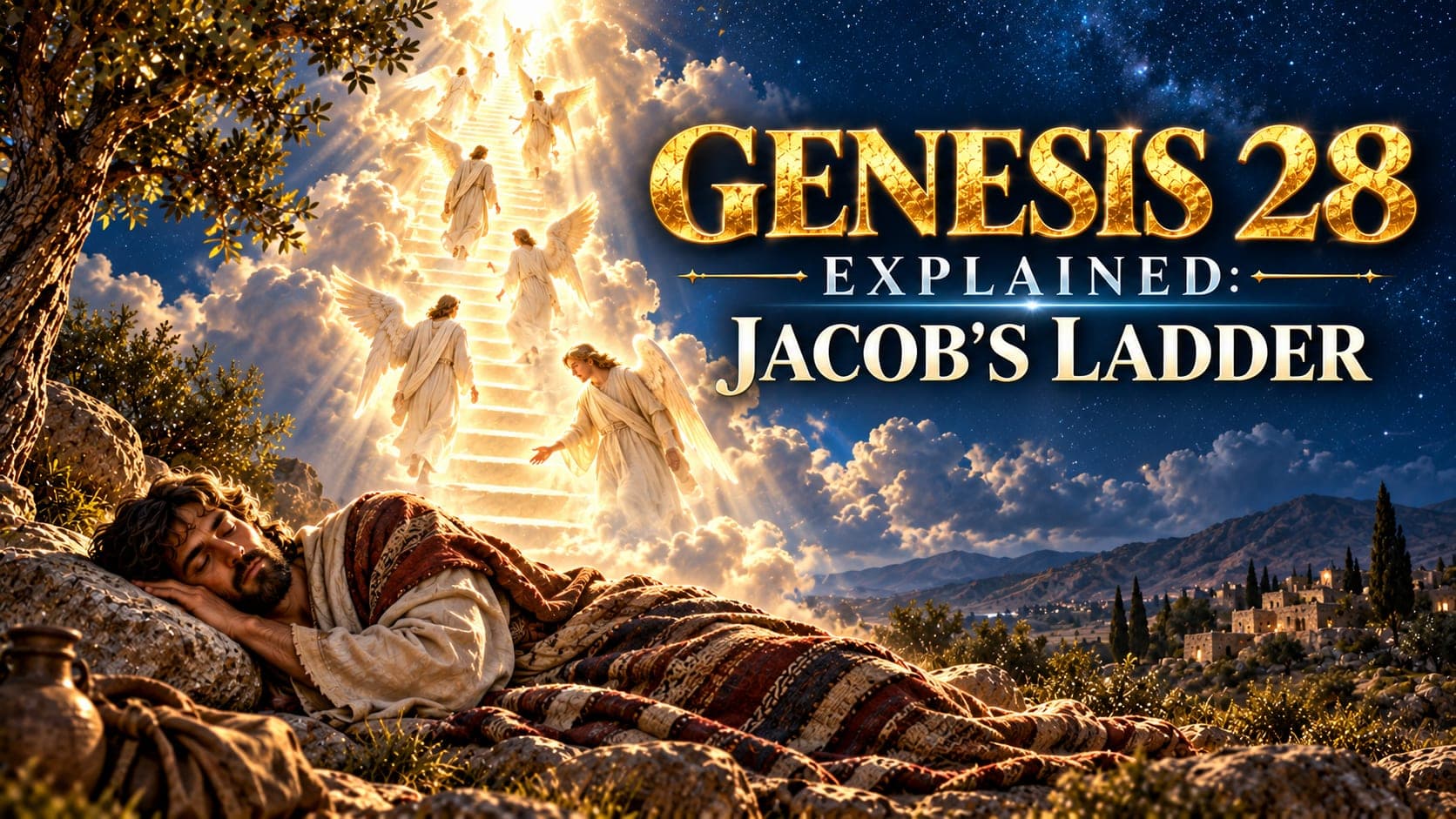
"And he lighted upon a certain place, and tarried there all night, because the sun was set; and he took of the stones of that place, and put them for his pillows, and lay down in that place to sleep."
💡 A rock for a pillow is not a detail Genesis needed to include. It is there to make sure the reader feels exactly how exposed Jacob is. No tent, no servant, no flock, nothing that marked him as Isaac's son. Just open ground and a stone under his head.
"And he dreamed, and behold a ladder set up on the earth, and the top of it reached to heaven: and behold the angels of God ascending and descending on it."
The Hebrew word behind ladder, sullam, appears only this one time in the entire Old Testament. Whatever Jacob saw, Genesis reaches for a word it never uses anywhere else to describe it, something reaching from the ground all the way to heaven, with angels moving on it in both directions at once.
📌 Notice the angels are already ascending and descending before Jacob ever wakes up. This is not a picture of heaven opening because Jacob did something to deserve it. It is a picture of activity between heaven and earth that was apparently already happening, that Jacob simply gets to see for one night.
"And, behold, the LORD stood above it, and said, I am the LORD God of Abraham thy father, and the God of Isaac: the land whereon thou liest, to thee will I give it, and to thy seed;"
"And thy seed shall be as the dust of the earth, and thou shalt spread abroad to the west, and to the east, and to the north, and to the south: and in thee and in thy seed shall all the families of the earth be blessed."
📌 Every piece of the covenant God gave Abraham gets spoken over Jacob directly here. The land, the offspring like the dust of the earth, and the promise that all the families of the earth will be blessed through his line. Isaac already spoke a version of this blessing over Jacob in verses 3 and 4. Now the LORD Himself confirms it, in Jacob's own hearing, with no human witness and no possibility Jacob heard it secondhand.
Then God adds something neither Abraham nor Isaac was promised in quite this way.
"And, behold, I am with thee, and will keep thee in all places whither thou goest, and will bring thee again into this land; for I will not leave thee, until I have done that which I have spoken to thee of."
⚠️ God promises presence and a return, not just land and descendants. Jacob is leaving everything familiar, running from a brother who wants him dead, walking toward an uncle he has never met. God tells him plainly that wherever this road goes, He is going with him, and it will end with Jacob coming back to this land, not disappearing into it.
4. Jacob Wakes Up Afraid, Not Comforted (verses 16 and 17)
Given everything God just said, Jacob's first reaction on waking up is not relief.
"And Jacob awaked out of his sleep, and he said, Surely the LORD is in this place; and I knew it not."
"And he was afraid, and said, How dreadful is this place! this is none other but the house of God, and this is the gate of heaven."
💡 Jacob's fear is not fear of punishment. It is fear of proximity. He had no idea God was anywhere near this particular patch of ground, and finding out changes how he sees the place instantly. "Dreadful" here means something closer to awe mixed with dread, the reaction of a man who just realized he was never as alone as he thought, even lying down on a stone in the middle of nowhere with no one watching.
❓ It is worth asking what Jacob expected instead. He had just helped deceive his own father. If God showed up to settle accounts, this would have been a reasonable night for it. Instead, God shows up to renew a promise.
5. The Pillar and the Name Bethel (verses 18 and 19)
Jacob does not just remember the dream. He marks the ground where it happened.
"And Jacob rose up early in the morning, and took the stone that he had put for his pillows, and set it up for a pillar, and poured oil upon the top of it."
"And he called the name of that place Bethel: but the name of that city was called Luz at the first."
📌 Bethel means house of God, the exact phrase Jacob had just used out loud in verse 17. The same stone that was under his head while he slept becomes the first thing his hands touch when he gets up, turned from a pillow into a marker. Pouring oil on it was a way of setting something apart as sacred, a physical way of saying this ground now means something it did not mean the night before.
An ordinary town called Luz gets a new name because of one night one traveler spent passing through it. Nothing about the place itself changed. What changed was what Jacob now knew was true about it.
6. Jacob's Vow (verses 20 to 22)
The chapter closes with Jacob making a vow of his own, and the wording of it is worth reading slowly.
"And Jacob vowed a vow, saying, If God will be with me, and will keep me in this way that I go, and will give me bread to eat, and raiment to put on,"
"So that I come again to my father's house in peace; then shall the LORD be my God:"
"And this stone, which I have set for a pillar, shall be God's house: and of all that thou shalt give me I will surely give the tenth unto thee."
⚠️ Read closely, everything Jacob asks for in this vow, God already promised him in verse 15. Presence, provision, and a safe return to this land. Jacob is not asking God for anything new. He is repeating God's own promise back to Him in the form of a condition, as if he needs to see it proven before he will fully commit.
He is not the first person in this family to offer God a tenth of something. Abram gave a tenth of everything to Melchizedek after defeating the kings who had captured Lot. Jacob's vow here promises the same portion, though Genesis never records the moment he actually pays it.

Hard Questions Genesis 28 Raises
Why does God appear to Jacob right after the deception in Genesis 27? Genesis never explains the timing, and it never excuses what happened in the previous chapter either. What the text shows is God renewing a promise He already made before Jacob was born, in Genesis 25:23, regardless of how Jacob had just behaved. The covenant traces back to God's own word to Abraham, not to anything Jacob did to earn it in the moment.
What exactly was the ladder Jacob saw? Genesis 28:12 uses a Hebrew word, sullam, found nowhere else in the Old Testament, so there is no second passage to compare it against. What the text is clear about is the effect: something connecting earth to heaven, with angels moving on it continually. Beyond that, Genesis leaves the exact picture to the reader's imagination.
Is Jacob's vow real faith, or is he bargaining with God? The wording is conditional, "if God will be with me... then shall the LORD be my God," which can sound like Jacob is negotiating rather than trusting. It can also be read as a man taking his first real step of personal faith, turning a promise God spoke over his family into something he commits to for himself, in his own words, at a place he will remember by name for the rest of his life. Genesis does not tell the reader which reading is correct. It simply records what Jacob said and moves on.
Why does Esau's new marriage not fix anything? Genesis 28:8 and 9 shows Esau correctly noticing his father's displeasure with Canaanite wives, then responding to the wrong problem. The blessing was never a reward for marrying well. It was a promise spoken over Jacob before either brother was born. No later decision by Esau could change who that promise belonged to.
Practical Tips From Genesis 28
This chapter has real encouragement for anyone walking through a season that feels empty of God.
- God can show up in the exact place you feel most alone. Jacob had no tent, no servant, no comfort, and that is precisely where the LORD met him. Your emptiest season is not proof God is absent from it.
- A promise does not require your track record to be clean first. Jacob had just helped deceive his father, and God renewed the covenant with him anyway. Do not wait to feel worthy before you take God's word seriously.
- Mark the moments God meets you. Jacob set up a stone and named the place. Find your own way to remember where God showed up for you, so you can return to that memory later.
- Do not solve the wrong problem. Esau tried to fix his standing with a new marriage when the real issue was never about marriage at all. Make sure you understand what is actually broken before you try to repair it.
- Bring God your honest fear, not a polished response. Jacob's first words were fear, not gratitude. God did not need him to perform confidence he did not feel.
- Let God's promises come before your commitment, not after. Jacob vowed after hearing what God already said He would do. Look for what God has already promised before you try to negotiate your own terms.
Top 4 Bible Verses From Genesis 28
1. Genesis 28:12
"And he dreamed, and behold a ladder set up on the earth, and the top of it reached to heaven: and behold the angels of God ascending and descending on it."
The single most famous image in the chapter, a connection between heaven and earth that Jacob did nothing to create and simply gets shown for one night.
2. Genesis 28:15
"And, behold, I am with thee, and will keep thee in all places whither thou goest, and will bring thee again into this land; for I will not leave thee, until I have done that which I have spoken to thee of."
A promise of presence made to a man who is about to spend years far from home, running from one brother toward an uncle he has never met.
3. Genesis 28:16 and 17
"And Jacob awaked out of his sleep, and he said, Surely the LORD is in this place; and I knew it not. And he was afraid, and said, How dreadful is this place! this is none other but the house of God, and this is the gate of heaven."
The moment an ordinary patch of ground becomes unforgettable, and a man realizes he was never as alone as he thought.
4. Genesis 28:20 to 22
"And Jacob vowed a vow, saying, If God will be with me, and will keep me in this way that I go, and will give me bread to eat, and raiment to put on, So that I come again to my father's house in peace; then shall the LORD be my God: And this stone, which I have set for a pillar, shall be God's house: and of all that thou shalt give me I will surely give the tenth unto thee."
Jacob's own vow, echoing back the very promise God just gave him, spoken as the first personal commitment of his faith rather than something he simply inherited from his father and grandfather.

Frequently Asked Questions About Genesis 28
What does Genesis 28 mean?
It records Isaac sending Jacob away to find a wife among Rebekah's family, Esau's attempt to please his parents with a third marriage, Jacob's dream of a ladder reaching to heaven with angels on it, God renewing the covenant with him directly, and the vow Jacob makes at a place he names Bethel.
What is Jacob's ladder in the Bible?
Genesis 28:12 describes something set up on the earth with its top reaching to heaven, with angels of God ascending and descending on it. The Hebrew word used for it appears only this once in the Old Testament, so Scripture gives no second description to compare it to.
Why did Jacob use a stone for a pillow?
Genesis 28:11 says Jacob was traveling alone with no tent or provisions, so he used one of the stones from that place. The detail underlines how exposed and unprepared he was for the night God chose to meet him.
What does Bethel mean?
Bethel means house of God. Genesis 28:19 says Jacob gave the place this new name after his dream, even though the city had already been called Luz before he ever arrived there.
Why did Jacob pour oil on the stone?
Genesis 28:18 records Jacob setting the stone up as a pillar and pouring oil on top of it, an act that set the stone apart as a marker of something sacred, turning the place where he slept into a place he would remember and could return to.
Was Jacob's vow a bargain with God?
Genesis 28:20 to 22 records Jacob using conditional language, promising to make the LORD his God if certain things happen. Everything he lists was already promised to him in verse 15, so the vow reads less like Jacob offering God new terms and more like a man committing personally to a promise he had only just heard.
Why does God bless Jacob after what he did in Genesis 27?
Genesis never says Jacob earned this moment. The covenant traces back to God's promise to Rebekah in Genesis 25:23 and to Abraham long before that, made before Jacob had done anything at all, good or bad.
Who was Mahalath, Esau's new wife?
Genesis 28:9 names her as Ishmael's daughter and Nebajoth's sister, making her Esau's first cousin, since Ishmael and Isaac were half brothers, both sons of Abraham. Genesis 36:3 later refers to this same wife by the name Bashemath, without explaining the difference.
Did Jacob deserve this blessing more than Esau?
Genesis does not frame it as a matter of who deserved it. The blessing follows God's own word spoken before either brother was born, not either son's conduct. Genesis 28 shows Jacob receiving the covenant directly from God, without claiming he had become more righteous than his brother.
How does Genesis 28 connect to the rest of the Bible?
It sets up Jacob's arrival in Haran in the very next chapter, where he will meet Rachel at a well much like his grandfather's servant once did. Jesus references this exact scene in John 1:51, telling Nathanael he will see heaven open and angels ascending and descending, pointing to Himself as the true connection between heaven and earth that Jacob's ladder only pictured.
Final Thoughts
Genesis 28 is a chapter about a man who expected nothing and was met by everything.
📌 God's promises do not wait for you to clean yourself up first. Jacob was fleeing the consequences of his own deception when God renewed the covenant with him anyway.
📌 The place that feels emptiest can turn out to be the one where God is closest. Jacob had no idea the LORD was in that place, and finding out changed how he saw everything about it.
📌 A promise you inherited still has to become a promise you personally trust. Jacob had heard the blessing spoken over him by his father. At Bethel, he made it his own for the first time.
You may feel like you are in a season with no tent, no comfort, and no clear sign God is near.
So here is your one next step.
Look for the ground under your own feet right now. Genesis 28 says it may already be more sacred than it looks.