📖 Genesis 33 Explained: Jacob and Esau Meet Again
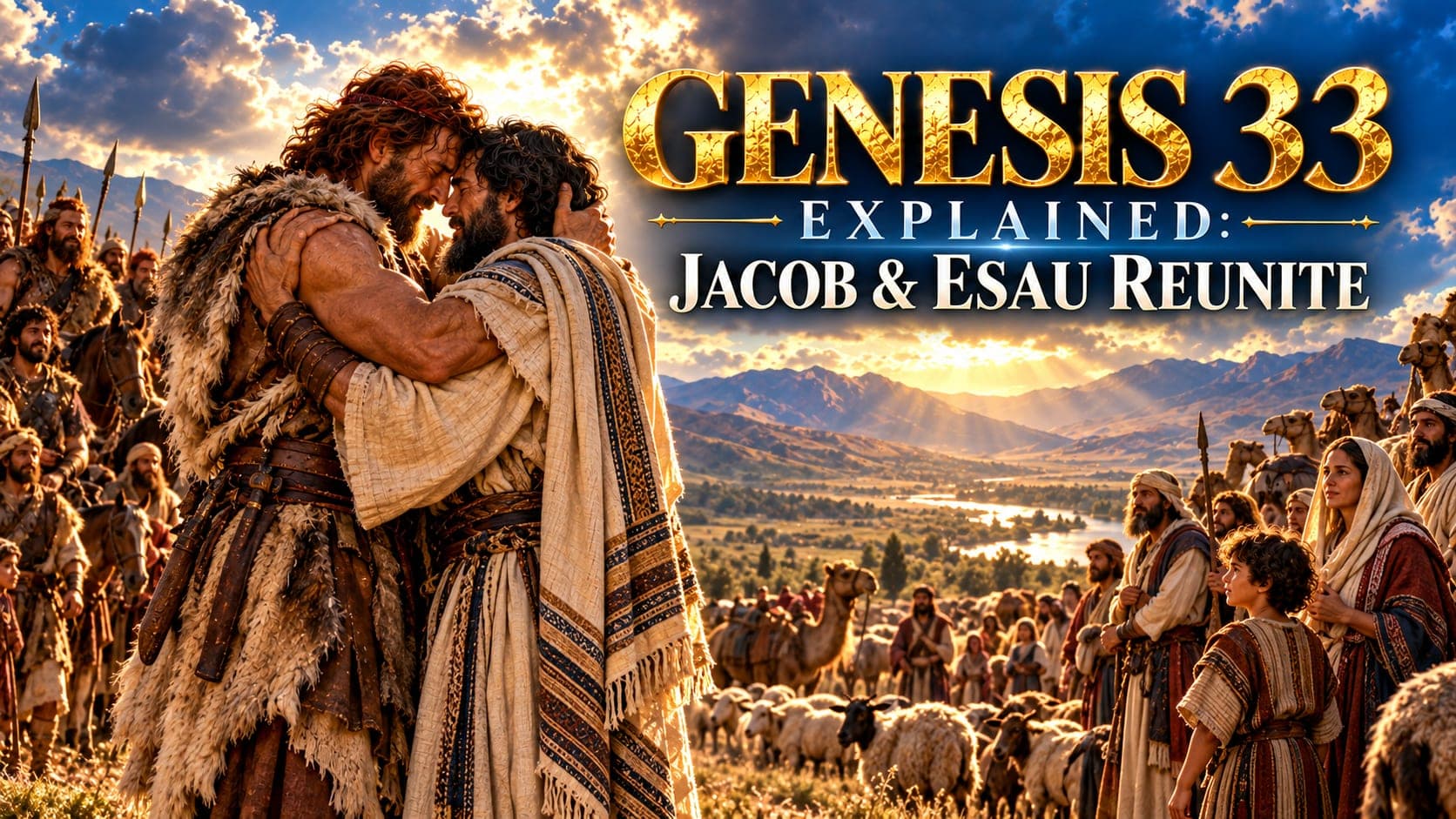
Jacob lifts his eyes, and there is Esau, four hundred men behind him, walking straight toward him.
Genesis 33 explained is the reunion Jacob spent the entire previous chapter dreading. After twenty years apart, a stolen blessing, a stolen birthright, and a threat of murder that never quite went away in Jacob's mind, the two brothers finally stand face to face again. Jacob bows to the ground seven times before Esau ever says a word.
Maybe you have walked toward a conversation you were sure would end badly, and it did not go the way you feared at all.
- ❓ Why does Jacob bow seven times before Esau even reaches him?
- ❓ Did Esau really forgive Jacob, or is he just being polite?
- ❓ What does Jacob mean when he says seeing Esau's face was like seeing the face of God?
- ❓ Why does Jacob tell Esau he is coming to Seir, and then go somewhere else entirely?
📌 The brother Jacob spent a sleepless night preparing to face turns out to already be over it. The fear that drove the whole previous chapter dissolves in a single embrace.
This walkthrough goes through the whole chapter in order: Jacob arranging his family by how much he loved each of them, the run and the embrace, the strange comparison Jacob makes between Esau's face and God's, the gift Esau almost refuses, the polite excuse Jacob gives for traveling separately, and the quiet, unresolved decision Jacob makes to settle in Shechem instead of going home to his father.
Watch what Jacob does the moment the danger actually passes.
What Happened Just Before This Chapter
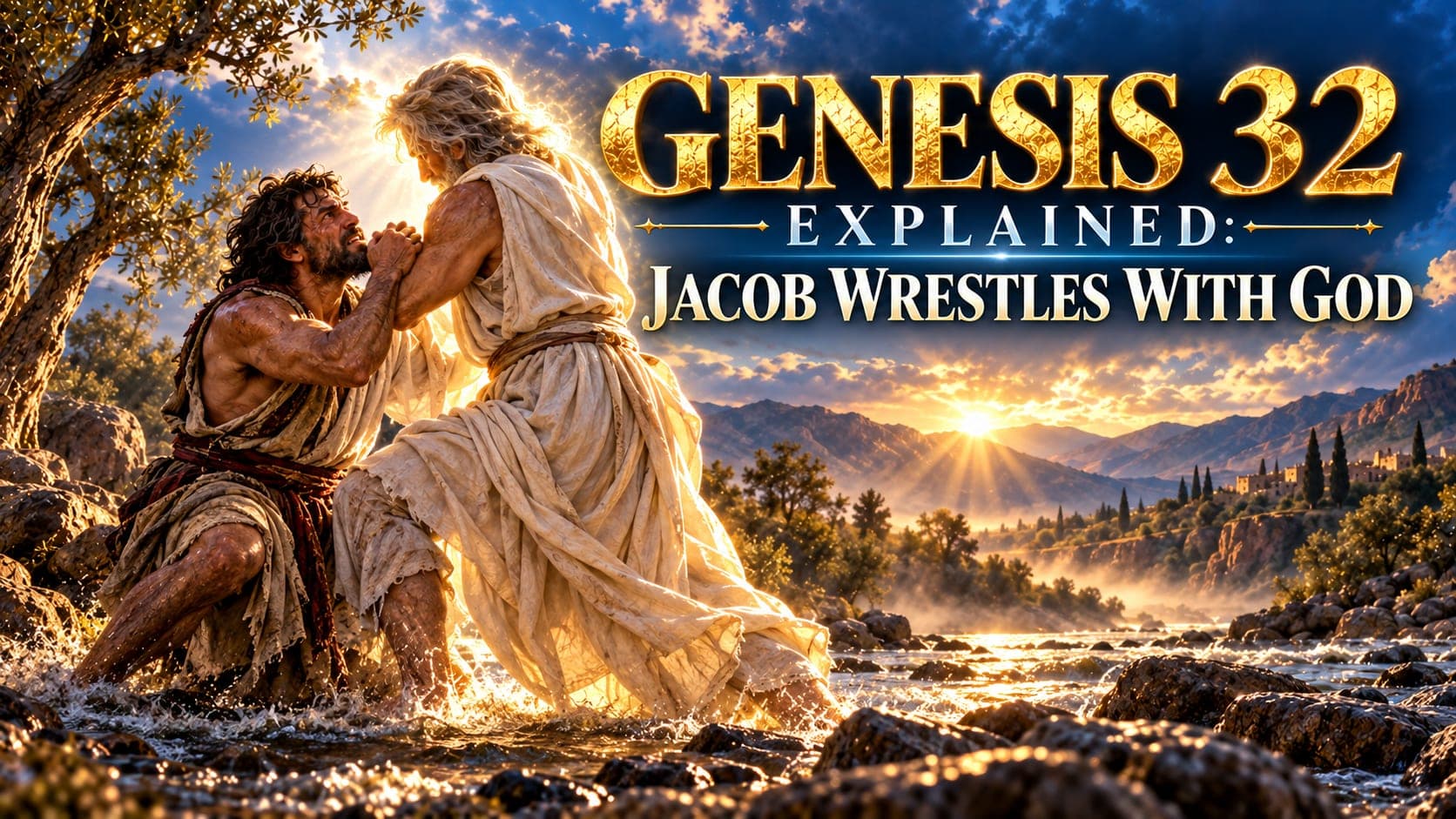
Genesis 32 ended with Jacob alone at the ford of the Jabbok, wrestling a man until daybreak, walking away with a new name, Israel, and a hip that would never fully heal. He had already sent hundreds of animals ahead of Esau in careful waves, and he had already prayed the most honest prayer of his life, admitting he was not worthy of anything God had given him.
📌 Genesis 33 opens with the meeting Jacob spent that entire sleepless night bracing for. Everything he could plan, give, and pray, he has already done. Now he has to actually walk toward his brother and find out if any of it mattered.
Genesis 33 Explained Verse by Verse
1. Jacob Arranges His Family, and Bows Seven Times (verses 1 to 3)
The chapter opens with the sight Jacob has feared since the messengers first came back with news of four hundred men.
"And Jacob lifted up his eyes, and looked, and, behold, Esau came, and with him four hundred men. And he divided the children unto Leah, and unto Rachel, and unto the two handmaids."
"And he put the handmaids and their children foremost, and Leah and her children after, and Rachel and Joseph hindermost."
⚠️ Notice exactly what this arrangement reveals. Jacob places Rachel and Joseph last, the position farthest from any danger coming from the front. He is still thinking like a man who divided his camp into two bands back in Genesis 32, hoping the ones he loves most have the best odds if this goes wrong. Even after a night of wrestling with God, Jacob walks into this morning still hedging.
Then Jacob himself goes ahead of everyone else.
"And he passed over before them, and bowed himself to the ground seven times, until he came near to his brother."
💡 Bowing to the ground seven times was the standard way a servant approached a king in the ancient Near East. Jacob is not simply being humble in a general sense. He is performing, in full view of Esau's men, the exact posture of a subject approaching a ruler he cannot resist. This is the same man who once dressed in disguise to steal a blessing that made him lord over his brother. Now he walks toward that same brother bowing low enough to eat dust, seven separate times, before either of them speaks a word.
2. Esau Runs, and the Fear Ends in an Embrace (verses 4 to 7)
Every plan Jacob made, the waves of gifts, the careful order of his family, the seven bows, assumed a brother who still wanted revenge. Esau answers none of it.
"And Esau ran to meet him, and embraced him, and fell on his neck, and kissed him: and they wept."
📌 Four verbs land on top of each other in one sentence: ran, embraced, fell on his neck, kissed. This is not a stiff, formal reunion between two men keeping score. Esau closes the distance himself, and the tears are shared, not one-sided. Twenty years of dread built around a threat Esau apparently let go of long before Jacob ever crossed the Jabbok.
Once the weeping stops, Esau notices who else is standing there.
"And he lifted up his eyes, and saw the women and the children; and said, Who are those with thee? And he said, The children which God hath graciously given thy servant."
"Then the handmaidens came near, they and their children, and they bowed themselves. And Leah also with her children came near, and bowed themselves: and after came Joseph near and Rachel, and they bowed themselves."
💡 Jacob answers Esau's question by naming God first, not himself. The children are not proof of Jacob's success. They are something God gave him. And Jacob's whole household follows his lead from Genesis 33:3, bowing in the same careful order he set up at the start of the chapter, handmaids first, Leah next, Rachel and Joseph last.
3. "As Though I Had Seen the Face of God" (verses 8 to 11)
Esau turns to the hundreds of animals that had already been arriving in droves before he ever reached Jacob.
"And he said, What meanest thou by all this drove which I met? And he said, These are to find grace in the sight of my lord."
"And Esau said, I have enough, my brother; keep that thou hast unto thyself."
⚠️ A brother Jacob expected to demand everything back instead tries to hand the gift right back to him. Esau does not need the animals. He has done well for himself in the years apart. Jacob, though, will not let the gift go, and what he says next is the most striking line in the whole chapter.
"And Jacob said, Nay, I pray thee, if now I have found grace in thy sight, then receive my present at my hand: for therefore I have seen thy face, as though I had seen the face of God, and thou wast pleased with me."
📌 Jacob is not calling Esau divine. He is describing what it felt like to brace for judgment and receive welcome instead. Only one other night in his life compares: the wrestling match at Peniel, where he named the place "face of God" after surviving an encounter he had no right to walk away from. Now he uses almost the same language for his brother's face. The God who spared him in the dark is the same God whose mercy he now sees looking back at him in Esau's forgiveness.
Jacob presses the gift on Esau a second time, and this time Esau accepts it.
"Take, I pray thee, my blessing that is brought to thee; because God hath dealt graciously with me, and because I have enough. And he urged him, and he took it."
💡 Jacob calls the gift his "blessing," the same Hebrew word behind the blessing he tricked out of Isaac in Genesis 27. This time the blessing moves from Jacob to Esau instead of the other way around, given freely instead of stolen. It is not a coincidence of wording. It reads like a man quietly trying to hand something back.
4. Jacob Declines to Travel Together (verses 12 to 15)
With the tension broken, Esau offers something that sounds like real brotherhood: to travel the rest of the way with Jacob and protect him.
"And he said, Let us take our journey, and let us go, and I will go before thee."
"And he said unto him, My lord knoweth that the children are tender, and the flocks and herds with young are with me: and if men should overdrive them one day, all the flock will die."
"Let my lord, I pray thee, pass over before his servant: and I will lead on softly, according as the cattle that goeth before me and the children be able to endure, until I come unto my lord unto Seir."
⚠️ Jacob's excuse is true and incomplete at the same time. Young animals and small children really could not keep pace with four hundred armed men on the move. But Jacob also says he will come to Esau at Seir, and the rest of the chapter never shows him going there. He is polite, and he is also managing the relationship carefully, the same instinct that guided every gift and every bow earlier in the chapter. Esau offers one more thing.
"And Esau said, Let me now leave with thee some of the folk that are with me. And he said, What needeth it? let me find grace in the sight of my lord."
💡 Jacob turns down an armed escort too. Whatever mix of caution and independence is driving him, he wants his family to travel on its own terms, not surrounded by Esau's men, however friendly the offer.
5. Two Different Directions (verses 16 and 17)
The two brothers part, and the text says it in one plain line each.
"So Esau returned that day on his way unto Seir."
"And Jacob journeyed to Succoth, and built him an house, and made booths for his cattle: therefore the name of the place is called Succoth."
📌 Succoth means booths, and Jacob names the place for the temporary shelters he built there, not for a house he intended to keep. Building an actual house at all, though, after twenty years of tents in Laban's fields, marks a real change. Whatever fear defined the last chapter is gone enough that Jacob stops to build something meant to last more than a single night.
6. Jacob Settles at Shechem, Buys Land, and Builds an Altar (verses 18 to 20)
From Succoth, Jacob moves on into Canaan itself, and the chapter closes on a decision that will shape the very next chapter of Genesis.
"And Jacob came to Shalem, a city of Shechem, which is in the land of Canaan, when he came from Padanaram; and pitched his tent before the city."
"And he bought a parcel of a field, where he had spread his tent, at the hand of the children of Hamor, Shechem's father, for an hundred pieces of money."
⚠️ Jacob does not simply pass through Shechem. He buys land there. That is a decision to stay, not a rest stop on the way to his father Isaac at Hebron, and not the return to Bethel he vowed to make in Genesis 28 when he first left home with nothing but a stone for a pillow. Genesis does not comment on the delay here. It simply records the purchase and lets the next chapter show what settling this close to Shechem's people will cost his daughter Dinah.
The chapter ends with an act of worship in the middle of that new land.
"And he erected there an altar, and called it EleloheIsrael."
💡 El-elohe-Israel means God, the God of Israel. It is the first time in Genesis that the new name from Peniel becomes part of an altar's name, Jacob claiming, in stone and worship, the identity he was given wrestling in the dark. He builds it, though, in Shechem, not at Bethel where he promised years earlier that the LORD would be his God if he returned home safely. The worship is real. The vow is still unfinished.

Hard Questions Genesis 33 Raises
Did Esau really forgive Jacob, or was he simply being gracious in the moment? The text gives no reason to doubt him. Esau runs to Jacob, weeps with him, tries twice to refuse the gift, and offers both his company and his men for protection. Nothing in Genesis 33 suggests performance. Whatever anger drove Esau to threaten Jacob's life in Genesis 27:41 appears to have genuinely faded over twenty years.
Did Jacob lie when he told Esau he would come to him at Seir? Genesis never records Jacob making that trip. Some readers call it an outright deception, a final echo of the same instinct that once tricked Isaac and outmaneuvered Laban. Others read it as a genuine intention Jacob simply never carried out, since Scripture elsewhere shows him settling closer to home instead. Genesis states the plan and the different outcome without explaining which it was, and does not present the choice as admirable either way.
What does it mean that Jacob compared Esau's face to the face of God? Genesis 33:10 uses almost the same wording Jacob used in Genesis 32:30 after wrestling at Peniel. He is not equating his brother with the LORD. He is describing an experience of undeserved mercy, bracing for judgment and receiving welcome instead, in language he already had ready from the most intense encounter of his own life.
Why did Jacob settle in Shechem instead of returning straight to Bethel or to his father Isaac? Genesis does not explain the decision directly. What it does show is a man who bought land and built an altar in a place he had not vowed to return to, while the vow he made at Bethel in Genesis 28:20 to 22 sits unfulfilled. The very next chapter opens with Dinah among the daughters of that same land, a consequence Genesis lets the reader connect without stating it outright.
Practical Tips From Genesis 33
This chapter has real weight for anyone walking toward a reunion they are certain will go badly.
- Do the hard work first, then still walk toward the moment. Jacob prayed, gave, and prepared in Genesis 32, and he still had to actually approach Esau himself. Real reconciliation usually asks something of you beyond the planning.
- Do not assume the other person is still where you left them. Jacob expected the Esau who threatened his life twenty years earlier. He met a brother who had already moved past it. People change more than fear tells you they will.
- Notice mercy when it arrives, and name it out loud. Jacob did not take Esau's welcome for granted. He compared it to seeing God's own face. Undeserved kindness deserves that kind of attention.
- Give back what you can, even years later. Jacob calling his gift a "blessing" is not an accident. If you have taken something from someone, look for a real way to return it, even long after the fact.
- You can accept peace without merging your whole life with someone else's. Jacob embraced Esau, wept with him, and still chose to travel his own road afterward. Reconciliation does not always require doing everything together again.
- Watch for the vow you have not kept yet. Jacob worshiped sincerely at Shechem while the promise he made at Bethel waited. Notice when you have settled somewhere comfortable instead of finishing what you already told God you would do.
Top 5 Bible Verses From Genesis 33
1. Genesis 33:4
"And Esau ran to meet him, and embraced him, and fell on his neck, and kissed him: and they wept."
The verse the whole chapter has been building toward, four verbs of welcome answering twenty years of dread in a single sentence.
2. Genesis 33:10
"And Jacob said, Nay, I pray thee, if now I have found grace in thy sight, then receive my present at my hand: for therefore I have seen thy face, as though I had seen the face of God, and thou wast pleased with me."
Jacob describing mercy in the only language he had strong enough for it, borrowed straight from the night he wrestled at Peniel.
3. Genesis 33:3
"And he passed over before them, and bowed himself to the ground seven times, until he came near to his brother."
The man who once schemed his way to a position of power over his brother now approaches him in the posture of a servant before a king.
4. Genesis 33:20
"And he erected there an altar, and called it EleloheIsrael."
The first time the name Israel, given to Jacob at Peniel, becomes part of an act of worship, even in a place he had not vowed to settle.
5. Genesis 33:11
"Take, I pray thee, my blessing that is brought to thee; because God hath dealt graciously with me, and because I have enough. And he urged him, and he took it."
The same Hebrew word for blessing that Jacob once stole from Esau, now handed back freely, and finally accepted.

Frequently Asked Questions About Genesis 33
What does Genesis 33 mean?
It records the long feared reunion between Jacob and Esau, twenty years after Jacob fled for stealing their father's blessing. Esau forgives him openly, the brothers part on good terms, and Jacob settles first at Succoth and then at Shechem, buying land and building an altar there.
Why did Jacob bow seven times before reaching Esau?
Genesis 33:3 describes the customary way a servant approached a ruler in the ancient Near East. Jacob performs that exact gesture toward his brother, publicly reversing the position of authority he once schemed to take for himself in Genesis 27.
Did Esau really forgive Jacob?
Genesis 33:4 gives every sign that he did. He runs to Jacob, embraces him, weeps with him, and twice tries to refuse the gift Jacob offers. Nothing in the chapter suggests Esau was only being polite in front of his men.
What does "I have seen thy face, as though I had seen the face of God" mean?
Jacob is not calling Esau divine. Genesis 33:10 echoes the language he used in Genesis 32:30 after wrestling at Peniel, describing the same feeling of surviving an encounter he feared and receiving mercy he did not expect.
Why did Jacob refuse Esau's offer to travel together?
Genesis 33:13 and 14 has Jacob explain that young children and nursing animals could not keep pace with four hundred men on the move. The excuse was true, though Genesis never shows Jacob actually following through on his promise to meet Esau afterward at Seir.
Did Jacob lie to Esau about coming to Seir?
Genesis 33:14 records the promise, and the rest of the chapter shows Jacob going to Succoth and then Shechem instead. Scripture never explains whether this was deception or simply a plan that changed, and it does not present either option as praiseworthy.
What does El-elohe-Israel mean?
It means God, the God of Israel. Genesis 33:20 records Jacob giving this name to the altar he built at Shechem, the first time his new name from Genesis 32:28 appears attached to an act of worship.
Why did Jacob settle in Shechem instead of going home to Bethel?
Genesis 33:18 and 19 shows Jacob buying land at Shechem and pitching his tent there. He had vowed in Genesis 28:20 to 22 to return to Bethel once he came home safely. Genesis does not explain the delay, and the very next chapter shows what settling that close to Shechem costs his family.
Did Jacob and Esau stay close after this reunion?
Genesis 33:16 and 17 shows the brothers parting ways immediately, Esau back to Seir and Jacob toward Succoth. Genesis 35:29 later brings them together once more, at their father Isaac's burial, but Scripture never shows them living in the same territory again.
How does Genesis 33 connect to the rest of Jacob's story?
It resolves the fear that drove all of Genesis 32, closing the account between Jacob and Esau that began with the stolen birthright and blessing. It also sets up the next chapter directly, since Jacob's decision to settle near Shechem places his daughter Dinah among a people who will bring the family real tragedy.
Final Thoughts
Genesis 33 answers the fear of Genesis 32 faster and more gently than Jacob had any reason to expect.
📌 The reunion Jacob spent a sleepless night preparing for was already resolved in Esau's heart. Twenty years had done what Jacob's gifts and bows did not need to accomplish alone.
📌 Undeserved mercy is worth naming for what it is. Jacob compared his brother's welcome to seeing the face of God, the same language he used for the night he thought he might not survive.
📌 Even a good reunion can leave something unfinished. Jacob worshiped sincerely at Shechem while the vow he made at Bethel still waited, and the next chapter shows what that delay cost him.
You may be bracing for a reunion right now, certain it will go the way you fear most.
So here is your one next step.
Walk toward it anyway, the way Jacob did, and let yourself be surprised if the mercy waiting there is bigger than the fear that got you moving.