📖 Joshua 11 Explained: The Last Battle and the Land's Rest From War
One more king decides he can still beat Israel if enough of his neighbors join him.
Joshua 11 explained is the chapter where the last organized resistance to Israel's conquest gathers in the north, bringing something the earlier battles never faced: horses and chariots in huge numbers. It is also the chapter that finally says, after ten chapters of marching and fighting, that the land rested from war.
Maybe you have faced one more fight right when you thought the hardest part was already over.
- ❓ Why does God tell Joshua to disable the horses and burn the chariots instead of keeping them?
- ❓ Why is Hazor burned when most conquered cities in this chapter are not?
- ❓ What does it mean that the LORD hardened these kings' hearts to fight?
- ❓ How does a chapter about war end with the land finally at rest?
📌 This chapter closes out the military campaign that started back in Joshua 1, and it closes it with one short sentence that changes everything that follows: Joshua left nothing undone.
This walkthrough moves through the whole chapter in order: the northern coalition forming at the waters of Merom, the strange command about horses and chariots, the burning of Hazor, the summary of everything Joshua took, and the two closing notes about giants and rest that bring the whole conquest narrative to a stop.
Watch how much of this short chapter is written as a summary, not just a battle report.
What Happened Just Before This Chapter
Joshua 10 ended with Israel finishing a southern campaign that took six cities in a single stretch, after God sent hailstones and extended the daylight to help Israel defend a city it had sworn to protect. The chapter closed with Joshua and the army back at Gilgal, the south of Canaan largely broken.
Chapter 11 moves the story north. One king who has watched everything happen in the south decides the only way to stop Israel is to stop acting alone.

Joshua 11 Explained Verse by Verse
1. Jabin Gathers the Last Great Coalition (verses 1 to 5)
The chapter opens with a king who understands exactly what he is watching.
"And it came to pass, when Jabin king of Hazor had heard those things, that he sent to Jobab king of Madon, and to the king of Shimron, and to the king of Achshaph,"
"And to the kings that were on the north of the mountains, and of the plains south of Chinneroth, and in the valley, and in the borders of Dor on the west,"
Jabin does not wait to be attacked. He sends word out across the whole north of Canaan, to every kind of king in the region, the same pattern the Amorite coalition used against Gibeon in the chapter before this one. Alone, no single city has stopped Israel yet. Jabin's plan is to make sure nobody faces Israel alone.
Verse 4 names what makes this coalition different from every army Israel has met so far.
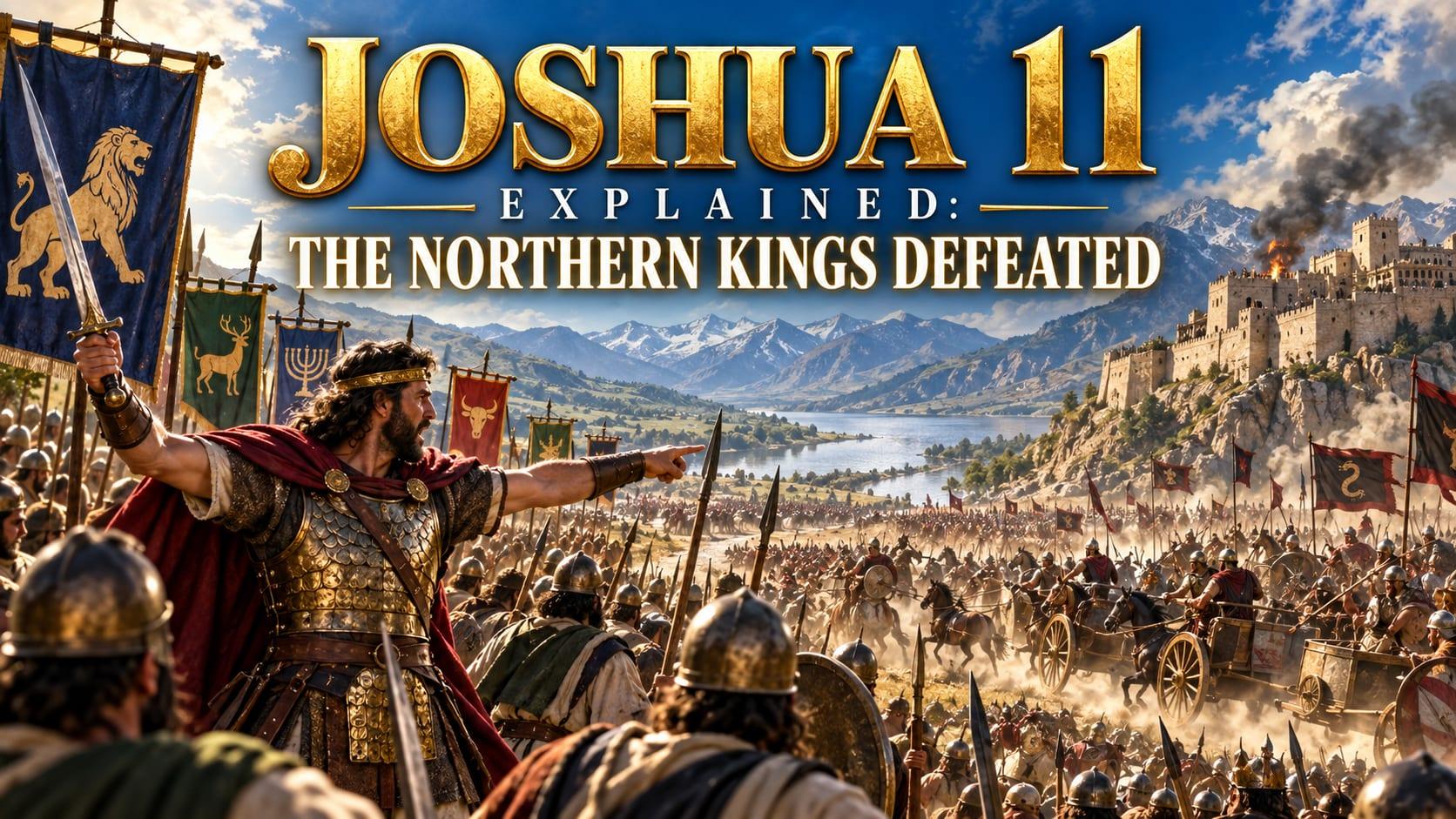
"And they went out, they and all their hosts with them, much people, even as the sand that is upon the sea shore in multitude, with horses and chariots very many."
⚠️ No earlier battle in the book of Joshua mentions enemy horses and chariots at all. Jericho, Ai, and the five kings of the south are described only in terms of men and walls. The north brings a different kind of army, one built for open ground, speed, and the kind of fight that favors whoever has the stronger cavalry.
"And when all these kings were met together, they came and pitched together at the waters of Merom, to fight against Israel."
💡 The waters of Merom sit in the far north of Canaan, well above the Sea of Galilee. This coalition is not reacting to an army already at its gates. It is choosing to march out and meet Israel on ground it picked for itself.
2. Be Not Afraid: Hamstring the Horses, Burn the Chariots (verses 6 to 9)
Before Israel sees a single chariot up close, God tells Joshua exactly what tomorrow holds.
"And the LORD said unto Joshua, Be not afraid because of them: for to morrow about this time will I deliver them up all slain before Israel: thou shalt hough their horses, and burn their chariots with fire."
Hough means to cut the tendons in a horse's leg, disabling it rather than killing it outright. Chariots and horses were valuable. By most military instincts, a defeated army's cavalry is exactly the kind of prize worth keeping. God's instruction runs the opposite direction, and it is specific enough that nobody could later claim they misunderstood it.
📌 God does not just promise a win here. He tells Joshua what to do with the very thing that made this enemy look dangerous in the first place. The horses and chariots that made this coalition different from every earlier one are the first thing named for destruction.
"So Joshua came, and all the people of war with him, against them by the waters of Merom suddenly; and they fell upon them."
"And the LORD delivered them into the hand of Israel, who smote them, and chased them unto great Zidon, and unto Misrephothmaim, and unto the valley of Mizpeh eastward; and they smote them, until they left them none remaining."
💡 Great Zidon, better known as Sidon, is a major Phoenician coastal city well to the north and west of Merom. The chase covers real distance in multiple directions, a sign of how completely this coalition's lines broke once the fighting started.
"And Joshua did unto them as the LORD bade him: he houghed their horses, and burnt their chariots with fire."
Verse 9 is a near word for word repeat of verse 6. The command was given, and the command was carried out, in the exact same language. The chapter is not shy about pointing out when Joshua does precisely what he was told, down to the specific detail about the horses.

3. Hazor Burned, the Head of All Those Kingdoms (verses 10 to 13)
With the field battle won, Joshua turns back toward the city that started this whole coalition.
"And Joshua at that time turned back, and took Hazor, and smote the king thereof with the sword: for Hazor beforetime was the head of all those kingdoms."
Archaeologists widely identify Hazor as one of the largest fortified cities in Canaan during this period, a detail that lines up with what the text itself says here. Jabin did not build this coalition from a minor town. He built it from the city other kings in the region already looked to.
"And they smote all the souls that were therein with the edge of the sword, utterly destroying them: there was not any left to breathe: and he burnt Hazor with fire."
"But as for the cities that stood still in their strength, Israel burned none of them, save Hazor only; that did Joshua burn."
📌 Verse 13 is one of the most specific details in the whole conquest narrative. Out of every northern city taken in this chapter, only Hazor is burned. The text names the reason earlier, in verse 10: Hazor was the head of all those kingdoms, the city that organized this entire war. Only Jericho, Ai, and now Hazor are ever burned by Israel in this conquest, and each time the text gives a reason specific to that city rather than a blanket policy for every conquered town.
4. Nothing Undone (verses 14 and 15)
Two verses step back from the battle itself to say something about Joshua's whole character.
"And all the spoil of these cities, and the cattle, the children of Israel took for a prey unto themselves; but every man they smote with the edge of the sword, until they had destroyed them, neither left they any to breathe."
"As the LORD commanded Moses his servant, so did Moses command Joshua, and so did Joshua; he left nothing undone of all that the LORD commanded Moses."
💡 Verse 14's language, sparing nothing that breathed, echoes the command Moses had already given for conquered cities in Deuteronomy 20. This was not Joshua inventing harsh terms on his own. It was Joshua carrying out instructions written down long before this generation ever reached Canaan.
📌 Verse 15 traces a straight line: the LORD commanded Moses, Moses commanded Joshua, Joshua left nothing undone. Three links in one chain, and the chapter states plainly that none of them broke. This is the clearest single statement in the book of Joshua about why Joshua is remembered as faithful rather than brilliant or lucky.
5. The Whole Land, and Hearts the LORD Hardened (verses 16 to 20)
The chapter pulls back further still, summarizing everything the conquest has covered.
"So Joshua took all that land, the hills, and all the south country, and all the land of Goshen, and the valley, and the plain, and the mountain of Israel, and the valley of the same;"
"Joshua made war a long time with all those kings."
💡 "A long time" matters. Reading the battles back to back across these chapters can make the conquest feel fast. Verse 18 corrects that impression on purpose. This was years of campaigning, not one dramatic season.
"There was not a city that made peace with the children of Israel, save the Hivites the inhabitants of Gibeon: all other they took in battle."
That one exception points straight back to the treaty Gibeon talked its way into in Joshua 9. Every other city in this entire conquest chose the battlefield instead.
Then comes the hardest verse in the chapter.
"For it was of the LORD to harden their hearts, that they should come against Israel in battle, that he might destroy them utterly, and that they might have no favour, but that he might destroy them, as the LORD commanded Moses."
⚠️ This verse says plainly that the LORD hardened these kings' hearts toward war. Scripture uses this same kind of language for Pharaoh in Exodus 14, where Pharaoh's own repeated choices and God's hardening of his heart are both stated without the text resolving exactly how the two fit together. Joshua 11:20 does something similar. It never says these kings were innocent men forced into a war they wanted no part of. Jabin built this coalition on his own initiative in verse 1, long before verse 20 ever mentions hardening. The verse states a result, not an excuse.

6. The Anakim Cut Off, and the Land Rested From War (verses 21 to 23)
Two closing notes bring the entire military campaign of the book of Joshua to a stop.
"And at that time came Joshua, and cut off the Anakims from the mountains, from Hebron, from Debir, from Anab, and from all the mountains of Judah, and from all the mountains of Israel: Joshua destroyed them utterly with their cities."
💡 The Anakim are the same people whose size terrified the spies Moses sent into Canaan a generation earlier, the report that led an entire nation to refuse to enter the land at all. Forty years later, the generation that grew up hearing about those giants is the one that cuts them off from the mountains of Judah and Israel.
"There was none of the Anakims left in the land of the children of Israel: only in Gaza, in Gath, and in Ashdod, there remained."
📌 The text does not claim every Anakite everywhere was gone. Gaza, Gath, and Ashdod keep some, cities that stay important later in Israel's history, including as the home of a famous Philistine giant generations after this. The victory is real and it is also stated honestly, without rounding up to a claim the text itself does not make.
Then the chapter ends on a sentence that has been building since Joshua 1.
"So Joshua took the whole land, according to all that the LORD said unto Moses; and Joshua gave it for an inheritance unto Israel according to their divisions by their tribes. And the land rested from war."
📌 "The land rested from war" is the hinge of the entire book of Joshua. Everything from chapter 1 to this verse has been marching, fighting, and taking ground. Starting in the next chapter, the book changes shape completely, turning from battles to the careful work of dividing that land among the tribes. This one sentence closes the military half of Joshua and opens the second half.
Hard Questions Joshua 11 Raises
Why did God tell Joshua to hamstring the horses and burn the chariots instead of taking them as plunder? What the text says: verse 6 gives this command before the battle even starts, and verse 9 confirms it was carried out exactly as given. How this is read: the text does not explain the reasoning directly, but the effect is clear. Israel does not come out of this battle with a cavalry of its own, which keeps the coming victories from being explained by superior weapons rather than by the LORD fighting for Israel, the same theme already stated outright the chapter before this one.
Why was Hazor burned when most of the cities Israel conquered in the book of Joshua are not? What the text says: verse 13 states plainly that Israel burned none of the standing cities except Hazor, and verse 10 gives the reason, that Hazor was the head of all those kingdoms. How this fits the pattern: the same specific treatment applies earlier to Jericho and Ai, each burned for reasons tied to that city rather than a general rule applied to every town taken in the conquest.
What does it mean that the LORD hardened these kings' hearts to fight, in verse 20? What the text says: it states this directly, tying the hardening to God's purpose of destroying them utterly. How Christians read it: Scripture describes something similar with Pharaoh in Exodus 14, where human choice and divine hardening appear together without the text fully explaining how they relate. Jabin's own decision to build a war coalition in verse 1 comes before any mention of hardening in verse 20. The text holds both without picking one explanation and discarding the other.
How does "the land rested from war" in verse 23 fit with later chapters that describe land still not fully taken? What the text says: Joshua 13:1, right after this chapter, has God telling an aging Joshua that there remains very much land yet to be possessed. How this fits together: verse 23's rest describes the end of the organized military campaign under Joshua's direct command, not the complete removal of every remaining people from every corner of the land. The book of Judges later shows exactly how much was left for each tribe to finish on its own.

Top Verses From Joshua 11
1. Joshua 11:6
"And the LORD said unto Joshua, Be not afraid because of them: for to morrow about this time will I deliver them up all slain before Israel: thou shalt hough their horses, and burn their chariots with fire."
The first enemy chariots and horses in the whole conquest, and the first thing God names for destruction before the battle even starts.
2. Joshua 11:15
"As the LORD commanded Moses his servant, so did Moses command Joshua, and so did Joshua; he left nothing undone of all that the LORD commanded Moses."
A three link chain of obedience, from the LORD to Moses to Joshua, stated as complete with nothing left out.
3. Joshua 11:20
"For it was of the LORD to harden their hearts, that they should come against Israel in battle, that he might destroy them utterly, and that they might have no favour, but that he might destroy them, as the LORD commanded Moses."
One of the most direct statements in Joshua about God's sovereignty working alongside kings who already chose war for themselves.
4. Joshua 11:23
"So Joshua took the whole land, according to all that the LORD said unto Moses; and Joshua gave it for an inheritance unto Israel according to their divisions by their tribes. And the land rested from war."
The verse that ends the military half of the book of Joshua and turns the story toward dividing the land instead of taking it.
Frequently Asked Questions About Joshua 11
What happened in Joshua 11?
Jabin king of Hazor gathers a large northern coalition with horses and chariots to fight Israel at the waters of Merom. Israel defeats them, disables the horses and burns the chariots as God commanded, burns Hazor itself, and the chapter closes with a summary of the whole conquest and the land resting from war.
Why did God tell Joshua to hamstring the horses instead of keeping them?
Joshua 11:6 and 9 record this as a direct command, carried out exactly as given. The effect keeps Israel from winning future battles because of superior cavalry, matching the chapter's wider point that the LORD fought for Israel rather than Israel's own weapons or numbers.
Where was the waters of Merom?
It was a body of water in the far north of Canaan, north of the Sea of Galilee, where the coalition of northern kings camped to meet Israel in battle rather than wait to be attacked.
Why was Hazor burned when other conquered cities were not?
Joshua 11:10 and 13 say Hazor was burned specifically because it was the head of all those kingdoms, the city that organized the whole coalition. The text names Jericho, Ai, and Hazor as the only cities burned in this conquest, each for a reason tied to that specific city.
What does it mean that the LORD hardened the kings' hearts?
Joshua 11:20 states that the LORD hardened these kings so they would come against Israel in battle and be destroyed. The verse does not undo the fact that Jabin chose to build this coalition on his own in verse 1. Scripture holds divine sovereignty and human choice together here without fully explaining how they fit.
Who were the Anakim in Joshua 11?
They were a people known for their size, the same group whose report terrified the spies Moses sent into Canaan a generation earlier. Joshua 11:21 and 22 describe them being cut off from the mountains of Judah and Israel, though some remained in Gaza, Gath, and Ashdod.
What does "the land rested from war" mean in Joshua 11:23?
It marks the end of the organized military campaign Joshua led from chapter 1 onward. It is not a claim that every enemy was gone from every corner of the land, since Joshua 13:1 immediately follows by saying much land still remained to be possessed.
How long did the conquest of Canaan actually take?
Joshua 11:18 says plainly that Joshua made war a long time with these kings. The battles read quickly one after another across these chapters, but the text itself corrects any impression that the whole conquest happened in a single short season.
Did any city besides Gibeon avoid war with Israel?
No. Joshua 11:19 states that no city made peace with Israel except the Hivites of Gibeon, referring back to the treaty struck through deception in Joshua 9. Every other city in the entire conquest was taken in battle.
Final Thoughts
Joshua 11 reads like a battle report until it quietly turns into something else.
📌 The biggest threat yet gets the most specific instructions yet. Horses and chariots make this coalition different from everything Israel faced before, and God names exactly what to do with them before the fighting even starts.
📌 "He left nothing undone" is the real headline of this chapter. Not the size of the army at Merom, not the fall of Hazor, but a three generation chain of obedience from the LORD to Moses to Joshua that never broke.
📌 Rest from war is not the same as a finished story. Verse 23 closes one campaign while the very next chapter admits how much ground is still left to take. Both are true in the same book.
You probably are not facing horses and chariots this week. But you likely have one more fight showing up right when you expected the hard part to already be over.
Here is the one thing this chapter actually asks of you.
Finish the instructions you were already given, the way Joshua did, instead of waiting for a quieter season to start obeying them.