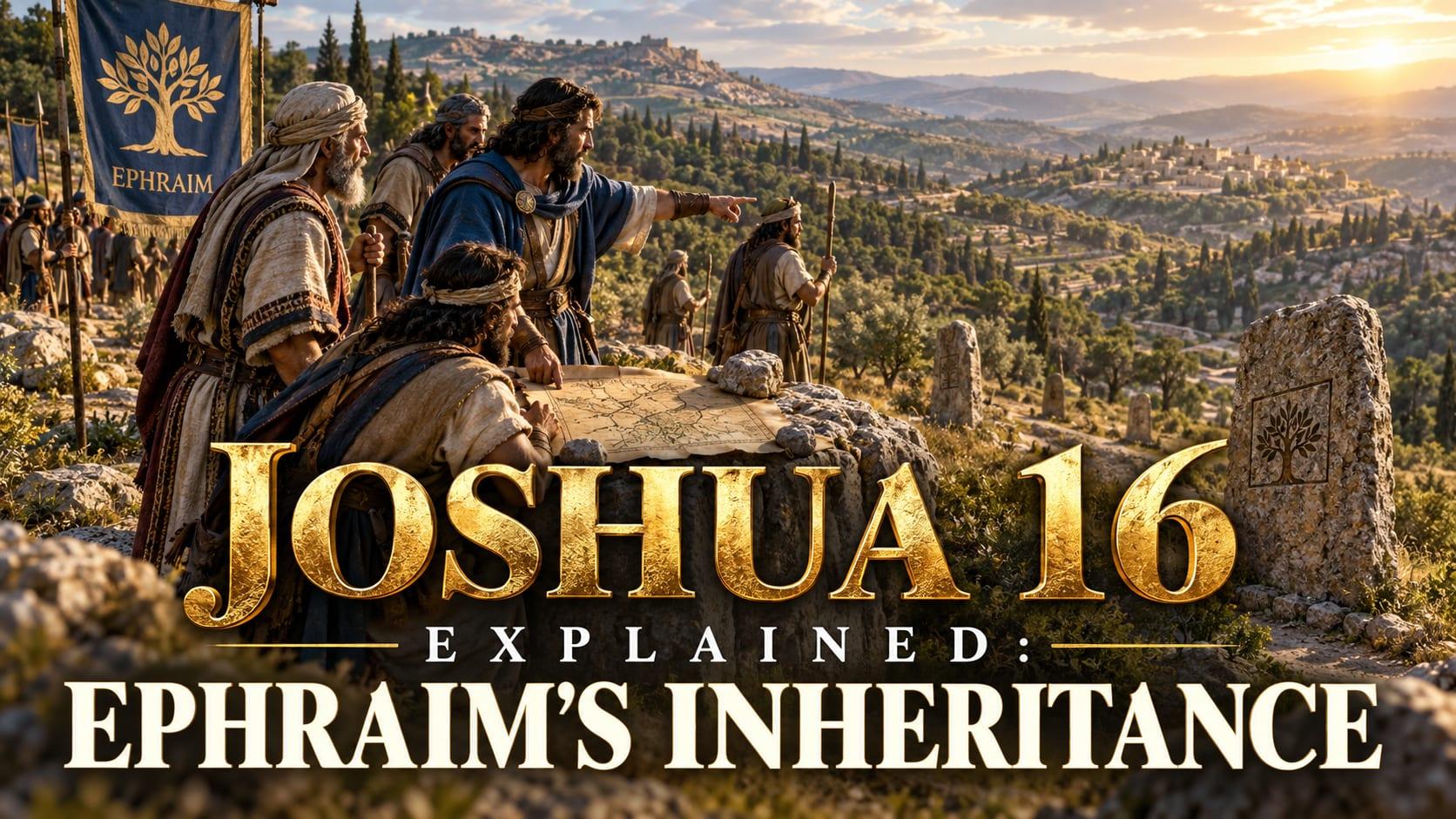
📖 Joshua 16 Explained: Ephraim's Border and Gezer's Canaanites
Ten verses. One tribe. A border Joshua himself belonged to.
Joshua 16 explained is the shortest land chapter so far in the book, and the most personal one. This is where the sons of Joseph receive their lot, where the text pauses to trace Ephraim's own border, and where a famous Bible leader turns out to be dividing out the very tribe he himself was born into.
Maybe you have finished a big job and the smallest leftover piece is the one nobody wants to touch.
- ❓ Why are Ephraim and Manasseh handled together before the text splits them apart?
- ❓ Was Joshua personally connected to the tribe this chapter describes?
- ❓ Why does Ephraim end up owning cities sitting inside Manasseh's own territory?
- ❓ Why does a short border chapter end on a city Ephraim never actually took?
📌 The man leading this whole division was, by birth, a member of the very tribe this chapter describes.
This walkthrough moves through the whole chapter in order: the shared lot for Joseph's sons, the specific line Ephraim's border follows, the odd detail of Ephraim holding cities inside Manasseh's ground, and the one Canaanite city that stayed standing long after this chapter closed.
Ten verses rarely carry this much, but this chapter does.
What Happened Just Before This Chapter
Joshua 15 gave Judah the largest inheritance recorded in the book, traced its border in detail, and still closed by admitting one city, Jerusalem, that Judah never actually took from the Jebusites living inside it.
Joshua 16 moves to the next tribe in line, the descendants of Joseph, and starts the same way Judah did: a border traced with care. But where Judah's chapter stretched to 63 verses, Joseph's sons get a fraction of that space before the text splits their land between Ephraim and the half tribe of Manasseh.

Joshua 16 Explained Verse by Verse
1. One Lot for Both Sons of Joseph (verses 1 to 4)
The chapter opens by treating Ephraim and Manasseh as a single lot before it ever treats them as two.
"And the lot of the children of Joseph fell from Jordan by Jericho, unto the water of Jericho on the east, to the wilderness that goeth up from Jericho throughout mount Bethel,"
The border starts at the Jordan near Jericho, the first city Israel ever conquered in Canaan, and climbs west through the hill country toward Bethel.
"So the children of Joseph, Manasseh and Ephraim, took their inheritance."
📌 This verse names Manasseh before Ephraim, even though Joshua is about to spend the rest of the chapter on Ephraim alone. That order is not an accident. Manasseh was Joseph's firstborn. When Jacob blessed the two boys in Genesis 48, he deliberately crossed his hands, laid his right hand on the younger Ephraim instead of the firstborn Manasseh, and said plainly that the younger brother would become greater. Genesis 48:20 even records him setting "Ephraim before Manasseh" by name. This chapter is that old blessing playing out on a map: Ephraim gets its own detailed border next, while Manasseh waits one more chapter.
There is a second, quieter detail worth catching here. The man drawing this border was not a disinterested official. Numbers 13:8lists "Oshea the son of Nun" as the spy representing the tribe of Ephraim, and verse 16 of that same chapter says Moses renamed him Jehoshua, the name Joshua carries through the rest of the Bible. Joshua was an Ephraimite. The leader handing out everyone else's land was, in this chapter, finally handing out his own tribe's.
2. Ephraim's Border, Point by Point (verses 5 to 8)
With the shared lot recorded, the text narrows its focus and traces Ephraim's own line.
"And the border of the children of Ephraim according to their families was thus: even the border of their inheritance on the east side was Atarothaddar, unto Bethhoron the upper;"
"The border went out from Tappuah westward unto the river Kanah; and the goings out thereof were at the sea. This is the inheritance of the tribe of the children of Ephraim by their families."
💡 Bethhoron the upper sits on this border for a reason worth remembering. The same town, this time called "Bethhoron the nether," shows up centuries later in 1 Kings 9:17, among the cities Solomon rebuilt. A line drawn on a map in Joshua's day was still a real, named place when a king of Israel was fortifying his kingdom generations afterward.
Four markers carry the whole description: Atarothaddar on the east, Bethhoron the upper along the way, Tappuah to the river Kanah, and the Mediterranean Sea itself as the western edge. Ephraim's territory sat squarely in the central hill country, smaller than Judah's sprawling allotment but planted right in the heart of the land.
3. Ephraim's Cities Inside Manasseh's Land (verse 9)
Right after fixing Ephraim's own border, the chapter adds a detail that does not fit neatly inside that line at all.
"And the separate cities for the children of Ephraim were among the inheritance of the children of Manasseh, all the cities with their villages."
📌 Ephraim did not only receive the land inside its own border. It also received individual cities sitting inside Manasseh's territory, named separately here and listed again when Manasseh's own chapter opens. The two half brothers' land was not two clean, side by side blocks. It overlapped, city by city, the way two branches of one family often end up tangled together even after the inheritance is divided.
That tangle matches the blessing behind it. Jacob never separated the two sons entirely. He blessed them together, with one set of crossed hands, and told Joseph that both would become a people. A border with islands of the younger brother's cities sitting inside the older brother's ground is a strange way to draw a map, but it is a faithful way to keep one blessing intact.

4. Gezer: Tribute Instead of Conquest (verse 10)
The chapter's final verse does for Ephraim exactly what Joshua 15:63 just did for Judah one chapter earlier.
"And they drave not out the Canaanites that dwelt in Gezer: but the Canaanites dwell among the Ephraimites unto this day, and serve under tribute."
⚠️ Notice this is not quite the same admission Joshua 15 made about Jerusalem. The Jebusites simply kept living in Jerusalem alongside Judah. The Canaanites of Gezer stayed too, but this verse adds a phrase Joshua 15:63 never used: they "serve under tribute." Ephraim could not drive them out, but it could and did force them into forced labor and tax. An unfinished conquest still found a way to extract something from the people it could not remove.
This is also not the first time Gezer appears in the book. Joshua 10:33 already recorded "Horam king of Gezer" marching out to help Lachish, and Joshua striking him down until none of his men were left standing. A king of Gezer died on that battlefield years before this chapter was written. His city, apparently, did not fall with him, the same pattern Joshua 13 and 15 already showed at other unconquered places.
Gezer's story does not end here either. Centuries later, 1 Kings 9:16 records a king of Egypt capturing the city, burning it, and giving it as a wedding present to his own daughter when she married Solomon. Solomon then rebuilt it. Unlike Jerusalem, which an Israelite king, David, finally claimed for Israel, Gezer finally changed hands through a foreign king's gift. Even the city Ephraim could never take was not Ephraim's to finish taking.
Hard Questions Joshua 16 Raises
Does verse 10 saying Ephraim never drove the Canaanites from Gezer contradict Joshua 10:33, where the king of Gezer was already struck down? What the text says: Joshua 10:33 records Horam, king of Gezer, defeated in the field alongside Lachish's defenders. Joshua 16:10 says Ephraim could not drive the Canaanite inhabitants out of the city itself. How this fits: a king losing his army on an open battlefield and a fortified city surrendering its population are two separate events. Scripture records both as true because both happened, one after the other, years apart.
Why does this chapter name Manasseh first in verse 4, then spend every remaining verse on Ephraim instead? What the text says: verse 4 lists "Manasseh and Ephraim" in that order, then verses 5 through 10 describe Ephraim's border exclusively. How this is read: Manasseh was Joseph's firstborn by birth order, which verse 4 still respects by naming him first. But Genesis 48:20 already recorded Jacob giving Ephraim the greater blessing, and this chapter's structure, Ephraim receiving the detailed treatment while Manasseh waits for its own chapter next, reflects that reversal.
How could Ephraim legally own cities sitting inside land that belonged to Manasseh? What the text says: verse 9 states plainly that Ephraim's separate cities sat "among the inheritance of the children of Manasseh." How this is read: the two tribes descended from one father, Joseph, and the land division by lot in Joshua 14 placed the outcome outside human preference. An overlap like this reads as the two half brothers' portions staying woven together rather than two unrelated tribes sharing a border by coincidence.
Why does "serve under tribute" appear here but not in Joshua 15's account of the Jebusites in Jerusalem? What the text says: Joshua 15:63 only says the Jebusites "dwell with" Judah. Joshua 16:10 adds that the Canaanites of Gezer "serve under tribute." How this is read: both are honest admissions that conquest stopped short of full removal, but Gezer's outcome includes forced labor and taxation on top of coexistence, a harsher arrangement than Jerusalem's. Judges 1:28 and 1:29 describe this same pattern happening across several Canaanite cities once Israel grew strong enough to impose it.

Top Verses From Joshua 16
1. Joshua 16:4
"So the children of Joseph, Manasseh and Ephraim, took their inheritance."
One sentence closing out a promise that began generations earlier, when Jacob blessed Joseph's two sons with his own crossed hands in Egypt.
2. Joshua 16:5
"And the border of the children of Ephraim according to their families was thus: even the border of their inheritance on the east side was Atarothaddar, unto Bethhoron the upper;"
The opening line of a border that Joshua, an Ephraimite by birth, was tracing for the people he had grown up among before he ever led them.
3. Joshua 16:9
"And the separate cities for the children of Ephraim were among the inheritance of the children of Manasseh, all the cities with their villages."
Proof that this inheritance was never meant to be two separate, tidy halves. Joseph's two sons stayed interwoven on the map the same way they were blessed together in Egypt.
4. Joshua 16:10
"And they drave not out the Canaanites that dwelt in Gezer: but the Canaanites dwell among the Ephraimites unto this day, and serve under tribute."
The chapter's honest final line. A king of Gezer had already fallen in battle, yet his city outlasted him for generations, finally changing hands through an Egyptian king's gift rather than an Israelite conquest.
Frequently Asked Questions About Joshua 16
What happened in Joshua 16?
The children of Joseph, Ephraim and Manasseh, received their shared lot from the Jordan near Jericho westward to the sea. The chapter then traces Ephraim's specific border, notes that some of Ephraim's cities sat inside Manasseh's territory, and closes by admitting Ephraim never drove the Canaanites out of Gezer.
Was Joshua from the tribe of Ephraim?
Yes. Numbers 13:8 lists him among the twelve spies as "Oshea the son of Nun" representing Ephraim, and verse 16 says Moses renamed him Jehoshua, the name he carries for the rest of Scripture. The man dividing this land was, by birth, a member of the tribe this chapter describes.
Why does the chapter mention Manasseh and Ephraim together before separating them?
Both were sons of Joseph, so they first received one combined lot as his descendants. The text then splits off Ephraim's specific border in this chapter, with Manasseh's own detailed allotment following in Joshua 17.
Why did Ephraim get more attention than Manasseh, its older brother?
Genesis 48:20 records Jacob deliberately blessing the younger Ephraim ahead of the firstborn Manasseh, naming him first and promising his descendants would become greater. This chapter's focus on Ephraim's border reflects that same order.
What does it mean that Ephraim had cities inside Manasseh's land?
Joshua 16:9 states that some of Ephraim's separate cities and villages sat within territory that otherwise belonged to Manasseh. The two tribes' land was not cleanly divided into two blocks; it overlapped in places, reflecting how closely tied the two half brothers remained even after each received his own inheritance.
What happened at Gezer, and why could Ephraim not take it?
Joshua 16:10 says the Canaanites kept living in Gezer, forced into tribute rather than removed outright. The city's king had already been defeated in battle back in Joshua 10:33, but the fortified city itself held out. It eventually fell generations later to an Egyptian king, who gave it to his daughter as a wedding gift when she married Solomon.

Is Joshua 16:10 the same problem as Joshua 15:63 and Jerusalem?
It is the same pattern, an unconquered city sitting inside a tribe's own territory, but not an identical outcome. Jerusalem's Jebusites simply kept living there until David took the city. Gezer's Canaanites were put under tribute, a harsher arrangement, and the city changed hands through a foreign king rather than an Israelite one.
Where was Gezer located?
Gezer sat on Ephraim's western border in the lowlands between the hill country and the coastal plain, a strategic location that explains why both Canaanite kings and later Egyptian and Israelite rulers all fought to control it.
Why is Joshua 16 so much shorter than Joshua 15?
Judah received the largest tribal allotment recorded in the book, with dozens of named towns across four regions. Ephraim's smaller, more compact territory in the central hill country simply needed fewer verses to describe fully.
Final Thoughts
Joshua 16 is short enough to read in a minute, and it still carries three things worth sitting with.
📌 An old blessing can quietly reshape a new map. Jacob crossed his hands over two boys in Egypt generations earlier, and this border still followed the order he set that day.
📌 Family ties do not always draw clean lines. Ephraim's cities sitting inside Manasseh's land were not a mistake to fix. They were what staying connected actually looked like on paper.
📌 A defeated enemy is not the same as a finished fight. Gezer's king fell in battle long before this chapter closed, and the city still outlasted this entire generation of Israelites.
You are probably not tracing a tribal border this week. But you may be the one person in your own family whose place in it was decided by a choice someone else made long before you had any say in it.
So here is the one thing this chapter actually asks of you.
Take the ground you were actually given, the way Ephraim did, instead of waiting for every leftover Canaanite to clear out first.