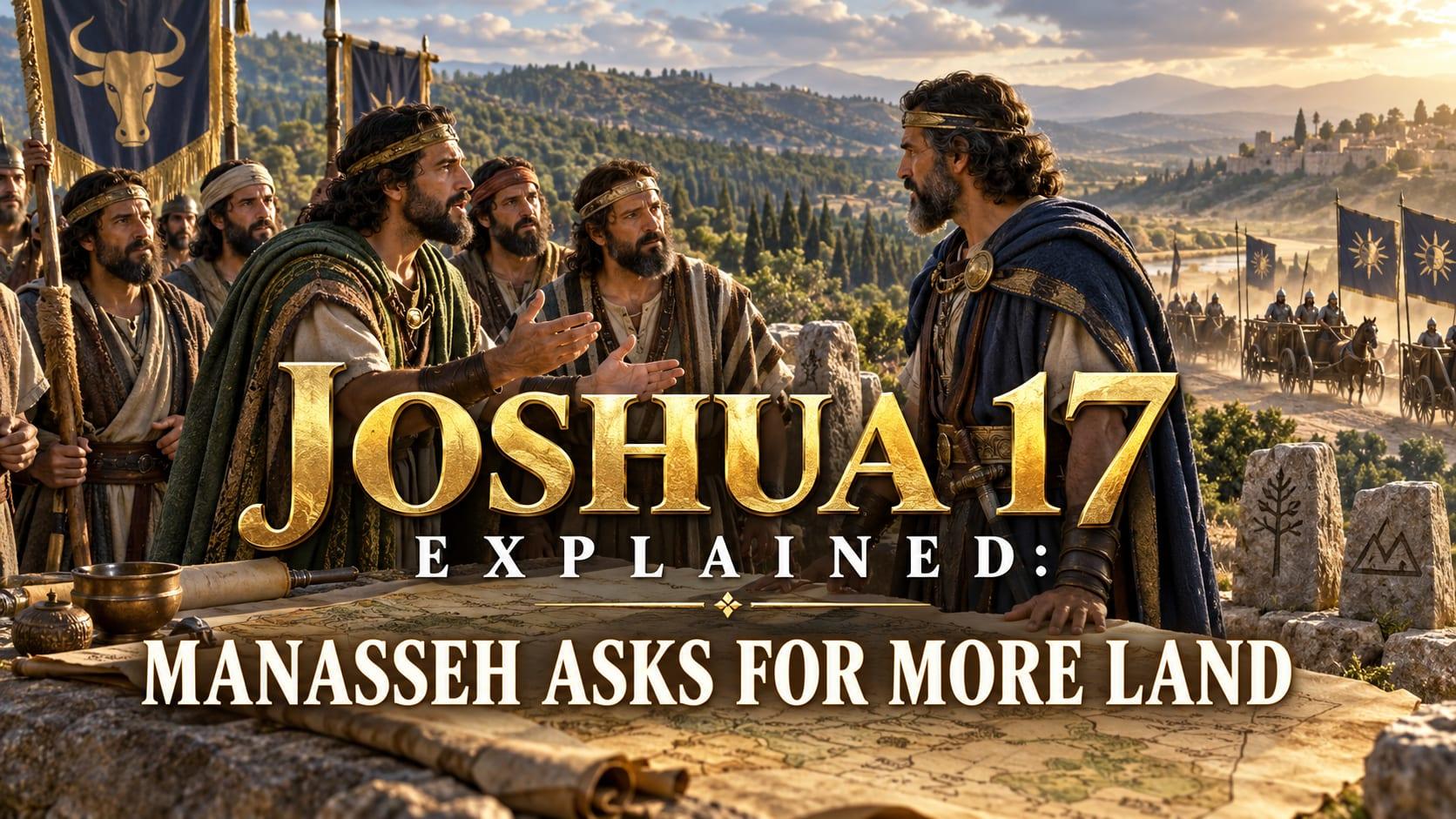
📖 Joshua 17 Explained: Zelophehad's Daughters Claim Their Land
Five sisters show up with a law their father never lived to use. A whole tribe shows up with a complaint.
Joshua 17 explained is the chapter where Manasseh, Joseph's firstborn, finally receives land on both sides of the Jordan, where five women collect on a ruling made in the wilderness years earlier, and where a tribe large enough to fill a whole territory decides their one allotment is not enough and tells Joshua so to his face.
Maybe you have watched someone claim a right that was theirs all along, only to also watch someone else complain about a fair result.
- ❓ Why does one tribe end up with land on both sides of the Jordan?
- ❓ How could five sisters with no brothers legally inherit anything in the ancient world?
- ❓ Was the sons of Joseph's complaint about their land fair, or just entitlement?
- ❓ Why does Joshua answer a complaint about not enough land by telling them to go cut down a forest?
📌 Joshua does not hand Manasseh more ground. He tells them the ground they are asking for was already theirs, and the only thing standing between them and it was their own willingness to go take it.
This walkthrough moves through the whole chapter in order: Machir's inheritance across the Jordan, Zelophehad's five daughters making their case before the priest and the leader of Israel, the border Manasseh shares with Ephraim, the Canaanite cities it could not finish taking, and the answer Joshua gives a tribe that wanted more without doing more.
Eighteen verses, and almost none of it is wasted.
What Happened Just Before This Chapter
Joshua 16 gave Ephraim its own detailed border, noted that some of Ephraim's cities sat inside the land that belonged to its brother tribe Manasseh, and closed by admitting Ephraim never fully drove the Canaanites out of Gezer.
Joshua 17 finishes what Joshua 16 started. The two sons of Joseph, crossed and blessed together by their grandfather Jacob, received one combined lot back in chapter 16. This chapter is where Manasseh, the older of the two, finally gets the specific territory that lot actually promised him, and it turns out to be scattered across two very different stretches of land.

Joshua 17 Explained Verse by Verse
1. One Family Holds Land on Both Sides of the Jordan (verses 1 and 2)
The chapter opens by singling out one branch of Manasseh before it ever gets to the rest of the tribe.
"There was also a lot for the tribe of Manasseh; for he was the firstborn of Joseph; to wit, for Machir the firstborn of Manasseh, the father of Gilead: because he was a man of war, therefore he had Gilead and Bashan."
📌 Machir's family already had their inheritance settled before Israel ever crossed the Jordan into Canaan. Moses gave Gilead and Bashan to half of Manasseh's tribe years earlier, specifically because Machir's descendants fought for it as men of war. That land is called Bashan for a reason worth knowing: Deuteronomy 3:11 and 13 call it "the land of giants," the former kingdom of Og, a king so large that Deuteronomy describes his iron bed as thirteen and a half feet long. Manasseh did not merely receive leftover ground east of the river. It received the defeated giant king's own territory.
"There was also a lot for the rest of the children of Manasseh by their families; for the children of Abiezer, and for the children of Helek, and for the children of Asriel, and for the children of Shechem, and for the children of Hepher, and for the children of Shemida: these were the male children of Manasseh the son of Joseph by their families."
Six named family lines, all descended from Gilead, all waiting for their own ground west of the Jordan in Canaan itself. Machir's branch had already settled. These six had not, and the rest of the chapter belongs to them.
2. Five Sisters Collect on an Old Ruling (verses 3 to 6)
One of those six names, Hepher, had a son named Zelophehad who died in the wilderness without a single son of his own. That should have ended his family's claim to any inheritance at all.
"But Zelophehad, the son of Hepher, the son of Gilead, the son of Machir, the son of Manasseh, had no sons, but daughters: and these are the names of his daughters, Mahlah, and Noah, Hoglah, Milcah, and Tirzah."
"And they came near before Eleazar the priest, and before Joshua the son of Nun, and before the princes, saying, The LORD commanded Moses to give us an inheritance among our brethren. Therefore according to the commandment of the LORD he gave them an inheritance among the brethren of their father."
📌 These five sisters, Mahlah, Noah, Hoglah, Milcah, and Tirzah, are not asking Joshua for a favor. They are holding him to a law already on the books. Years before, the same five women had stood before Moses in the wilderness and made the identical case:
"Why should the name of our father be done away from among his family, because he hath no son? Give unto us therefore a possession among the brethren of our father."
God answered through Moses in Numbers 27, establishing that a daughter inherits when there is no son, so a family's name and portion do not vanish simply because it produced no male heir. Numbers 36 later added a safeguard: the daughters had to marry within their own tribe, so the land would stay with Manasseh instead of transferring to whichever tribe they married into. By the time Joshua 17 opens, that ruling is years old and has never actually been applied, because Israel had no land in Canaan yet to apply it to. These five women are the first people in history to collect on it.
💡 A right granted in the wilderness is not the same as a right received. Someone still had to show up, years later, in front of the people now in charge, and ask for exactly what had already been promised.
"And there fell ten portions to Manasseh, beside the land of Gilead and Bashan, which were on the other side Jordan; Because the daughters of Manasseh had an inheritance among his sons: and the rest of Manasseh's sons had the land of Gilead."
The text does not break down exactly how the ten portions divided among the six family lines and five sisters, and nothing here should be guessed at beyond what it plainly says. What it does say plainly is enough: because of these daughters, the land divided differently than it would have if Zelophehad's line had simply disappeared for lack of a son.
3. A Border That Shares Cities With Its Own Brother (verses 7 to 10)
With the inheritance question settled, the text turns to Manasseh's actual border in Canaan.
"And the coast of Manasseh was from Asher to Michmethah, that lieth before Shechem; and the border went along on the right hand unto the inhabitants of Entappuah."
"Now Manasseh had the land of Tappuah: but Tappuah on the border of Manasseh belonged to the children of Ephraim; And the coast descended unto the river Kanah, southward of the river: these cities of Ephraim are among the cities of Manasseh."
⚠️ Notice the arrangement runs in the opposite direction from Joshua 16. There, Ephraim held separate cities sitting inside land that belonged to Manasseh. Here, the town of Tappuah sits on Manasseh's own border yet belongs to Ephraim. The two half brothers' territory was not a clean line drawn once and left alone. It threaded back and forth, each one holding pieces inside the other's ground, the same way their father Joseph raised Machir's own children on his knees according to Genesis 50:23, long before either boy had a border to call his own.
"Southward it was Ephraim's, and northward it was Manasseh's, and the sea is his border; and they met together in Asher on the north, and in Issachar on the east."
4. Three Districts Manasseh Could Not Finish Taking (verses 11 to 13)
Beyond its own border, Manasseh also held cities inside the land of two other tribes, Issachar and Asher.
"And Manasseh had in Issachar and in Asher Bethshean and her towns, and Ibleam and her towns, and the inhabitants of Dor and her towns, and the inhabitants of Endor and her towns, and the inhabitants of Taanach and her towns, and the inhabitants of Megiddo and her towns, even three countries."
Six named cities, grouped by the text into three districts. The next verse admits what actually happened to them.
"Yet the children of Manasseh could not drive out the inhabitants of those cities; but the Canaanites would dwell in that land. Yet it came to pass, when the children of Israel were waxen strong, that they put the Canaanites to tribute, but did not utterly drive them out."
📌 This is not a one time admission that quietly disappears from the record. Judges 1:27 and 28 repeats almost this exact wording generations later, naming the same cities, Bethshean, Taanach, Dor, Ibleam, and Megiddo, still Canaanite, still paying tribute rather than being removed. What Joshua 17 records as an unfinished task, Judges records as a condition that simply never got finished at all.
5. "Why Hast Thou Given Me But One Lot" (verse 14)
Right after the border is finished, the tribe that just received all of this turns around and objects.
"And the children of Joseph spake unto Joshua, saying, Why hast thou given me but one lot and one portion to inherit, seeing I am a great people, forasmuch as the LORD hath blessed me hitherto?"
⚠️ Read what the complaint actually rests on. Not injustice. Not a broken promise. The sons of Joseph argue that their own size and God's own blessing on them entitle them to more than they were given. It is the complaint of people who have already received a great deal, arguing from their own success that they deserve still more, directed at the very man who had just spent two chapters dividing out everyone else's ground fairly.
The irony sits right inside the same chapter. Five daughters with no legal claim at all had to ask for an inheritance and prove their case from an old ruling. A tribe that already held a large, fertile combined lot asks for more simply because it is large. One request came from genuine need. The other came from appetite.

6. The Mountain Is Yours If You Clear It (verses 15 to 18)
Joshua does not simply hand over more conquered ground. He points them at ground nobody has cleared yet.
"And Joshua answered them, If thou be a great people, then get thee up to the wood country, and cut down for thyself there in the land of the Perizzites and of the giants, if mount Ephraim be too narrow for thee."
💡 Joshua turns their own word back on them. They called themselves a great people. He answers, then act like one, and go cut down the forest yourselves. The word "giants" here echoes Bashan, the land Machir's family already held across the Jordan, but this forest sits in central Canaan, not Bashan, a separate stretch of wooded hill country still needing to be cleared by hand before it could be farmed or settled.
The sons of Joseph push back with their real objection, and it is not really about the forest.
"And the children of Joseph said, The hill is not enough for us: and all the Canaanites that dwell in the land of the valley have chariots of iron, both they who are of Bethshean and her towns, and they who are of the valley of Jezreel."
⚠️ Iron chariots were not an imagined excuse. Generations later, Judges 4:3 records Jabin, king of Canaan, oppressing Israel for twenty years with nine hundred chariots of iron, commanded by Sisera, in this very region. The fear the sons of Joseph raised here was not cowardice. It was an accurate read of a real, dangerous enemy that would in fact go on to crush Israel for two decades before Deborah and Barak finally broke it.
"And Joshua spake unto the house of Joseph, even to Ephraim and to Manasseh, saying, Thou art a great people, and hast great power: thou shalt not have one lot only: But the mountain shall be thine; for it is a wood, and thou shalt cut it down: and the outgoings of it shall be thine: for thou shalt drive out the Canaanites, though they have iron chariots, and though they be strong."
📌 Joshua does not dismiss the danger. He acknowledges the iron chariots are real and tells them to drive the Canaanites out anyway. The land was never going to be handed over cleared, safe, and ready. Having great power, by Joshua's own words, is not something you wait to be given more of. It is something you prove by using the power you already have on the hard ground still in front of you.
Hard Questions Joshua 17 Raises
Was the complaint in verse 14 legitimate, or was it simply greed? What the text says: the sons of Joseph argue from their size and God's blessing that one lot was not enough. How this is read: Joshua does not rebuke them for asking, and he does not call it sin. He also does not simply give them more. His answer redirects the real issue: the problem was never the size of their allotment. It was that part of it, the wooded hill country and the Canaanite valley towns, still had to be taken by their own effort rather than received finished.
Do Joshua 17:3 and 4 mean women could generally inherit land under Mosaic law? What the text says: Zelophehad's five daughters received their father's portion specifically because he died with no sons. Numbers 27's ruling applies to that exact situation, a family with no male heir, and Numbers 36 required the daughters to marry inside their own tribe so the land stayed with Manasseh. This is a narrow, specific provision for a specific case, not a general replacement of inheritance passing through sons.
Does Joshua 17:12 and 13 admitting Manasseh could not drive out the Canaanites contradict Joshua 21:43 through 45, which says God gave Israel all the land and it rested from war? What the text says: Joshua 21 describes the overall campaign as complete, the land given as promised. Joshua 17, like Joshua 13, 15, and 16 before it, lists specific cities still holding Canaanite residents. How this fits: the nationwide military campaign that broke organized Canaanite resistance had ended, but individual walled cities inside already allotted tribal land were left for each tribe to finish clearing on its own. Judges 1 shows several tribes, including Manasseh, never completing that second stage.
Are the "giants" of verse 15 the same Anakim that Caleb drove out of Hebron in Joshua 14? What the text says: Joshua 17:15 names "the Perizzites and the giants" in the wooded hill country of central Canaan, a different region from Hebron in the south. How this is read: Scripture does not say these two groups are the same clan. Deuteronomy 3:11 and 13 already used the word "giants" for the Rephaim of Bashan, defeated by Og and given to Machir's branch of Manasseh in verse 1 of this very chapter. The safest reading is that "giants" names a type of formidable, large people remembered in more than one part of Canaan, not necessarily one single family group.

Top Verses From Joshua 17
1. Joshua 17:4
"And they came near before Eleazar the priest, and before Joshua the son of Nun, and before the princes, saying, The LORD commanded Moses to give us an inheritance among our brethren."
Five sisters holding the nation's leaders to a promise made years earlier in the wilderness, and receiving exactly what had already been commanded.
2. Joshua 17:14
"Why hast thou given me but one lot and one portion to inherit, seeing I am a great people, forasmuch as the LORD hath blessed me hitherto?"
A complaint built entirely out of the tribe's own size and blessing, aimed at a leader who had just finished dividing the land fairly.
3. Joshua 17:17 and 18
"Thou art a great people, and hast great power: thou shalt not have one lot only: But the mountain shall be thine; for it is a wood, and thou shalt cut it down: and the outgoings of it shall be thine: for thou shalt drive out the Canaanites, though they have iron chariots, and though they be strong."
Joshua's answer to entitlement: the ground is already theirs, iron chariots and all. What is missing is not land. It is the will to go take it.
4. Joshua 17:12 and 13
"Yet the children of Manasseh could not drive out the inhabitants of those cities; but the Canaanites would dwell in that land."
An honest line that Judges 1:27 repeats almost word for word generations later, proof that an unfinished conquest does not quietly fix itself over time.
Frequently Asked Questions About Joshua 17
What happened in Joshua 17?
Manasseh received its inheritance in two parts: Gilead and Bashan across the Jordan for Machir's family, and territory in central Canaan for the rest of the tribe. Zelophehad's five daughters claimed their father's portion, Manasseh's border and shared cities with Ephraim were recorded, several Canaanite cities remained unconquered, and the sons of Joseph complained to Joshua that one lot was not enough.
Who was Zelophehad, and why do his daughters matter in Joshua 17?
Zelophehad was a descendant of Manasseh who died in the wilderness with no sons, only five daughters. Numbers 27 recorded God's ruling that daughters inherit when there is no son, and Joshua 17:3 and 4 shows those same five women, Mahlah, Noah, Hoglah, Milcah, and Tirzah, finally collecting on that ruling once Israel actually possessed land to divide.
Why did the tribe of Manasseh get land on both sides of the Jordan?
Machir, Manasseh's firstborn, and his descendants fought as men of war and received Gilead and Bashan east of the Jordan under Moses, before Israel ever crossed into Canaan. The rest of Manasseh's family lines then received separate territory west of the Jordan, splitting one tribe across two regions.
Does Joshua 17 mean women could inherit land in ancient Israel?
In this specific case, yes. Numbers 27 established that a daughter inherits her father's portion when he leaves no son, and Joshua 17 shows that ruling actually carried out in Canaan. Numbers 36 added the condition that such daughters marry within their own tribe, keeping the land inside Manasseh rather than passing to another tribe through marriage.
Why did the sons of Joseph complain about their land in Joshua 17:14?
They argued that their large population and God's evident blessing on them entitled them to more than the one combined lot Ephraim and Manasseh had received. The chapter does not treat this as injustice corrected, but as a complaint Joshua answers by pointing them toward land they had not yet bothered to clear themselves.
What was Joshua's answer to that complaint?
Joshua told them the wooded hill country and the Canaanite valley towns were already theirs to take. If they were truly a great people with great power, as they claimed, they could prove it by cutting down the forest and driving out the Canaanites themselves, iron chariots included.
What were the iron chariots mentioned in Joshua 17:16?
They belonged to Canaanite cities in the valley of Jezreel, including Bethshean. Judges 4:3 later records Jabin, king of Canaan, oppressing Israel for twenty years using nine hundred iron chariots from this same region, confirming the threat the sons of Joseph named here was real and eventually came to pass.
Did Manasseh ever drive the Canaanites out of Bethshean, Taanach, Dor, Ibleam, and Megiddo?
Joshua 17:12 says it could not at the time. Judges 1:27 and 28 repeats the same report generations later, naming the same cities still inhabited by Canaanites paying tribute rather than being removed, showing the task recorded as unfinished in Joshua was still unfinished when Judges was written.
Who was Machir, and why did he receive Gilead and Bashan?
Machir was Manasseh's firstborn son. Genesis 50:23 says his children were raised on Joseph's own knees. Joshua 17:1 says his descendants received Gilead and Bashan specifically because they were men of war, land that Deuteronomy 3:13 identifies as the former kingdom of the giant king Og.
Why does Joshua 17 mention Ephraim's border inside Manasseh's chapter?
Verses 8 and 9 note that the town of Tappuah sat on Manasseh's border but belonged to Ephraim. The two brother tribes' territories overlapped in both directions, Ephraim holding ground inside Manasseh in Joshua 16 and Manasseh's border touching Ephraim's city here, reflecting how closely the two sons of Joseph remained tied even after their land was divided.
Final Thoughts
Joshua 17 puts two very different requests side by side, and the contrast is the whole point.
📌 A promise only becomes real when someone shows up to claim it. Zelophehad's daughters did not receive their inheritance automatically just because Numbers 27 had already ruled in their favor. They had to stand in front of Eleazar and Joshua and ask for exactly what was already theirs.
📌 Being blessed is not the same as being owed more. The sons of Joseph used their own size and God's own blessing as the basis for a complaint, and Joshua's answer quietly exposed the real issue: they already had more ground than they had bothered to clear.
📌 A real danger is not an excuse to stop. The iron chariots the sons of Joseph feared were not imaginary. Joshua told them to go fight anyway, because having power only means something once you use it on the hard ground in front of you.
You probably are not facing iron chariots this week. But you likely have something you have been calling impossible that you have not actually tried to clear yet.
So here is the one thing this chapter actually asks of you.
Stop asking for a bigger lot, and go cut down the one patch of forest still standing between you and the ground you already have.