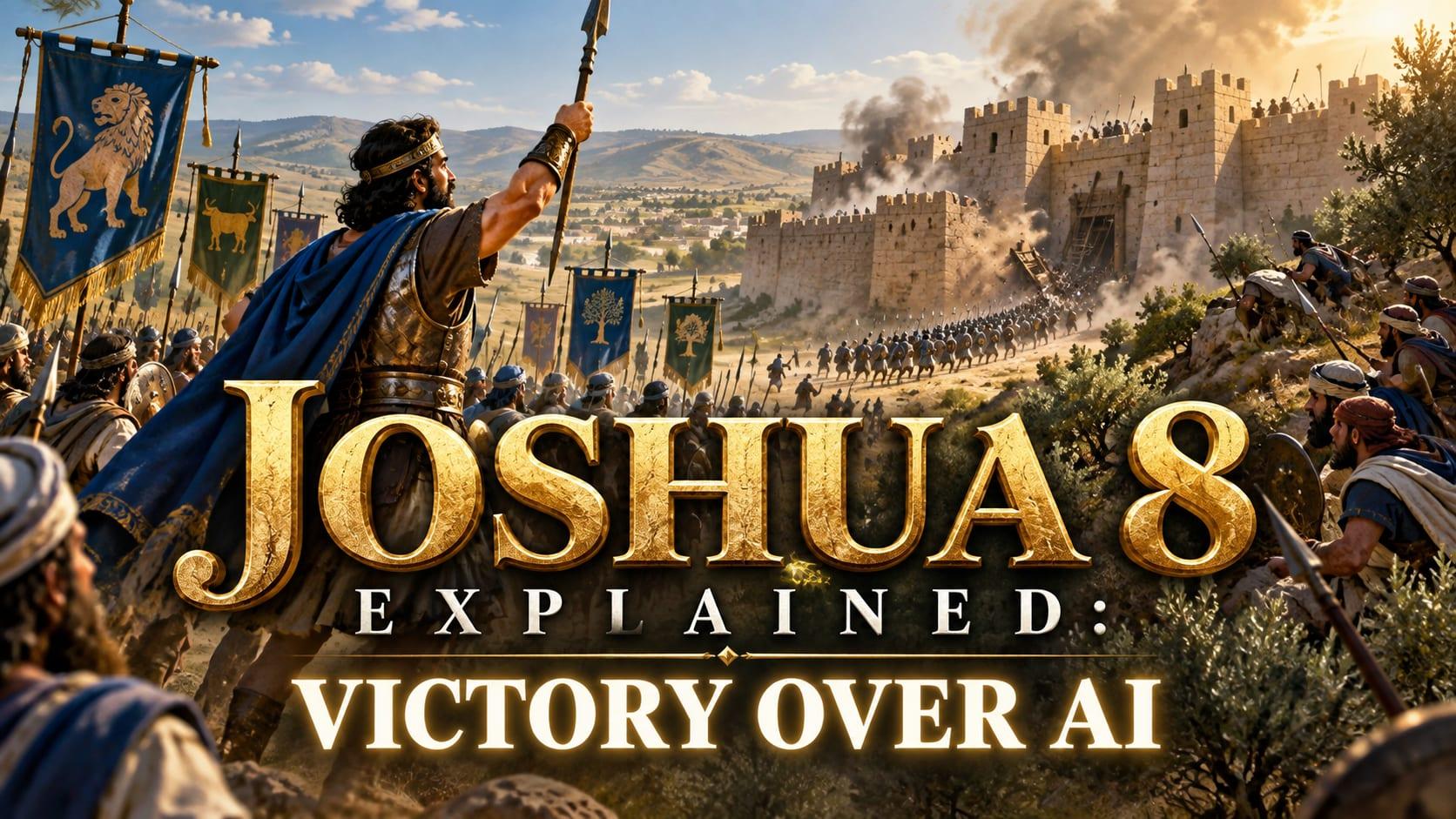
📖 Joshua 8 Explained: The Ambush at Ai and the Altar on Ebal
Same city. Same soldiers. A completely different outcome.
Joshua 8 explained is the record of Israel's second try at Ai, the city that sent them running in the chapter before this one. This time there is no careless overconfidence and no hidden sin sitting under a tent floor. There is a careful ambush, a burning city, and then something nobody would expect right after a battle: Joshua stops the whole nation to build an altar and read the entire law out loud, to everyone, down to the children.
Maybe you know what it feels like to be handed a second shot at something that beat you the first time.
- ❓ Why does God send Israel straight back to the exact city that already defeated them once?
- ❓ Why does the chapter mention two different ambush numbers, thirty thousand men and then five thousand?
- ❓ How does a fake retreat talk the entire army of Ai into leaving its own gate wide open?
- ❓ Why does Joshua stop a conquering army to build an altar and read the whole law of Moses out loud?
📌 The first word God speaks in this chapter is "fear not." The last thing Joshua does in this chapter is read every single blessing and curse Moses ever wrote down.
Here is the chapter worked through in order: the command to go back, the ambush laid out step by step, the decoy retreat that pulls Ai's whole army away from its own city, the spear that signals the trap, the burning, the destruction, and the altar Israel builds before it does anything else with its victory.
Take your time with the second half. It changes what the whole battle was actually for.
What Happened Just Before This Chapter
Joshua 7 explained why Israel lost thirty six men to a city barely worth mentioning. Achan had buried stolen silver and gold under his own tent, and the LORD withheld His presence from the whole camp until that one hidden theft was dragged into the open and dealt with. The chapter ended with judgment carried out in a valley and one short, important sentence.
"And they raised over him a great heap of stones unto this day. So the LORD turned from the fierceness of his anger. Wherefore the name of that place was called, The valley of Achor, unto this day."
Sin is removed. Anger has turned. The question left hanging at the end of chapter 7 is simple. Can Israel actually beat Ai now that the real problem is gone. Chapter 8 answers it in the very first verse, and it answers with the one thing Joshua needed to hear most.

Joshua 8 Explained Verse by Verse
1. Fear Not, Go Back (verses 1 and 2)
God does not send Israel anywhere new. He sends them back.
"And the LORD said unto Joshua, Fear not, neither be thou dismayed: take all the people of war with thee, and arise, go up to Ai: see, I have given into thy hand the king of Ai, and his people, and his city, and his land:"
📌 "Fear not" is not a throwaway greeting here. The last time Israel marched toward Ai, thirty six men died and the whole camp's hearts melted with fear. God opens the second attempt by naming that exact fear and shutting it down before Joshua takes a single step. He also states the outcome as already settled. The king, the people, the city, and the land are described as already given, before the army has even moved.
"And thou shalt do to Ai and her king as thou didst unto Jericho and her king: only the spoil thereof, and the cattle thereof, shall ye take for a prey unto yourselves: lay thee an ambush for the city behind it."
💡 One detail changes from Jericho. At Jericho, every animal and every scrap of silver and gold was devoted to the LORD, and Achan's theft of a small piece of it is exactly what just cost Israel so dearly. At Ai, God tells Israel plainly that the cattle and the plunder now belong to them. There is no repeat trap waiting inside this command. What was forbidden at Jericho is permitted here, stated out loud so nobody has to guess.
2. A Plan Built Around a Lie the Enemy Will Believe (verses 3 to 8)
Joshua does not simply march on Ai a second time with a bigger crowd. He builds a trap.
"So Joshua arose, and all the people of war, to go up against Ai: and Joshua chose out thirty thousand mighty men of valour, and sent them away by night."
"And he commanded them, saying, Behold, ye shall lie in wait against the city, even behind the city: go not very far from the city, but be ye all ready:"
Joshua tells this detachment exactly what the rest of the army is about to do, so the ambush knows precisely when to move.
"And I, and all the people that are with me, will approach unto the city: and it shall come to pass, when they come out against us, as at the first, that we will flee before them, (For they will come out after us) till we have drawn them from the city; for they will say, They flee before us, as at the first: therefore we will flee before them."
"Then ye shall rise up from the ambush, and seize upon the city: for the LORD your God will deliver it into your hand. And it shall be, when ye have taken the city, that ye shall set the city on fire: according to the commandment of the LORD shall ye do. See, I have commanded you."
📌 The plan runs entirely on Ai's own memory. "As at the first" appears twice in the span of two verses. Ai's men already beat Israel once by chasing a fleeing army out from the city gate, and Joshua is counting on them to try the exact same thing again, confident it will work a second time. A victory can make an enemy predictable. Joshua turns Ai's own success against it.
⚠️ This is not the same thing as the lie Rahab told the king of Jericho to protect two spies. Rahab's deception was her own choice, made under pressure, and Christians still debate how to weigh it. The retreat in this chapter is a battlefield tactic, commanded directly by God through Joshua, aimed at an armed enemy in open war, not at an individual being asked a direct question. Scripture treats military strategy against a warring nation very differently than it treats personal honesty between people.

3. Two Numbers for One Ambush (verses 9 to 13)
The troops move into position, and the chapter gives a detail that has puzzled careful readers for a long time.
"Joshua therefore sent them forth: and they went to lie in ambush, and abode between Bethel and Ai, on the west side of Ai: but Joshua lodged that night among the people."
"And Joshua rose up early in the morning, and numbered the people, and went up, he and the elders of Israel, before the people to Ai. And all the people, even the people of war that were with him, went up, and drew nigh, and came before the city, and pitched on the north side of Ai: now there was a valley between them and Ai."
"And he took about five thousand men, and set them to lie in ambush between Bethel and Ai, on the west side of the city."
⚠️ Verse 3 already said thirty thousand men were sent to lie in wait. Verse 12 now says five thousand men were placed in ambush, west of the city. Both numbers describe troops on the same side of Ai, doing the same job. This is one of the genuinely hard details in this chapter, and it is worth sitting with honestly rather than smoothing over. More on it below.
What is clear either way is the shape of the trap. One large force hides to the west, between Bethel and Ai. The main army, with Joshua himself, camps in plain sight to the north, right where Ai's watchmen can see every tent.
4. Ai Takes the Bait (verses 14 to 17)
The king of Ai sees an army he has already beaten once, and he does not hesitate.
"And it came to pass, when the king of Ai saw it, that they hasted and rose up early, and the men of the city went out against Israel to battle, he and all his people, at a time appointed, before the plain; but he wist not that there were liers in ambush against him behind the city."
💡 "He wist not" means he did not know. Those three words are the whole battle in miniature. Everything that follows only works because the king of Ai is confident he already understands exactly how this fight goes.
"And Joshua and all Israel made as if they were beaten before them, and fled by the way of the wilderness."
"And all the people that were in Ai were called together to pursue after them: and they pursued after Joshua, and were drawn away from the city."
"And there was not a man left in Ai or Bethel, that went not out after Israel: and they left the city open, and pursued after Israel."
📌 Not a man left behind, in either city. The decoy works better than the plan even needed. Both Ai and Bethel empty out completely, chasing a retreat that is not real, leaving the gate standing wide open for exactly the force that is lying in wait for it.

5. The Spear Signal and the City on Fire (verses 18 to 23)
The trap needs one more thing before it can close. A signal.
"And the LORD said unto Joshua, Stretch out the spear that is in thy hand toward Ai; for I will give it into thine hand. And Joshua stretched out the spear that he had in his hand toward the city."
"And the ambush arose quickly out of their place, and they ran as soon as he had stretched out his hand: and they entered into the city, and took it, and hasted and set the city on fire."
A raised spear, visible from a distance, tells a hidden army exactly when to move. The timing is not left to guesswork or a shout across a battlefield. God names the moment Himself.
"And when the men of Ai looked behind them, they saw, and, behold, the smoke of the city ascended up to heaven, and they had no power to flee this way or that way: and the people that fled to the wilderness turned back upon the pursuers."
"And when Joshua and all Israel saw that the ambush had taken the city, and that the smoke of the city ascended, then they turned again, and slew the men of Ai."
"And the other issued out of the city against them; so they were in the midst of Israel, some on this side, and some on that side: and they smote them, so that they let none of them remain or escape."
⚠️ Look at where Ai's army ends up. The decoy force turns around at the smoke signal, the ambush force pours out of the burning city behind them, and the men of Ai are trapped between both, on this side and on that side, with nowhere left to run. The same retreat they chased is now closing on them from the front while their own burning city closes on them from behind.
"And the king of Ai they took alive, and brought him to Joshua."
6. Twelve Thousand, and a City Made a Heap Forever (verses 24 to 29)
The chapter does not soften what the victory actually cost Ai.
"And it came to pass, when Israel had made an end of slaying all the inhabitants of Ai in the field, in the wilderness wherein they chased them, and when they were all fallen on the edge of the sword, until they were consumed, that all the Israelites returned unto Ai, and smote it with the edge of the sword."
"And so it was, that all that fell that day, both of men and women, were twelve thousand, even all the men of Ai."
"For Joshua drew not his hand back, wherewith he stretched out the spear, until he had utterly destroyed all the inhabitants of Ai."
⚠️ Verse 25 says the dead were "both of men and women," then in the same breath calls that number "all the men of Ai." That is the text's own wording, not a simplification added later. It confirms the destruction was total, reaching the entire population of the city, not only its fighting men. This is a hard verse, and it belongs in the hard questions section below rather than explained away here.
"Only the cattle and the spoil of that city Israel took for a prey unto themselves, according unto the word of the LORD which he commanded Joshua."
"And Joshua burnt Ai, and made it an heap for ever, even a desolation unto this day."
"And the king of Ai he hanged on a tree until eventide: and as soon as the sun was down, Joshua commanded that they should take his carcase down from the tree, and cast it at the entering of the gate of the city, and raise thereon a great heap of stones, that remaineth unto this day."
💡 Jericho was cursed, never to be rebuilt by anyone again. Ai is simply described as "an heap for ever," left as a desolation. The two cities meet different ends in the same short conquest, and the king who ambushed Israel once now lies under the same kind of stone heap Israel once raised over Achan. The exact site of ancient Ai is still debated among archaeologists today, so nothing here depends on pointing to a specific ruin.

7. Before Anything Else, an Altar and the Whole Law (verses 30 to 35)
This is the turn almost nobody expects. Israel has just won a hard fought battle, and instead of resting or pressing deeper into Canaan, Joshua stops everything.
"Then Joshua built an altar unto the LORD God of Israel in mount Ebal, As Moses the servant of the LORD commanded the children of Israel, as it is written in the book of the law of Moses, an altar of whole stones, over which no man hath lift up any iron: and they offered thereon burnt offerings unto the LORD, and sacrificed peace offerings."
📌 This was not Joshua's own idea. "As Moses the servant of the LORD commanded" points directly back to an instruction Moses gave years earlier, before Israel had even crossed the Jordan, in Deuteronomy 27. An altar of uncut stones, untouched by any iron tool, is the same kind of plain, unimproved altar God asked for back in the law given through Moses. Joshua is not improvising a victory celebration. He is finishing a command that has been waiting since before this generation ever set foot in Canaan.
"And he wrote there upon the stones a copy of the law of Moses, which he wrote in the presence of the children of Israel."
"And all Israel, and their elders, and officers, and their judges, stood on this side the ark and on that side before the priests the Levites, which bare the ark of the covenant of the LORD, as well the stranger, as he that was born among them; half of them over against mount Gerizim, and half of them over against mount Ebal; as Moses the servant of the LORD had commanded before, that they should bless the people of Israel."
💡 Two mountains, one standing for blessing and one for cursing, with the whole nation split between them. This exact arrangement was already planned out in detail in Deuteronomy 11, long before Israel knew where Ebal and Gerizim even were. Elders, officers, judges, native born Israelites, and foreigners living among them all stand together for this. Nobody is exempt and nobody is left out.
"And afterward he read all the words of the law, the blessings and cursings, according to all that is written in the book of the law."
"There was not a word of all that Moses commanded, which Joshua read not before all the congregation of Israel, with the women, and the little ones, and the strangers that were conversant among them."
📌 "Not a word" is the whole point of this closing scene. Achan sinned by hiding something small from the whole community. Joshua ends this chapter by making sure nothing in God's law stays hidden from anyone, including women and children who had no vote in any battle plan. The word of God, unlike stolen silver, is never meant to be kept under anyone's tent floor.
Hard Questions Joshua 8 Raises
Why does the chapter give two different ambush numbers, thirty thousand and five thousand? What the text says: verse 3 states Joshua sent thirty thousand mighty men of valour by night to lie in wait, and verse 12 separately states he took about five thousand men and set them in ambush west of the city. How this is read: some read the thirty thousand as the larger force moved out under cover of night for the whole operation, with the five thousand naming only the specific smaller unit that actually lay hidden closest to the city wall, the rest positioned farther back or folded into the main camp Joshua led to the north. Others treat it as a difficulty in the text that has never been fully resolved, possibly a copying difference in the numbers across the centuries this book was transmitted. Honest readers disagree here, and this article will not pretend otherwise.
Was it right for Israel to use a fake retreat to defeat Ai? What the text says: verses 2 and 7 both describe the ambush as God's own instruction to Joshua, not a human improvisation. How this fits the larger pattern: Scripture treats wartime strategy against an armed, warring city differently than it treats honesty between two people in ordinary life. Nothing in this chapter suggests Israelites were free to deceive one another or their neighbors generally. The tactic here is confined to a declared battle against a hostile city, commanded directly rather than chosen on Joshua's own initiative.
Why did the destruction of Ai include women, not just soldiers? What the text says: verse 25 states plainly that the fallen were "both of men and women," twelve thousand in total, calling that whole number "all the men of Ai," meaning the entire population. How Christians read it: this falls under the same conquest instructions given for the first cities taken in Canaan, treated in Scripture as a specific, time bound judgment on particular cities rather than a general rule for warfare. Many Christians still find this verse difficult to sit with, and this article will not claim it is easy. The text does not offer a tidy explanation that removes the weight of it. It only states what happened.
Why build an altar at Ebal specifically, right after a battle, instead of waiting? What the text says: verse 30 ties the timing and the location directly to an earlier command from Moses, not to anything about the battle just won. How this fits: Deuteronomy 27 and Deuteronomy 11 had already set Ebal and Gerizim as the place for this exact ceremony once Israel entered the land. Ai sits close enough to that region that the march to Ebal becomes possible for the first time right after this victory, which may be why it happens here rather than earlier.
Top Verses From Joshua 8
1. Joshua 8:1
"And the LORD said unto Joshua, Fear not, neither be thou dismayed: take all the people of war with thee, and arise, go up to Ai: see, I have given into thy hand the king of Ai, and his people, and his city, and his land:"
A defeated army gets a second command, opened with the exact words it needed most, and a victory described as already settled before a single soldier moves.
2. Joshua 8:18
"And the LORD said unto Joshua, Stretch out the spear that is in thy hand toward Ai; for I will give it into thine hand. And Joshua stretched out the spear that he had in his hand toward the city."
The exact moment the whole trap turns, timed by God rather than left to a shout or a guess across the battlefield.
3. Joshua 8:26
"For Joshua drew not his hand back, wherewith he stretched out the spear, until he had utterly destroyed all the inhabitants of Ai."
A small physical detail, a raised hand that does not lower, standing in for Joshua's full and complete obedience to the task he was given.
4. Joshua 8:34 and 35
"And afterward he read all the words of the law, the blessings and cursings, according to all that is written in the book of the law. There was not a word of all that Moses commanded, which Joshua read not before all the congregation of Israel, with the women, and the little ones, and the strangers that were conversant among them."
The real ending of the chapter. Not the battle, but every single word of God's law read out loud to everyone in the camp, nobody left out.
Frequently Asked Questions About Joshua 8
What happened in Joshua 8?
Israel defeats Ai on its second attempt, using an ambush and a fake retreat that lures the whole city out from behind its walls. The city is destroyed and burned, and Joshua then builds an altar at Mount Ebal and reads the entire law of Moses to the whole nation.
Why did Israel need an ambush this time after losing at Ai before?
The first attack in Joshua 7 failed because of Achan's hidden sin, not because of a weak plan. Once that sin was dealt with, God gave Joshua a specific strategy built around how Ai had already beaten Israel once, turning the enemy's own earlier success into the bait.
What was the spear signal in Joshua 8?
Joshua 8:18 and 19 describe God telling Joshua to stretch out a spear toward Ai. The moment he does, the hidden ambush force rises and takes the city, which means the timing of the whole battle was set by a visible signal rather than left to chance.
Why does Joshua 8 give two different numbers for the ambush force?
Verse 3 names thirty thousand men sent to lie in wait, while verse 12 separately names five thousand men placed in ambush west of the city. Interpreters read this differently, and the chapter itself does not fully resolve which number describes which part of the operation.
What happened to the king of Ai?
He was captured alive during the battle, then hanged on a tree until evening after the fighting ended. His body was then placed at the city gate under a heap of stones, the same kind of marker raised over Achan one chapter earlier.
Did women and children die in the destruction of Ai?
Joshua 8:25 states that the twelve thousand who fell that day were both men and women, describing the destruction as reaching the city's entire population. The text states this directly rather than softening it.
Why did Joshua build an altar on Mount Ebal right after the battle?
Joshua 8:30 and 31 tie the altar directly to a command Moses had already given, recorded in Deuteronomy 27, for what Israel was to do once it entered the land. The timing follows that earlier instruction rather than anything specific to the victory at Ai.
What is the significance of Mount Ebal and Mount Gerizim?
Deuteronomy 11 and Deuteronomy 27 set these two mountains as the place where Israel would hear the law's blessings and curses read, half the nation facing each mountain. Joshua 8:33 carries that plan out exactly as it was first given.
Why did Joshua read the whole law instead of just a summary?
Joshua 8:34 and 35 say there was not a single word Moses commanded that Joshua left out, read before the entire congregation, women and children included. The completeness of the reading matters as much as the reading itself.
How does Joshua 8 connect to the rest of the Bible?
The altar and the law reading directly fulfill instructions Moses gave in Deuteronomy 11 and Deuteronomy 27, years before Israel ever crossed the Jordan. The chapter shows that command finally being carried out word for word, stone by stone.
Final Thoughts
Joshua 8 is really two chapters wearing one number.
📌 A resolved failure does not guarantee an easy win, but it does open the door back to one. Israel still needed a careful plan at Ai. What changed was not the difficulty of the city. It was whether God was with them at all.
📌 The same army that hid a sin in chapter 7 reads the entire law out loud in chapter 8, in front of everyone. Hidden things and public things cannot both describe the same community for long. Israel chooses which one it will be, right after its clearest victory so far.
📌 Victory was never the finish line in this story. The altar was. Joshua does not use the win at Ai to rest or to push deeper into Canaan first. He uses it to make sure every single person, including the ones with no say in any battle, hears exactly what God actually requires.
You will not fight a battle like Ai's. But you have almost certainly had a win worth celebrating this week.
Here is the one thing this chapter actually asks of you.
Before you move on to whatever is next, stop like Joshua did, and put God's word back in front of you on purpose. Not just the part that is easy to hear. All of it.