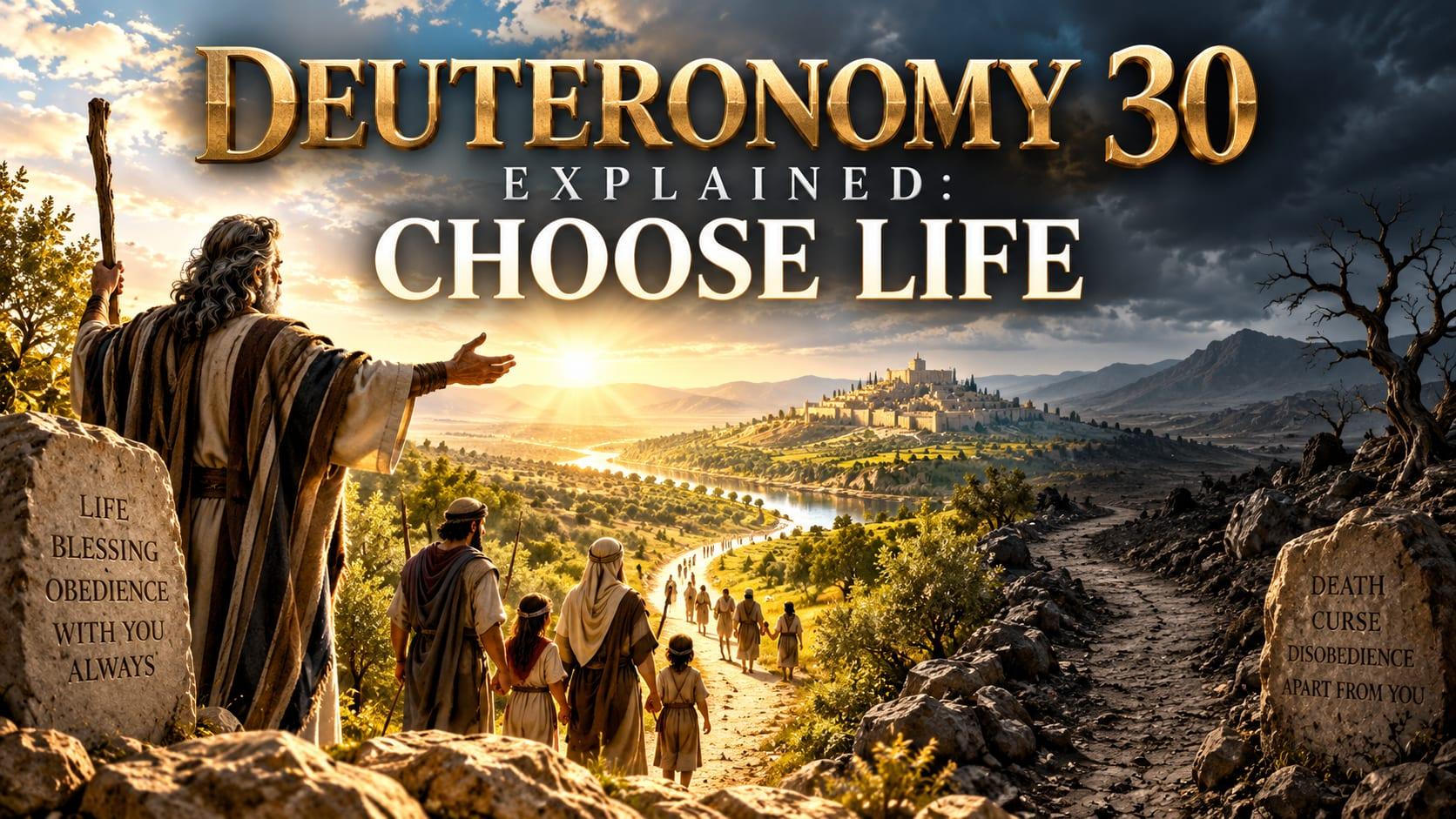
📖 Deuteronomy 30 Explained: Choose Life, Not Far Off
Moses has just spent a chapter describing exile, scattering, and a nation sold back into slavery.
Deuteronomy 30 explained is where he turns the page on all of it. This chapter promises that even after the worst of chapter 28 and chapter 29 comes true, God is not finished. He will gather Israel back from wherever they end up. He will do something to their hearts that no law code could ever force. And then Moses closes his entire speech with the plainest command in the whole book: choose life.
You may have only ever heard "choose life" quoted on its own, stripped of everything that leads up to it.
- ❓ What does it mean that God will circumcise Israel's heart?
- ❓ Why does Moses say the commandment is not too hard and not far off?
- ❓ Why does Paul quote this exact chapter centuries later in Romans?
- ❓ What is Moses actually asking Israel to choose between?
📌 Deuteronomy 30 is the hinge between everything that could go wrong in chapters 28 and 29, and the one decision that still stands open in front of Israel.
Read slowly. The verse Paul leans on hardest in Romans 10 is sitting in the middle of this chapter, doing something very different there than it does in his letter.
What Happened Just Before This Chapter
Deuteronomy 29 renewed the covenant in the land of Moab, named everyone bound by it down to the woodcutter and the water carrier, and warned that a single hidden root of idolatry could end in a devastation like Sodom and Gomorrah's. It closed on the line that the secret things belong to the LORD, while the revealed things belong to Israel, to obey.
Deuteronomy 30 picks up exactly where that warning left off, and answers a question chapter 29 never asked outright: what happens after the curse actually lands? Moses does not pretend Israel will never fail. He assumes they will, scattered among the nations exactly as Deuteronomy 28 already described, and then tells them what comes after that failure, not instead of it.

Deuteronomy 30 Explained Verse by Verse
1. Return After the Worst Has Happened (verses 1 to 3)
Moses opens by naming the exact scenario the last two chapters just finished describing.
"And it shall come to pass, when all these things are come upon thee, the blessing and the curse, which I have set before thee, and thou shalt call them to mind among all the nations, whither the LORD thy God hath driven thee,"
📌 "The blessing and the curse" is not a vague phrase. It is a direct pointer back to the fourteen verses of blessing and fifty four verses of curse Moses just finished reading. He is not introducing new material here. He is telling Israel what to do once that material stops being theory and starts being their actual life, scattered among nations that are not their own.
The condition for what happens next is stated in the very next breath.
"And shalt return unto the LORD thy God, and shalt obey his voice according to all that I command thee this day, thou and thy children, with all thine heart, and with all thy soul;"
"That then the LORD thy God will turn thy captivity, and have compassion upon thee, and will return and gather thee from all the nations, whither the LORD thy God hath scattered thee."
Notice the same root word appearing three times across these two verses, in slightly different forms: turn, return, return. Israel turns back to God, and God turns their captivity around. The exile was real and the scattering was real, but neither one is described here as the final word.
2. Gathered From the Ends of the Earth (verses 4 and 5)
Moses pushes the promise as far as it can possibly go.
"If any of thine be driven out unto the outmost parts of heaven, from thence will the LORD thy God gather thee, and from thence will he fetch thee:"
💡 "The outmost parts of heaven" is an idiom for the farthest, most unreachable edge of the horizon, not a claim about outer space. Moses is saying there is no distance Israel could be scattered to that puts them further than God is willing to go to bring them back. The promise then turns concrete.
"And the LORD thy God will bring thee into the land which thy fathers possessed, and thou shalt possess it; and he will do thee good, and multiply thee above thy fathers."
This is not a return to some generic homeland. It is the same land promised to Abraham, Isaac, and Jacob, handed back after judgment rather than kept from them permanently because of it.
3. A Heart God Circumcises Himself (verses 6 to 8)
Right after the physical return, Moses promises something that reaches deeper than geography.
"And the LORD thy God will circumcise thine heart, and the heart of thy seed, to love the LORD thy God with all thine heart, and with all thy soul, that thou mayest live."
⚠️ Earlier in this same book, Moses commanded Israel to do this themselves.
"Circumcise therefore the foreskin of your heart, and be no more stiffnecked."
Physical circumcision was the sign of the covenant God gave Abraham back in Genesis 17, a mark Israel's own hands could cut. A circumcised heart is different. Deuteronomy 10 commands it of the people. Deuteronomy 30 promises God will do it Himself. Moses does not explain the shift from command to promise, but he is not the last prophet to make it. Centuries later, Jeremiah and Ezekiel describe the same kind of inward work in almost the same breath.
"But this shall be the covenant that I will make with the house of Israel; After those days, saith the LORD, I will put my law in their inward parts, and write it in their hearts; and will be their God, and they shall be my people."
"A new heart also will I give you, and a new spirit will I put within you: and I will take away the stony heart out of your flesh, and I will give you an heart of flesh."
📌 Three prophets, three different centuries, describing the same thing: a change in the heart that the heart cannot produce for itself. Deuteronomy 30:6 is the earliest of the three, and it already says the goal of the circumcised heart is simply to love God, not to earn anything further.
Moses then promises the curses themselves will land on Israel's enemies instead.
"And the LORD thy God will put all these curses upon thine enemies, and on them that hate thee, which persecuted thee."

4. The Blessing of Chapter 28, Running Forward Again (verses 9 and 10)
Moses now echoes language that will sound familiar to anyone who just read the chapter before this one.
"And the LORD thy God will make thee plenteous in every work of thine hand, in the fruit of thy body, and in the fruit of thy cattle, and in the fruit of thy land, for good: for the LORD will again rejoice over thee for good, as he rejoiced over thy fathers:"
👀 Fruit of the body, fruit of the cattle, fruit of the land. These are the same categories that ran as curses in Deuteronomy 28:18, and here they run as blessing again, restored rather than invented new. The small word "again" matters: this is not Israel earning a brand new kind of favor. It is the same favor their fathers already had, returned to them after it was lost.
💡 "Rejoice over thee for good" also answers something Deuteronomy 28:63 never softened: God taking pleasure in Israel's ruin. Here the pleasure flips back to its original direction.
5. Not Too Hard, Not Far Off (verses 11 to 14)
Moses now turns from the distant future back to the exact moment Israel is standing in.
"For this commandment which I command thee this day, it is not hidden from thee, neither is it far off."
"It is not in heaven, that thou shouldest say, Who shall go up for us to heaven, and bring it unto us, that we may hear it, and do it? Neither is it beyond the sea, that thou shouldest say, Who shall go over the sea for us, and bring it unto us, that we may hear it, and do it?"
📌 Moses rules out the two excuses people reach for most: it is too far above me, or it is too far away from me. He is not describing the law as easy to keep perfectly. He is describing it as available, already placed in front of Israel rather than locked behind some impossible errand.
The answer to both questions lands in one short verse.
"But the word is very nigh unto thee, in thy mouth, and in thy heart, that thou mayest do it."
Paul picks up this exact verse in Romans, word for word in places, and sends it somewhere Moses never did.
"But the righteousness which is of faith speaketh on this wise, Say not in thine heart, Who shall ascend into heaven? (that is, to bring Christ down from above:) Or, Who shall descend into the deep? (that is, to bring up Christ again from the dead.) But what saith it? The word is nigh thee, even in thy mouth, and in thy heart: that is, the word of faith, which we preach;"
⚠️ Paul is not quoting Deuteronomy 30 to say the law was always secretly about faith in Christ. He borrows Moses's own phrasing, "who shall ascend," "who shall go over," and applies it to a different nearness: not the nearness of a command Israel could hear and do, but the nearness of a gospel that does not require anyone to climb to heaven or descend to the dead to reach Christ, because Christ has already come and already risen. Moses is talking about accessible instruction. Paul is talking about an accessible Savior. The verse travels a long way between those two meanings, and both uses are honest to what each writer is actually arguing.

6. Life and Death, and the Charge to Choose (verses 15 to 20)
Moses closes his entire speech, chapters back to the start of Deuteronomy, on one last stark choice.
"See, I have set before thee this day life and good, and death and evil;"
Moses had already set a version of this same choice in front of Israel earlier in the book, on the two mountains of blessing and curse. Here he narrows it one more time, down to the plainest terms a person can be handed: life, or death.
"In that I command thee this day to love the LORD thy God, to walk in his ways, and to keep his commandments and his statutes and his judgments, that thou mayest live and multiply: and the LORD thy God shall bless thee in the land whither thou goest to possess it. But if thine heart turn away, so that thou wilt not hear, but shalt be drawn away, and worship other gods, and serve them; I denounce unto you this day, that ye shall surely perish, and that ye shall not prolong your days upon the land, whither thou passest over Jordan to go to possess it."
👀 Love, walk, keep, on one side. Turn away, be drawn away, worship, serve, on the other. Neither side is passive. Moses describes life and death as the result of a direction someone actually walks in, not a fate handed down with no input from the person living it. Then comes the line that gives this chapter its most quoted phrase.
"I call heaven and earth to record this day against you, that I have set before you life and death, blessing and cursing: therefore choose life, that both thou and thy seed may live:"
📌 Calling heaven and earth to record is a legal formality, not poetry. Moses is naming permanent, unmovable witnesses to this exact moment, so that no generation after this one can claim the choice was never actually offered to them. "Choose life" sounds like a slogan on its own. In context it is the last line of a legal case Moses has been building for thirty chapters.
The final verse ties the whole choice back to the one relationship underneath it.
"That thou mayest love the LORD thy God, and that thou mayest obey his voice, and that thou mayest cleave unto him: for he is thy life, and the length of thy days: that thou mayest dwell in the land which the LORD sware unto thy fathers, to Abraham, to Isaac, and to Jacob, to give them."
💡 "He is thy life" is the real definition hiding under the whole choice. Life was never only about staying in the land. It was about God Himself being the thing a person cannot actually live without.
Hard Questions Deuteronomy 30 Raises
Who actually circumcises the heart, Israel or God? The text says both, in two different places, without resolving the tension for the reader. Deuteronomy 10:16 commands the people to circumcise their own heart. Deuteronomy 30:6 promises God will do it for them. Both verses come from the same speaker in the same book. The honest reading is that Israel is responsible to turn, while the actual change deep enough to make that turning real and lasting is something only God can finish. Jeremiah and Ezekiel pick up this exact promise centuries later and describe it as a new covenant God initiates, not a renovation Israel manages on its own.
Does "this commandment is not too hard" contradict Paul's teaching that no one can be made right with God by keeping the law? Not directly, because the two statements are answering different questions. Moses is saying the law is accessible, not hidden in heaven or across the sea, something Israel can actually hear and attempt. He is not claiming anyone who attempts it will keep it perfectly, and Deuteronomy itself spends chapters 27 through 29 assuming Israel will fail. Paul's argument in Romans and Galatians is about whether law keeping can make a person righteous before God, a separate question from whether the law's instructions were understandable. Moses says the commandment is near. Paul says nearness to a command is not the same thing as the righteousness only Christ provides.
Did the regathering promised in verses 1 to 5 happen when Israel returned from exile in Babylon? Partly, and most Bible teachers say so plainly rather than forcing a single answer. Ezra and Nehemiah record a real return to the land generations after the exile Deuteronomy 28 and 29 warned about. But Deuteronomy 30:6 promises a circumcised heart that loves God fully, and the post exile books do not describe that happening on a national scale; idolatry and compromise show up again almost immediately. That gap is why many Christians read this chapter as pointing toward something larger than the Babylonian return alone, fulfilled in part then and completed in the deeper, inward change the New Testament describes happening through Christ.

Top Verses From Deuteronomy 30
1. Deuteronomy 30:6
"And the LORD thy God will circumcise thine heart, and the heart of thy seed, to love the LORD thy God with all thine heart, and with all thy soul, that thou mayest live."
A promise that reaches past Israel's own effort, echoed centuries later almost word for word by Jeremiah and Ezekiel's new covenant prophecies.
2. Deuteronomy 30:14
"But the word is very nigh unto thee, in thy mouth, and in thy heart, that thou mayest do it."
The verse Paul later borrows in Romans 10 to describe the nearness of the gospel itself, built on Moses's original point that God's word was never locked away out of reach.
3. Deuteronomy 30:15
"See, I have set before thee this day life and good, and death and evil;"
The starkest choice in the whole book, stated in four words each, with nothing softened or left ambiguous.
4. Deuteronomy 30:19
"I call heaven and earth to record this day against you, that I have set before you life and death, blessing and cursing: therefore choose life, that both thou and thy seed may live:"
The most quoted line from this chapter, and a formal legal appeal to permanent witnesses, not a stray piece of encouragement.
5. Deuteronomy 30:20
"That thou mayest love the LORD thy God, and that thou mayest obey his voice, and that thou mayest cleave unto him: for he is thy life, and the length of thy days: that thou mayest dwell in the land which the LORD sware unto thy fathers, to Abraham, to Isaac, and to Jacob, to give them."
The real definition underneath the whole chapter's choice: not land for its own sake, but God Himself as the thing life actually depends on.
Frequently Asked Questions About Deuteronomy 30
What is Deuteronomy 30 about?
Deuteronomy 30 promises that Israel will be gathered back to the land after exile if they return to God, describes God circumcising their heart to love Him fully, declares the commandment near and doable rather than hidden away, and closes with Moses commanding Israel to choose life.
What does it mean that God will circumcise Israel's heart?
It means an inward change in affection and loyalty, not the physical sign of the covenant given in Genesis 17. Deuteronomy 10:16 commands Israel to do this themselves; Deuteronomy 30:6 promises God will do it for them, a promise Jeremiah 31 and Ezekiel 36 later repeat as part of the new covenant.
What does "the word is not far off" mean in Deuteronomy 30?
It means God's commandment was not locked away in heaven or across the sea, requiring some impossible journey to reach. Moses says it was already near Israel, in their mouth and heart, available to be heard and obeyed without excuse.
Why does Paul quote Deuteronomy 30 in Romans 10?
Paul borrows Moses's language about nearness, who shall ascend, who shall go over the sea, to describe the nearness of the gospel instead of the law. He is not saying Moses meant Christ all along; he is applying the same pattern of reasoning to a different, greater kind of access.
Did the promises in Deuteronomy 30:1 to 5 happen when Israel returned from Babylon?
Partly. Ezra and Nehemiah record a real physical return to the land, but the deeper promise of a fully circumcised, faithful heart in verse 6 does not match what actually happened afterward, since idolatry and compromise returned quickly. Many Christians see a fuller fulfillment of that part of the promise in the New Testament.
What does "choose life" mean in Deuteronomy 30:19?
It means choosing to love, obey, and stay close to God rather than turning away to other gods, stated as the final summary of the entire choice Moses has laid out across the book of Deuteronomy. It is not a general self help slogan; it is tied directly to covenant loyalty.
How is Deuteronomy 30 connected to the New Covenant?
Its promise of a circumcised heart that loves God fully is picked up almost word for word by Jeremiah's promise of a new covenant written on the heart and Ezekiel's promise of a new heart and new spirit, both describing the same kind of inward change Deuteronomy 30:6 first promises.
Why does Moses call heaven and earth to witness in Deuteronomy 30:19?
Calling heaven and earth as witnesses was a legal formality, naming permanent fixtures of creation as proof the choice was genuinely offered. It ensures no later generation could claim they were never actually given the option between life and death.
Final Thoughts
Deuteronomy 30 refuses to let the story end at exile.
📌 The worst outcome in chapter 28 is never the final word in this book. Moses promises return, regathering, and restored blessing on the far side of judgment, not instead of it.
📌 Some changes are too deep for a person to manage alone. Deuteronomy 30:6 promises God will circumcise the heart Himself, a promise Jeremiah and Ezekiel both describe again centuries later in almost the same words.
📌 The choice this chapter ends on was never out of reach. Not in heaven, not across the sea, but near enough to be in your own mouth and heart.
Here is your one next step from this chapter.
Read Deuteronomy 30:19 and 20 out loud today, and let "choose life" land the way Moses meant it: not as a motivational line, but as a real decision about who you are actually going to cleave to.