📖 Deuteronomy 33 Explained: The Blessing of Moses Before His Death
Moses just finished singing. Now, with the mountain already waiting for him, he blesses.
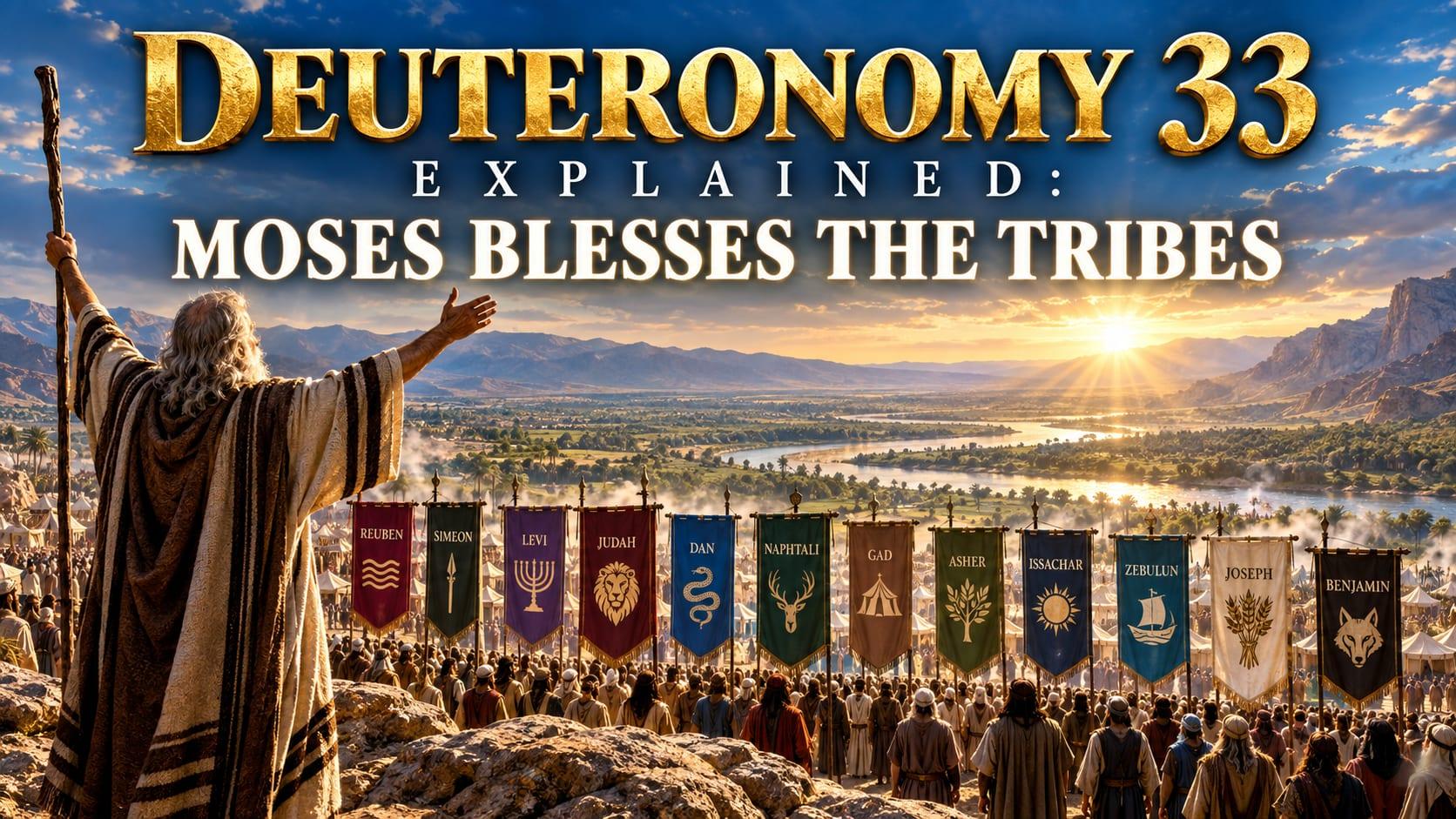
Deuteronomy 33 explained is Moses's very last public act before he climbs Nebo and dies. He goes tribe by tribe, naming Israel's twelve sons one more time, and he does not bless them all the same way. Some get a few lines. One gets the longest blessing in the whole chapter. One tribe does not get mentioned at all.
You may have skipped this chapter because it reads like a list of names.
- ❓ Why does Reuben's blessing sound more like a plea than a promise?
- ❓ Why does Levi, cursed by Jacob back in Genesis, end up the most honored tribe here?
- ❓ Why is Simeon left out of this blessing completely?
- ❓ And what does "underneath are the everlasting arms" actually mean?
📌 What Moses hands out here is not even handed. It is honest, and it is the last word Israel's twelve tribes get from the man who led all of them out of Egypt.
Walk through it slowly. By the end, a chapter that looks like a list of names turns out to be Moses settling, tribe by tribe, exactly what thirty years of watching them has taught him.
What Happened Just Before This Chapter
Deuteronomy 32 was the Song of Moses, a single piece sung to the whole nation, and it closed with God telling Moses the exact moment of his own death had arrived. "Get thee up into this mountain Abarim, unto mount Nebo," God said, and that chapter ended there, with the mountain named and the climb still ahead of him.
Moses has not climbed yet. Deuteronomy 33 is what he does in the time between hearing that instruction and obeying it. Before he leaves, he turns from singing one song to all of Israel and speaks a separate word over each tribe by name, the same way Jacob once blessed his twelve sons before his own death in Genesis 49. Two leaders, at the edge of their own deaths, give Israel's tribes their last words before someone else carries the story forward.

Deuteronomy 33 Explained Verse by Verse
1. The King Enthroned in Jeshurun (verses 1 to 5)
The chapter opens with a plain label, then moves straight into a vision of God arriving.
"And this is the blessing, wherewith Moses the man of God blessed the children of Israel before his death."
"The man of God" is a title Moses never claims for himself anywhere earlier in the book. Here, right before his death, someone finally says it plainly.
"The LORD came from Sinai, and rose up from Seir unto them; he shined forth from mount Paran, and he came with ten thousands of saints: from his right hand went a fiery law for them. Yea, he loved the people; all his saints are in thy hand: and they sat down at thy feet; every one shall receive of thy words."
Sinai, Seir, and Paran are all mountain country stretching south and east of Israel. Moses is not describing a single event. He is describing God moving across that whole region like a sunrise, arriving with an army of "saints" and a law that came from fire.
📌 Notice the order. Love comes before law in this sentence, not after it. "Yea, he loved the people" sits right next to "a fiery law for them," as if Moses wants Israel's very last memory of the law to be that it was given by someone who loved them first.
"Moses commanded us a law, even the inheritance of the congregation of Jacob. And he was king in Jeshurun, when the heads of the people and the tribes of Israel were gathered together."
💡 Israel would not crown an actual human king for generations. Moses says here that God already held that title, "king in Jeshurun," long before any throne existed. Everything that follows in this chapter is a king addressing his own tribes by name.
2. Reuben's Plea and Judah's Prayer (verses 6 and 7)
After that opening, Moses turns to the oldest son first, and the tone changes immediately.
"Let Reuben live, and not die; and let not his men be few."
That is the entire blessing on Israel's firstborn, six words asking that he merely survive. Compare it to how small Reuben had already become by the numbers. When Israel left Egypt, Reuben counted forty six thousand five hundred fighting men. By the second census, taken near the end of the wilderness years, that number had dropped to forty three thousand seven hundred thirty, a tribe shrinking while others grew.
📌 Jacob had already told Reuben, generations earlier, "thou shalt not excel." Moses is not inventing a new judgment here. He is watching an old one play out in real numbers and asking God, simply, to keep the tribe alive anyway.
Judah gets a short blessing too, but it reads as a prayer rather than a warning.
"And this is the blessing of Judah: and he said, Hear, LORD, the voice of Judah, and bring him unto his people: let his hands be sufficient for him; and be thou an help to him from his enemies."
Four short requests, and every one of them hands Judah's outcome to God instead of promising Judah strength on his own. Moses is not pretending any tribe earns its own survival.

3. Levi's Reward for Costly Loyalty (verses 8 to 11)
Then comes the tribe whose blessing changes the most since the last time anyone spoke over it.
"And of Levi he said, Let thy Thummim and thy Urim be with thy holy one, whom thou didst prove at Massah, and with whom thou didst strive at the waters of Meribah; Who said unto his father and to his mother, I have not seen him; neither did he acknowledge his brethren, nor knew his own children: for they have observed thy word, and kept thy covenant."
The Urim and Thummim were objects the high priest carried to seek God's decision on hard questions, and Massah and Meribah were the names Israel gave the place in Rephidim where they tested God over water. Moses is not praising Levi for comfort. He is praising a tribe that stayed faithful through the same hard stretches everyone else failed in.
📌 "I have not seen him, neither did he acknowledge his brethren" is not a compliment about coldness. It is a direct memory of one specific day. When Moses called out, "Who is on the LORD's side," after the golden calf, it was the sons of Levi who answered first.
"Then Moses stood in the gate of the camp, and said, Who is on the LORD's side? let him come unto me. And all the sons of Levi gathered themselves together unto him."
That obedience cost the Levites family ties and comfort that day, the exact cost Deuteronomy 33:9 is remembering. Moses closes Levi's blessing with the job that loyalty earned them.
"They shall teach Jacob thy judgments, and Israel thy law: they shall put incense before thee, and whole burnt sacrifice upon thine altar. Bless, LORD, his substance, and accept the work of his hands: smite through the loins of them that rise against him, and of them that hate him, that they rise not again."
💡 Teaching the law, carrying incense, offering sacrifice. Levi gets no land of its own later, but it gets the one job that puts a Levite in front of every single tribe, permanently.
4. Benjamin, and the Richest Blessing on Joseph (verses 12 to 17)
Benjamin's turn is brief and warm.
"The beloved of the LORD shall dwell in safety by him; and the Lord shall cover him all the day long, and he shall dwell between his shoulders."
Then Moses reaches Joseph, and the blessing stretches out longer than any other tribe gets in this chapter.
"And of Joseph he said, Blessed of the LORD be his land, for the precious things of heaven, for the dew, and for the deep that coucheth beneath,"
Heaven above, deep water below, every direction Moses can name gets called a source of Joseph's blessing. The language piles up, dew, sun, moon, ancient mountains, lasting hills, until Moses reaches the line that actually names who Joseph has become.
"And for the precious things of the earth and fulness thereof, and for the good will of him that dwelt in the bush: let the blessing come upon the head of Joseph, and upon the top of the head of him that was separated from his brethren. His glory is like the firstling of his bullock, and his horns are like the horns of unicorns: with them he shall push the people together to the ends of the earth: and they are the ten thousands of Ephraim, and they are the thousands of Manasseh."
📌 "Separated from his brethren" is the same man sold by his brothers and carried off to Egypt. By the time Moses speaks this blessing, that separation has turned into two full tribes, Ephraim and Manasseh, strong enough that Moses pictures them as horns pushing nations to the ends of the earth.

5. Six Tribes in Six Verses (verses 18 to 25)
Moses picks up the pace. Zebulun, Issachar, Gad, Dan, Naphtali, and Asher each get only a line or two, but none of it is filler.
"And of Zebulun he said, Rejoice, Zebulun, in thy going out; and, Issachar, in thy tents. They shall call the people unto the mountain; there they shall offer sacrifices of righteousness: for they shall suck of the abundance of the seas, and of treasures hid in the sand."
Zebulun's territory ran along the coast, which is why the sea shows up in its own blessing. Issachar's settled land explains the tent imagery right next to it. Moses is still shaping each word to the actual tribe standing in front of him, even in the short lines.
"And of Dan he said, Dan is a lion's whelp: he shall leap from Bashan."
⚠️ A lion's whelp, a young lion, is a picture of danger that has not finished growing yet. Bashan was fertile, well watered country east of the Jordan, and this single line hints at strength that leaps further than its small size suggests.
"And of Asher he said, Let Asher be blessed with children; let him be acceptable to his brethren, and let him dip his foot in oil. Thy shoes shall be iron and brass; and as thy days, so shall thy strength be."
💡 Dipping a foot in oil pictures land so rich with olive trees that oil runs freely across it. Iron and brass sandals picture a tribe built to walk through hard, rocky ground without wearing out. Moses closes the short blessings with a promise that strength will simply match whatever each day requires.
6. The God Who Carries With Everlasting Arms (verses 26 to 29)
Once every tribe has its word, Moses stops naming individuals and turns to God Himself.
"There is none like unto the God of Jeshurun, who rideth upon the heaven in thy help, and in his excellency on the sky. The eternal God is thy refuge, and underneath are the everlasting arms: and he shall thrust out the enemy from before thee; and shall say, Destroy them."
📌 "Underneath are the everlasting arms" is not a vague comfort line. It is the closing image of a chapter that just spent twenty nine verses showing exactly how uneven Israel's tribes were, strong ones and shrinking ones, honored ones and silent ones, all of them held up by the same arms underneath.
The chapter ends by picturing the safety that comes from being carried that way.
"Israel then shall dwell in safety alone: the fountain of Jacob shall be upon a land of corn and wine; also his heavens shall drop down dew."
"Happy art thou, O Israel: who is like unto thee, O people saved by the LORD, the shield of thy help, and who is the sword of thy excellency! and thine enemies shall be found liars unto thee; and thou shalt tread upon their high places."
That is the last word Moses speaks to Israel as a whole nation before this book turns to his own death in the very next chapter. He does not end with a warning, the way chapter 32 spent so long on. He ends calling them happy.

Hard Questions Deuteronomy 33 Raises
Why is Simeon left out of this blessing entirely? What the text says: Moses names Reuben, Judah, Levi, Benjamin, Joseph, Zebulun, Issachar, Gad, Dan, Naphtali, and Asher, eleven tribes in all, and Simeon is simply never mentioned. The text does not explain the silence directly. What is well documented elsewhere in the Torah: a Simeonite prince named Zimri led Israel into sin with Moabite women at Baalpeor, an event covered fully in Numbers 25, and by the next census Simeon's numbers had collapsed from fifty nine thousand three hundred men to twenty two thousand two hundred, the steepest drop of any tribe, recorded in Numbers 26. Scripture never states outright that this silence is the reason, so readers should hold the connection as likely, not certain, but the timing and the numbers line up closely enough that most Bible teachers read Simeon's absence here as the quiet aftermath of that failure.
Is Levi's honor in this chapter a contradiction of Jacob's curse on Levi in Genesis 49? What the text says: Jacob grouped Simeon and Levi together as violent brothers and promised both would be scattered in Israel, recorded in Genesis 49. Deuteronomy 33 instead makes Levi the teaching and sacrificing tribe, closest to God of any of them. Both things are true at once, not a contradiction. Levi was scattered, just not punished for it. Levites received no single block of land and lived spread among all the other tribes, which is exactly what Jacob said would happen. What changed between Genesis and Deuteronomy was Levi's own choice, standing with God at the golden calf instead of repeating the violence that earned the curse in the first place. The scattering stayed. What it meant turned from judgment into assignment.
Why is Reuben's blessing only six words while Joseph's runs five verses? What the text says: Moses gives no reason inside this chapter for the difference in length. What the rest of the Torah shows: Reuben, the actual firstborn, had already been told by Jacob that he would not excel, because of what he did to his father's bed, and Reuben's numbers were already shrinking by the time Moses spoke. Moses is not inventing a new demotion here. He is praying for survival over a tribe whose decline was already underway, while a tribe like Joseph, blessed and fruitful since Genesis, simply gets more to say about it.
Top Verses From Deuteronomy 33
1. Deuteronomy 33:27
"The eternal God is thy refuge, and underneath are the everlasting arms: and he shall thrust out the enemy from before thee; and shall say, Destroy them."
The most quoted line in the chapter, and the image that holds the whole thing together. Every tribe named before this verse, strong or shrinking, is pictured resting on the same arms.
2. Deuteronomy 33:12
"The beloved of the LORD shall dwell in safety by him; and the Lord shall cover him all the day long, and he shall dwell between his shoulders."
Benjamin's blessing in one sentence, safety that lasts all day instead of just a moment of rescue.
3. Deuteronomy 33:6
"Let Reuben live, and not die; and let not his men be few."
The shortest blessing in the chapter and one of the most honest. Not every blessing promises greatness. Some simply ask God to keep someone alive.
4. Deuteronomy 33:9
"Who said unto his father and to his mother, I have not seen him; neither did he acknowledge his brethren, nor knew his own children: for they have observed thy word, and kept thy covenant."
A direct memory of the golden calf, when Levi chose obedience over family loyalty. It cost them everything that day and earned them the priesthood here.
5. Deuteronomy 33:29
"Happy art thou, O Israel: who is like unto thee, O people saved by the LORD, the shield of thy help, and who is the sword of thy excellency! and thine enemies shall be found liars unto thee; and thou shalt tread upon their high places."
The last sentence Moses speaks to the whole nation before this book turns to his own death. He chooses to end on happiness, not warning.
Frequently Asked Questions About Deuteronomy 33
What is Deuteronomy 33 about?
Deuteronomy 33 is the Blessing of Moses, his final public words over the twelve tribes of Israel before he climbs Mount Nebo and dies. Each tribe receives its own short word, from Reuben's plea for survival to Joseph's long blessing of abundance, and the chapter closes by praising God as the refuge who carries all of them.
Why is this called the Blessing of Moses?
Verse 1 names it directly: "this is the blessing, wherewith Moses the man of God blessed the children of Israel before his death." It parallels Jacob's own blessing over his twelve sons at the end of his life in Genesis 49, spoken by a different leader at the same kind of moment.
Why is Simeon missing from Deuteronomy 33?
The text never says why. Simeon is the only one of the twelve tribes not mentioned anywhere in the chapter. The likely explanation, though not stated outright, connects to the Baalpeor incident in Numbers 25, led by a Simeonite prince, and the sharp drop in Simeon's numbers recorded shortly after in Numbers 26.
What does "underneath are the everlasting arms" mean?
It pictures God as a refuge holding Israel up from below, not just protecting from the outside. Deuteronomy 33:27 places this image right at the end of a chapter that just showed how differently each tribe was blessed, as the one thing every tribe shared underneath it all.
Why does Levi get such a strong blessing after being cursed in Genesis 49?
Jacob cursed Levi's violence and promised the tribe would be scattered in Israel. That scattering still happened, Levites received no single territory, but it became an assignment rather than a punishment after Levi stood with Moses against the golden calf in Exodus 32. The curse's shape stayed the same. Its meaning changed.
What are the Urim and Thummim mentioned in verse 8?
They were objects carried by the high priest, tied to the priestly garments described in Exodus 28, used to seek a direct decision from God on difficult questions. Deuteronomy 33:8 entrusts them to Levi as part of the tribe's priestly role.
What were Massah and Meribah?
They were names given to the place at Rephidim where Israel ran out of water and tested God, recorded in Exodus 17. Deuteronomy 33:8 ties Levi's blessing back to that same testing ground, remembering a tribe that stayed faithful through it.
Why does Joseph get the longest blessing in the chapter?
Joseph's blessing covers five verses, more than any other tribe, picturing abundance from heaven above and the deep below. By Moses's time, Joseph had become two full tribes, Ephraim and Manasseh, which may explain why his portion of the chapter grew to match.
How does Deuteronomy 33 connect to Deuteronomy 34?
Deuteronomy 33 is the last thing Moses says to the nation. Deuteronomy 34 is what happens immediately after, Moses climbing Mount Nebo, viewing the promised land, and dying there exactly as God told him back in Deuteronomy 32.
Final Thoughts
Deuteronomy 33 is easy to skim and hard to actually sit with.
📌 Blessing does not mean identical treatment. Reuben gets six words. Joseph gets five verses. Simeon gets none. Moses does not pretend otherwise, and neither should you when you read it.
📌 What gets scattered does not have to stay a punishment. Levi was scattered just as Jacob said, and that same scattering became the priesthood once Levi chose faithfulness over family loyalty at the worst possible moment.
📌 Underneath every uneven blessing in this chapter sits the same refuge. The everlasting arms do not hold the strong tribes more tightly than the shrinking ones.
You are probably more like one tribe in this chapter than another, some days strong like Joseph, some days barely hanging on like Reuben.
So here is your one next step.
Read Deuteronomy 33:27 slowly today, and let it answer whichever tribe you feel like right now.