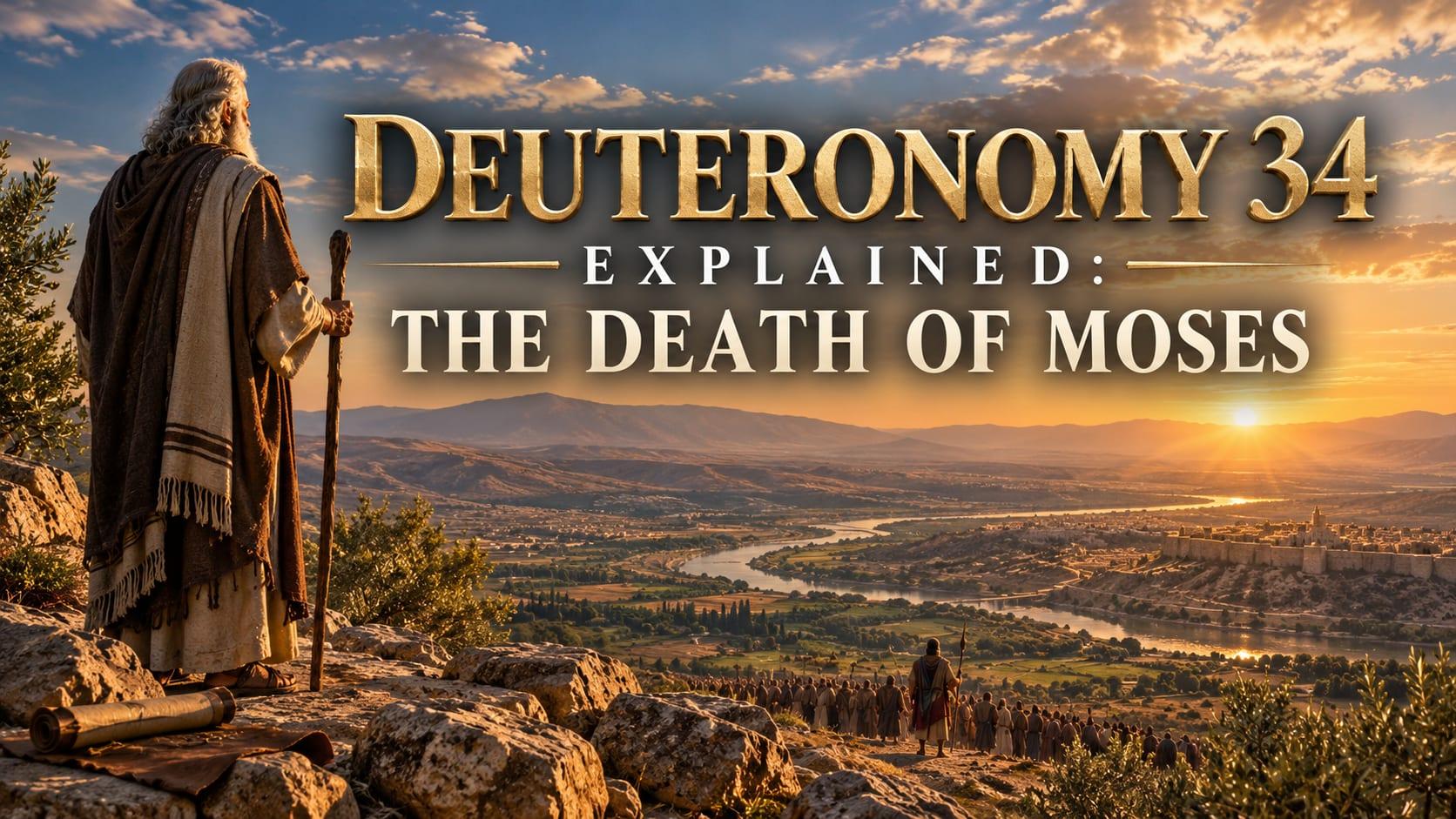
📖 Deuteronomy 34 Explained: The Death of Moses on Mount Nebo
One mountain. One long look. One death that no human being ever actually watched happen.
Deuteronomy 34 explained is the last chapter Moses ever lives inside, twelve verses that close out not only Deuteronomy but the whole Torah. He climbs one final slope, sees the entire promised land laid out in front of him, and dies there without ever setting one foot across the river he spent forty years walking toward.
Maybe you have only ever read this chapter as the sad part right before the real story starts in Joshua.
- ❓ Who actually buried Moses, since no one else was there to do it?
- ❓ Why does nobody know where his grave is, to this day?
- ❓ If Moses wrote the first five books of the Bible, who wrote the account of his own death?
- ❓ What does it mean that no prophet since has ever matched him?
📌 Deuteronomy 34 is not a sad footnote. It is God keeping every promise He ever made to Moses, in full view of the one promise He never changed His mind about.
Walk through it slowly. By the end, a grave nobody could find starts to look less like a loss and more like the last and strangest honor Moses was ever given.
What Happened Just Before This Chapter
Deuteronomy 33 was Moses's last word to the whole nation, a blessing spoken tribe by tribe, closing on happiness instead of warning. He had not yet climbed the mountain God named for him back in Deuteronomy 32, Mount Nebo, in the range of Abarim, across the Jordan from Jericho.
Deuteronomy 34 is Moses finally making that climb. The song is sung. The law is written down. The tribes are blessed. The successor is already standing ready. All that is left is the walk up the mountain, and whatever happens once he reaches the top of it.

Deuteronomy 34 Explained Verse by Verse
1. The Whole Land, in One Long Look (verses 1 to 4)
The chapter opens with Moses walking the last stretch of ground he will ever walk under his own strength.
"And Moses went up from the plains of Moab unto the mountain of Nebo, to the top of Pisgah, that is over against Jericho. And the LORD shewed him all the land of Gilead, unto Dan, And all Naphtali, and the land of Ephraim, and Manasseh, and all the land of Judah, unto the utmost sea, And the south, and the plain of the valley of Jericho, the city of palm trees, unto Zoar."
Nebo sits east of the Jordan, in the hill country of Moab. From its summit the text sweeps in every direction at once: Gilead and Dan to the north, Ephraim, Manasseh, and Judah stretching west toward the Mediterranean, then south along the Jordan valley down to Zoar near the Dead Sea. However much of that was visible to Moses's own eyes that day, the chapter presents it as a single, deliberate showing, the whole inheritance in one look, not a partial glimpse.
Then God speaks, and the promise He is keeping is named out loud.
"And the LORD said unto him, This is the land which I sware unto Abraham, unto Isaac, and unto Jacob, saying, I will give it unto thy seed: I have caused thee to see it with thine eyes, but thou shalt not go over thither."
Years earlier, Moses had asked for far more than a view. He begged, in his own words, to cross the river and see the good land for himself. That request was refused outright. This smaller one, just to see it, is granted in full, down to the letter.
📌 God does not offer Moses a loophole around the consequence of Meribah, and He does not leave him with nothing either. He answers exactly the size of prayer He chose to answer, no more and no less, and Moses receives it without another recorded word of protest.
2. The Death of Moses, and a Grave Nobody Ever Found (verses 5 and 6)
Two short verses carry the weight of the whole chapter.
"So Moses the servant of the LORD died there in the land of Moab, according to the word of the LORD."
"The servant of the LORD" is the title Israel's own history keeps attaching to Moses from this point on. The very next book opens the same way.
"Now after the death of Moses the servant of the LORD it came to pass, that the LORD spake unto Joshua the son of Nun, Moses' minister, saying,"
No one watched Moses die. No funeral procession is described. What happens to his body comes next, in one plain, strange sentence.
"And he buried him in a valley in the land of Moab, over against Bethpeor: but no man knoweth of his sepulchre unto this day."
📌 "He buried him" is grammatically ambiguous, but almost every reader through history has taken the obvious meaning: God Himself did the burying. No human was present to see the death happen, so no human could have dug the grave either.
Compare this to the only other patriarch-level funeral the Torah describes in full, Jacob's burial in Genesis 50.
"And forty days were fulfilled for him; for so are fulfilled the days of those which are embalmed: and the Egyptians mourned for him threescore and ten days."
"For his sons carried him into the land of Canaan, and buried him in the cave of the field of Machpelah, which Abraham bought with the field for a possession of a buryingplace of Ephron the Hittite, before Mamre."
Jacob gets forty days of embalming, seventy days of Egyptian mourning, a chariot procession across two countries, and a named, purchased tomb future generations could visit. Moses, who led a nation Jacob never lived to see, gets none of that. No procession. No marker. No pilgrimage site.
⚠️ Scripture never states why the grave was hidden, so any answer here is reasoned, not quoted. The likeliest reason most Bible teachers give is simple: a known grave belonging to Moses would have been an open invitation to a people who had already turned a golden calf into an object of worship within weeks of leaving Egypt. Whatever the reason, the mystery clearly mattered to someone beyond this chapter.
"Yet Michael the archangel, when contending with the devil he disputed about the body of Moses, durst not bring against him a railing accusation, but said, The Lord rebuke thee."
💡 Jude gives no details about what that dispute actually involved. But it tells you the body and the grave were never a closed, forgotten matter. Centuries later they were still worth an archangel and the devil contesting.

3. Still Strong at a Hundred and Twenty (verse 7)
The chapter pauses to say something unusual about the body that just died.
"And Moses was an hundred and twenty years old when he died: his eye was not dim, nor his natural force abated."
📌 This was not a body finally giving out from old age. It was a death on a set day, for one specific reason, and nothing else. Moses had told Israel in the previous chapter that he could "no more go out and come in," but that phrase describes the stamina to lead campaigns and migrations, not his eyesight or his physical strength. The two statements sit together without contradicting each other.
Tradition credits Moses himself with writing Psalm 90, a psalm that names the ordinary human lifespan plainly.
"The days of our years are threescore years and ten; and if by reason of strength they be fourscore years, yet is their strength labour and sorrow; for it is soon cut off, and we fly away."
💡 Seventy years, eighty at most, and even that is called labor and sorrow by the very man who reached one hundred and twenty with his eyes still sharp. Moses outlived his own stated standard by decades, and the text makes a point of saying his strength never faded on the way there.
4. Thirty Days That Israel Had Already Mourned Once Before (verse 8)
Grief gets exactly one verse.
"And the children of Israel wept for Moses in the plains of Moab thirty days: so the days of weeping and mourning for Moses were ended."
Thirty days was not a new number for Israel. It was the exact length of time the nation had already mourned Moses's own brother, years earlier, at the other end of the wilderness years.
"And when all the congregation saw that Aaron was dead, they mourned for Aaron thirty days, even all the house of Israel."
📌 Two brothers, the same thirty days of national grief, and the same root cause. Aaron died at Mount Hor and Moses died at Mount Nebo, both within sight of a land neither of them ever entered, both for what happened at the water of Meribah. Jacob's seventy days of mourning, by contrast, came from Egypt, a foreign nation honoring Joseph's father. Israel's thirty days, twice now, were a nation burying its own.
5. Joshua Was Already Ready (verse 9)
The leadership question, the one thing that could have thrown Israel into chaos at the worst possible moment, had already been settled.
"And Joshua the son of Nun was full of the spirit of wisdom; for Moses had laid his hands upon him: and the children of Israel hearkened unto him, and did as the LORD commanded Moses."
This is not a new announcement. It is this chapter confirming what God set in motion back in Numbers 27 and what Moses charged Joshua with publicly in Deuteronomy 31 actually worked. The laying on of hands was never just a gesture. Something real transferred through it, enough that Israel listened to Joshua immediately, with no gap and no committee deciding who came next.
💡 Notice the last line too. Israel obeying Joshua is described as Israel doing "as the LORD commanded Moses." The chain of command changed hands. The actual authority behind it never did.

6. No Prophet Like Moses, Yet (verses 10 to 12)
The Torah closes with what reads like an epitaph, but it is pointed forward as much as it looks back.
"And there arose not a prophet since in Israel like unto Moses, whom the LORD knew face to face,"
"In all the signs and the wonders, which the LORD sent him to do in the land of Egypt to Pharaoh, and to all his servants, and to all his land, And in all that mighty hand, and in all the great terror which Moses shewed in the sight of all Israel."
📌 Two credentials, named specifically. A face to face relationship with God that no successor matched, and a scale of signs and wonders no successor repeated. This is the last sentence of the five books traditionally credited to Moses, closing not just Deuteronomy but the entire Torah.
But Moses himself had already written the next line of this story, generations earlier in the same book.
"The LORD thy God will raise up unto thee a Prophet from the midst of thee, of thy brethren, like unto me; unto him ye shall hearken;"
Deuteronomy 34:10 says "since," not "forever." It is describing a gap that had not yet been filled at the time these words were written, the exact gap Moses himself had already promised, generations earlier, would one day be filled.
Hard Questions Deuteronomy 34 Raises
Who actually wrote Deuteronomy 34, since it records Moses's own death? What the text says: nothing inside this chapter names its writer. What has long been understood: Moses could not have written an eyewitness account of his own burial, or the statement that "no man knoweth of his sepulchre unto this day," a line that only makes sense after real time had passed. The standard Jewish and Christian answer, held for thousands of years, is that Joshua, or another writer under the same inspiration, added this closing notice once Moses had died. That does not weaken the rest of the Torah's connection to Moses. It simply accounts for the one page in five books that no living author could have written about himself.
Why was Moses's grave hidden, and why does God bury him personally? What the text says: only that Moses died, that he was buried, and that the location was unknown "unto this day." What is reasoned rather than stated: a marked, visitable grave for someone of Moses's stature carried real risk for a people who had already shown, more than once, how quickly they could turn toward something they could see and touch instead of the God they could not. Jude 1:9 at least confirms the matter was never treated as trivial. Generations later, the body and its resting place were still significant enough to be the subject of a contested dispute.
Does "there arose not a prophet since in Israel like unto Moses" conflict with the New Testament calling Jesus greater than Moses? What the text says: a historical claim about everyone between Moses and the time this verse was written, that none of them matched his relationship with God or the scale of what God did through him. How it has been understood: not as a contradiction, but as the very gap Deuteronomy 18:15 had already promised would be filled. Peter and Stephen both quote that promise directly in Acts and point straight at Jesus as the fulfillment of it, and Hebrews goes further, calling Moses a faithful servant in God's house and calling Christ a son over that same house. Deuteronomy 34:10 was never written to close a door forever. It marked a bar that stayed unmatched by every judge, king, and prophet who followed, right up until the one person this same book had already said to expect.
"For Moses truly said unto the fathers, A prophet shall the Lord your God raise up unto you of your brethren, like unto me; him shall ye hear in all things whatsoever he shall say unto you."
"And Moses verily was faithful in all his house, as a servant, for a testimony of those things which were to be spoken after; But Christ as a son over his own house; whose house are we, if we hold fast the confidence and the rejoicing of the hope firm unto the end."

Top Verses From Deuteronomy 34
1. Deuteronomy 34:4
"And the LORD said unto him, This is the land which I sware unto Abraham, unto Isaac, and unto Jacob, saying, I will give it unto thy seed: I have caused thee to see it with thine eyes, but thou shalt not go over thither."
A promise made to three men long dead, kept in full view of a fourth who would not get to walk into it. God names exactly what He is honoring, and exactly where the honoring stops.
2. Deuteronomy 34:6
"And he buried him in a valley in the land of Moab, over against Bethpeor: but no man knoweth of his sepulchre unto this day."
The only funeral in the Bible that nobody attended. No mourners, no procession, no marker, just a grave that has stayed hidden for thousands of years since.
3. Deuteronomy 34:7
"And Moses was an hundred and twenty years old when he died: his eye was not dim, nor his natural force abated."
Proof this death was an appointment, not a decline. Moses did not fade out. He was called home at full strength, on a day God had already named.
4. Deuteronomy 34:9
"And Joshua the son of Nun was full of the spirit of wisdom; for Moses had laid his hands upon him: and the children of Israel hearkened unto him, and did as the LORD commanded Moses."
A leadership transition with no vacancy, no scramble, and no vote. The hardest part of losing a leader this size had already been handled before he ever left.
5. Deuteronomy 34:10
"And there arose not a prophet since in Israel like unto Moses, whom the LORD knew face to face,"
The last line of the Torah's own verdict on Moses, and a sentence that leaves the door open rather than closing it. Deuteronomy 18:15 already named who would eventually walk through it.
Frequently Asked Questions About Deuteronomy 34
What is Deuteronomy 34 about?
Deuteronomy 34 covers the last day of Moses's life: God showing him the whole promised land from the top of Mount Nebo, his death at a hundred and twenty with his strength undimmed, his burial in an unmarked grave, Israel's thirty days of mourning, Joshua's confirmed succession, and the Torah's closing statement that no prophet since had equaled Moses.
Why couldn't Moses enter the promised land?
This chapter states the fact without repeating the reason, since Deuteronomy already explained it earlier: Moses's failure to honor God at the waters of Meribah. Here the focus is on what Moses is given instead, a full view of the land from the mountaintop, not on arguing the sentence itself.
Who buried Moses?
Verse 6 simply says "he buried him," without naming a human subject, and no one else was present to have done it. Nearly every reader through history takes this to mean God Himself buried Moses, the only funeral like it in the entire Bible.
Why is Moses's grave unknown?
Scripture never states the reason directly. The most common explanation among Bible teachers is that a known, visitable grave for someone of Moses's stature risked becoming a shrine, for a people who had already shown a weakness for worshiping what they could see and touch.
Who wrote the account of Moses's death if Moses wrote the Torah?
Tradition credits Joshua, or another writer under the same inspiration, with adding this final chapter once Moses had died, since no one can write an eyewitness account of his own burial. This has been the standard explanation for thousands of years and does not change who wrote the rest of the five books.
What does "his eye was not dim, nor his natural force abated" mean?
It means Moses did not die of old age catching up with him. At a hundred and twenty, well past the lifespan his own Psalm 90 calls ordinary, his eyesight and physical strength were still intact. His death came by appointment, not by decline.
Why did Israel mourn for Moses for thirty days?
Thirty days was the same length of mourning Israel had already observed for Aaron in Numbers 20. Both brothers died within sight of the promised land they had led Israel toward for decades, neither one entering it.
What does "there arose not a prophet since in Israel like unto Moses" mean?
It states that, up to the time this verse was written, no one in Israel had matched Moses's direct relationship with God or the scale of signs and wonders done through him. The word "since" describes a gap in history, not a permanent ceiling.
Is Jesus greater than Moses, even though this chapter calls him unmatched?
Yes, and this chapter does not argue against that. Deuteronomy 18:15 already promised a future Prophet "like unto" Moses, and the New Testament names Jesus as that fulfillment, with Hebrews 3 going further still: Moses served faithfully as a servant in God's house, while Christ is described as a son over that same house.
Is Deuteronomy 34 the end of the Torah?
Yes. This chapter closes not only Deuteronomy but the entire five books traditionally credited to Moses. The book of Joshua picks up immediately afterward, opening with the words "after the death of Moses the servant of the LORD."
Final Thoughts
Deuteronomy 34 is short, and it still manages to hold grief, mystery, and hope in the same twelve verses.
📌 God answers prayer at the size He chooses, not the size you ask. Moses begged to cross the river and was refused. He asked only to see the land, and got every mile of it shown to him at once.
📌 A hidden grave was not a lesser honor than a famous one. Jacob got a named tomb and a seventy day funeral. Moses got buried by God's own hand in a place no one has ever found, which is its own kind of honor entirely.
📌 "No prophet like Moses, yet" was never the end of the sentence. Moses himself had already written the rest of it back in Deuteronomy 18, and the New Testament names exactly who finished it.
So here is your one next step from this chapter.
Read Deuteronomy 18:15 right alongside Deuteronomy 34:10, and let the gap between those two verses be the question that carries you into the rest of the Bible.