📖 Deuteronomy 32 Explained: The Song of Moses and the Rock
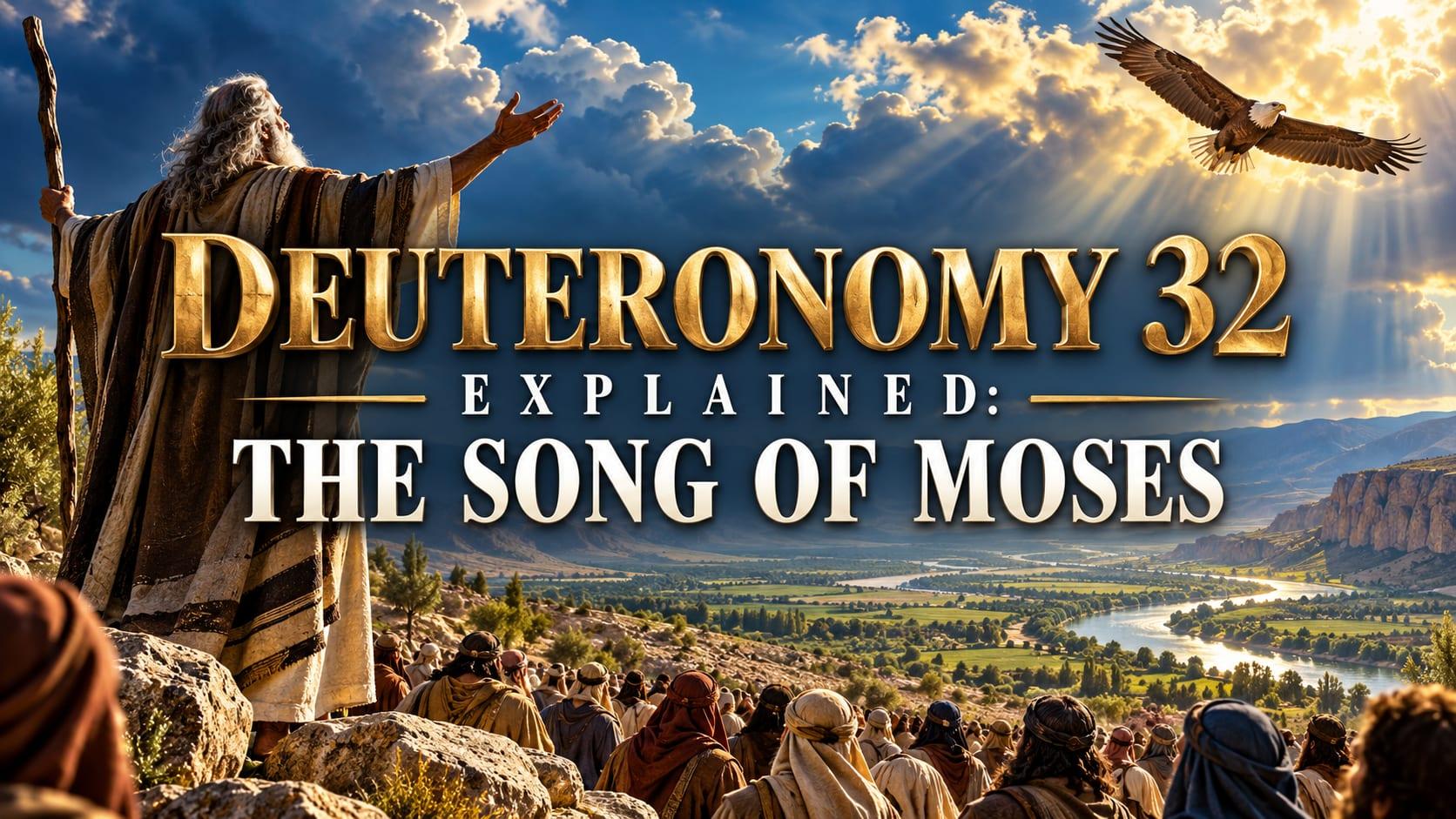
Moses already said everything he had to say as a leader. Now he says it one more time as a songwriter.
Deuteronomy 32 explained is the Song of Moses itself, the same song he promised in the last chapter would outlive every scroll Israel could lose or ignore. It is poetry, not law code, and it covers the whole relationship between God and Israel in miniature: rescue, love, rebellion, anger, and mercy that gets the last word.
You may know this chapter only as the place where God is called "the Rock."
- ❓ Why does Moses call heaven and earth to listen before he even starts singing?
- ❓ Why does the word "Rock" keep showing up, for both the true God and the false ones?
- ❓ Why does a song about God's love turn so violent in the middle?
- ❓ And why does the chapter end with Moses climbing a mountain to die?
📌 This song was never written to flatter Israel. It was written as evidence, sung by the very people it would one day testify against.
Walk through it slowly. By the end, the anger in the middle of this song looks a lot less like cruelty and a lot more like a father who refuses to pretend nothing is wrong.
What Happened Just Before This Chapter
Deuteronomy 31 was all setup. Moses handed leadership to Joshua, handed the written law to the priests, and received a strange assignment from God: write a song and teach it to the whole nation, specifically so it could never be lost, hidden, or shelved the way a scroll could be.
That chapter ended with Moses doing exactly what he was told, speaking the song "in the ears of all the congregation of Israel" until it was finished. Deuteronomy 32 is that song, word for word. Everything Moses has preached for thirty chapters now gets compressed into something Israel's children would carry in their mouths without even trying.

Deuteronomy 32 Explained Verse by Verse
1. The Whole Sky and Earth Are Called to Listen (verses 1 to 6)
The song opens the way a courtroom opens, not the way a hymn opens.
"Give ear, O ye heavens, and I will speak; and hear, O earth, the words of my mouth. My doctrine shall drop as the rain, my speech shall distil as the dew, as the small rain upon the tender herb, and as the showers upon the grass:"
📌 Moses is doing exactly what he told the elders he would do back in the previous chapter, calling heaven and earth as witnesses against Israel. That is not a poetic flourish. It is the opening move of a formal case, the same pattern prophets like Isaiah and Micah use centuries later when God brings a complaint against His own people.
Then, in the same breath as that courtroom language, Moses names the one he is defending.
"He is the Rock, his work is perfect: for all his ways are judgment: a God of truth and without iniquity, just and right is he."
💡 "Rock" is the title that holds this whole song together. The word shows up nine times across these fifty two verses. Five of those times it is capitalized, naming Israel's actual God. The other four are lowercase, either a literal stone or the hollow "rock" other nations trust in instead. Moses is building a contrast he will not let go of until the song ends.
Then the accusation lands, right next to the praise.
"They have corrupted themselves, their spot is not the spot of his children: they are a perverse and crooked generation. Do ye thus requite the LORD, O foolish people and unwise? is not he thy father that hath bought thee? hath he not made thee, and established thee?"
⚠️ Notice the order. God's perfect character comes first. Israel's failure comes second, and it is framed as ingratitude toward a father, not just as breaking rules. Every verse after this one unpacks exactly what that father did, and exactly how His children answered it.
2. Found in the Wilderness, Carried Like an Eagle (verses 7 to 14)
Before any accusation gets detailed, Moses spends eight verses on nothing but love.
"For the LORD's portion is his people; Jacob is the lot of his inheritance. He found him in a desert land, and in the waste howling wilderness; he led him about, he instructed him, he kept him as the apple of his eye."
"The apple of his eye" was an idiom for the pupil itself, the single most protected, most sensitive part of the body. That is the comparison Moses reaches for to describe how God watched over a people with nothing, lost in a desert that could kill them a dozen different ways.
"As an eagle stirreth up her nest, fluttereth over her young, spreadeth abroad her wings, taketh them, beareth them on her wings: So the LORD alone did lead him, and there was no strange god with him."
📌 This is not a new picture Moses is inventing here. Back at Sinai, God had already told Israel how He brought them out of Egypt:
"Ye have seen what I did unto the Egyptians, and how I bare you on eagles' wings, and brought you unto myself."
One generation later, with that whole wilderness journey finished, Moses reaches for the exact same image to summarize it. He does not stop at rescue. He adds abundance.
"He made him ride on the high places of the earth, that he might eat the increase of the fields; and he made him to suck honey out of the rock, and oil out of the flinty rock;"
💡 Honey and oil out of dry rock is not a normal harvest. It is Moses saying that even the hardest, least promising ground produced plenty under God's hand. Nothing about Israel's years in the wilderness was owed to them. Every bit of it was given.

3. Jeshurun Grows Fat and Forgets (verses 15 to 18)
Right after describing that abundance, the song turns on a single word.
"But Jeshurun waxed fat, and kicked: thou art waxen fat, thou art grown thick, thou art covered with fatness; then he forsook God which made him, and lightly esteemed the Rock of his salvation."
"Jeshurun" means something close to "the upright one." It is a rare, almost affectionate nickname for Israel, used only a handful of times in the whole Bible, twice more in Moses's closing blessing just ahead in Deuteronomy 33. Moses picks the fondest name he has for Israel at the exact moment he describes them kicking like a well fed animal that no longer needs the hand that raised it.
📌 The problem was never scarcity. It was comfort. Israel did not wander off from God during the hungry years in the wilderness. They wandered off once they were fed, settled, and secure.
"They provoked him to jealousy with strange gods, with abominations provoked they him to anger. They sacrificed unto devils, not to God; to gods whom they knew not, to new gods that came newly up, whom your fathers feared not. Of the Rock that begat thee thou art unmindful, and hast forgotten God that formed thee."
This is not a hypothetical warning. Israel had already done exactly this once, building a golden calf while Moses was still up on Sinai, and would do it again at Baalpeor, joining themselves to the gods of Moab. Moses is not guessing about what Israel is capable of. He watched it happen twice already.
4. A God Who Hides His Face (verses 19 to 27)
The song does not soften what comes next.
"And when the LORD saw it, he abhorred them, because of the provoking of his sons, and of his daughters. And he said, I will hide my face from them, I will see what their end shall be: for they are a very froward generation, children in whom is no faith."
"They have moved me to jealousy with that which is not God; they have provoked me to anger with their vanities: and I will move them to jealousy with those which are not a people; I will provoke them to anger with a foolish nation."
📌 Paul quotes this exact verse centuries later, in Romans, to explain why the gospel went out to the Gentiles.
"But I say, Did not Israel know? First Moses saith, I will provoke you to jealousy by them that are no people, and by a foolish nation I will anger you."
What was first a warning about a nation that shamed Israel becomes, in Paul's hands, a description of the whole world being welcomed into a covenant Israel once had to itself. Moses could not have known the full shape of that, but the words he wrote down carried it anyway.
The warning itself keeps going, and it does not stay abstract for long.
"I will heap mischiefs upon them; I will spend mine arrows upon them. They shall be burnt with hunger, and devoured with burning heat, and with bitter destruction: I will also send the teeth of beasts upon them, with the poison of serpents of the dust. The sword without, and terror within, shall destroy both the young man and the virgin, the suckling also with the man of gray hairs."
⚠️ Read that honestly. It is harsh. But look at what stops it from going further.
"I said, I would scatter them into corners, I would make the remembrance of them to cease from among men: Were it not that I feared the wrath of the enemy, lest their adversaries should behave themselves strangely, and lest they should say, Our hand is high, and the LORD hath not done all this."
📌 God holds back full judgment, not because Israel earns a pass, but because He will not let Israel's enemies mistake their own cruelty for strength. Even inside the harshest stretch of this song, God's own reputation for justice restrains Him.

5. A Foolish Nation, an Inferior Rock (verses 28 to 33)
Moses turns from Israel's failure to a blunt verdict on Israel's enemies.
"For they are a nation void of counsel, neither is there any understanding in them. O that they were wise, that they understood this, that they would consider their latter end!"
"How should one chase a thousand, and two put ten thousand to flight, except their Rock had sold them, and the LORD had shut them up? For their rock is not as our Rock, even our enemies themselves being judges."
💡 This is the verse where the capital and lowercase "rock" sit side by side on purpose. Any defeat Israel suffers only happens because their own Rock allowed it as discipline. The enemy's rock, their gods, their strength, their luck, never had any power of its own. Even Israel's enemies, Moses says, would admit that if they were honest.
6. Vengeance Belongs to God Alone (verses 34 to 42)
Here the song pulls back from Israel's guilt and lands on the one truth the whole chapter has been building toward.
"To me belongeth vengeance, and recompence; their foot shall slide in due time: for the day of their calamity is at hand, and the things that shall come upon them make haste. For the LORD shall judge his people, and repent himself for his servants, when he seeth that their power is gone, and there is none shut up, or left."
📌 Both Paul and the writer of Hebrews reach straight for this verse when they tell believers not to take justice into their own hands.
"For we know him that hath said, Vengeance belongeth unto me, I will recompense, saith the Lord. And again, The Lord shall judge his people."
Vengeance never belonged to Israel in the first place, and it does not belong to you either. Moses is not telling Israel to sit back and watch their enemies gloat forever. He is telling them that settling the score was never their job to begin with.
Then comes the line that should end every argument about who is really in control.
"See now that I, even I, am he, and there is no god with me: I kill, and I make alive; I wound, and I heal: neither is there any that can deliver out of my hand."
Every false rock mocked earlier in the song gets answered here. They could not feed Israel, could not fight for Israel, and could not deliver anyone out of this God's hand either.
7. Mercy at the End of the Song, and Moses's Final Climb (verses 43 to 52)
A song this heavy could easily end on judgment alone. It does not.
"Rejoice, O ye nations, with his people: for he will avenge the blood of his servants, and will render vengeance to his adversaries, and will be merciful unto his land, and to his people."
💡 Even the nations outside Israel get invited to rejoice at this song's ending. Centuries later, Revelation pictures a crowd standing before God singing this very song again, alongside a new one.
"And they sing the song of Moses the servant of God, and the song of the Lamb, saying, Great and marvellous are thy works, Lord God Almighty; just and true are thy ways, thou King of saints."
📌 The Song of Moses does not stay stuck in the wilderness. Scripture picks it back up at the very end of the story, sung by people who finally see the whole case Moses just made, settled in their favor.
Back in Deuteronomy, Moses finishes speaking and gives Israel one last charge.
"And he said unto them, Set your hearts unto all the words which I testify among you this day, which ye shall command your children to observe to do, all the words of this law. For it is not a vain thing for you; because it is your life: and through this thing ye shall prolong your days in the land, whither ye go over Jordan to possess it."
Then, the same day, God gives Moses his own final assignment.
"And the LORD spake unto Moses that selfsame day, saying, Get thee up into this mountain Abarim, unto mount Nebo, which is in the land of Moab, that is over against Jericho; and behold the land of Canaan, which I give unto the children of Israel for a possession:"
⚠️ This is not a surprise to Moses. God had already given him almost this exact instruction years earlier, right after Joshua was publicly commissioned:
"And the LORD said unto Moses, Get thee up into this mount Abarim, and see the land which I have given unto the children of Israel. And when thou hast seen it, thou also shalt be gathered unto thy people, as Aaron thy brother was gathered."
Deuteronomy 32 simply carries out, in its own moment, what had already been settled in the earlier commissioning of Joshua. The chapter closes by repeating, plainly, exactly why Moses himself cannot cross the river.
"Because ye trespassed against me among the children of Israel at the waters of MeribahKadesh, in the wilderness of Zin; because ye sanctified me not in the midst of the children of Israel. Yet thou shalt see the land before thee; but thou shalt not go thither unto the land which I give the children of Israel."
📌 Moses spends the whole song insisting that God's judgments are just, then closes the chapter by accepting the justice of his own. He does not argue his way out of the mountain. He climbs it.

Hard Questions Deuteronomy 32 Raises
Why does a song about God's love turn so violent in the middle? What the text says: verses 22 to 25 describe real, severe judgment, fire, arrows, famine, wild animals. How it has been understood: this is covenant language, the same kind of warning spelled out earlier in the blessings and curses of Deuteronomy 28, not random cruelty. The violence is the stated consequence of a choice Israel already agreed to, laid out in advance so nobody could later claim they were blindsided by it. The song does not end there either. Mercy gets the final word in verse 43, after judgment has already had its say.
Does Deuteronomy 32:8 really say what some modern translations suggest? What the text says, in the King James reading used here: God set the boundaries of the nations "according to the number of the children of Israel." Some ancient copies of this verse, including a Dead Sea Scrolls fragment and the old Greek translation, read it differently, closer to "according to the number of the sons of God." Scholars are genuinely divided on which wording is original. What is not in dispute either way is the point of the verse: God, not any human border or empire, decided how the nations were divided, going all the way back to the scattering after Babel.
Is this song a contradiction of God's mercy shown earlier in Deuteronomy? No. The song holds both truths the same way the rest of the book already has. God is "a God of truth and without iniquity, just and right" in verse 4, and the same God who promises in Deuteronomy 30 to circumcise Israel's heart after judgment. Justice and mercy are not presented as opposites fighting for control. They are presented as two sides of the same faithful character.
Top Verses From Deuteronomy 32
1. Deuteronomy 32:4
"He is the Rock, his work is perfect: for all his ways are judgment: a God of truth and without iniquity, just and right is he."
The verse that sets the title for the whole song. Everything that follows, love, anger, judgment, and mercy, gets tested against this one claim about God's character.
2. Deuteronomy 32:10
"He found him in a desert land, and in the waste howling wilderness; he led him about, he instructed him, he kept him as the apple of his eye."
One of the most tender pictures of God's care anywhere in the Old Testament, aimed at a people who had nothing to offer Him back except need.
3. Deuteronomy 32:35
"To me belongeth vengeance, and recompence; their foot shall slide in due time: for the day of their calamity is at hand, and the things that shall come upon them make haste."
The verse both Paul and the writer of Hebrews reach for when they tell believers not to take revenge into their own hands. Settling scores was never anyone's job but God's.
4. Deuteronomy 32:39
"See now that I, even I, am he, and there is no god with me: I kill, and I make alive; I wound, and I heal: neither is there any that can deliver out of my hand."
The flattest statement of God's exclusive power in the whole song, answering every false rock named earlier in a single verse.
5. Deuteronomy 32:47
"For it is not a vain thing for you; because it is your life: and through this thing ye shall prolong your days in the land, whither ye go over Jordan to possess it."
Moses's own summary of why he spent thirty two chapters on this. Not religious decoration, but the literal difference between life and death for the nation he is leaving behind.
Frequently Asked Questions About Deuteronomy 32
What is Deuteronomy 32 about?
Deuteronomy 32 is the full text of the Song of Moses, the song God commanded in chapter 31 as a permanent witness. It traces God's rescue and care for Israel, Israel's turn to false gods, God's judgment, and His promised mercy, then closes with Moses being sent up Mount Nebo to view the promised land before his death.
Why is this chapter called the Song of Moses?
Deuteronomy 31:22 and 32:44 both describe Moses writing and speaking this exact song to Israel. It is Hebrew poetry meant to be memorized and sung, not a legal section like most of the rest of the book.
Why does God call Himself "the Rock" in this chapter?
"Rock" pictures God as unmoving, reliable shelter, the opposite of the fake gods Israel kept chasing. The word appears nine times in this chapter, five capitalized for Israel's true God and four lowercase for literal stone or the empty "rock" other nations trusted instead.
What does "Jeshurun" mean?
It means something like "the upright one," a rare and fairly affectionate nickname for Israel. Moses uses it in verse 15 right as he describes Israel growing fat and kicking against the God who fed them, and uses it twice more in his closing blessing in Deuteronomy 33.
Why does God's anger sound so violent in this chapter?
Verses 22 to 25 describe real judgment in strong, physical terms because the covenant itself, laid out earlier in Deuteronomy 28, warned of exactly this. The song is not cruelty for its own sake. It is the stated cost of the choice Israel already agreed to, and it is followed by mercy rather than left to stand alone.
What does Deuteronomy 32:8 mean about dividing the nations?
It credits God, not any human empire, with setting the boundaries of the nations after they scattered from Babel. Some ancient manuscripts word the second half of the verse differently than the King James text does, and scholars are divided on the original wording, but every version agrees that God, not chance, drew the lines.
Is Deuteronomy 32:35 the same verse Paul quotes in Romans?
Paul draws on this same verse in Romans 12:19 when he tells believers not to avenge themselves, and the writer of Hebrews quotes it directly in Hebrews 10:30. Both point back to the same truth Moses states here: vengeance belongs to God alone.
Why does Moses climb Mount Nebo at the end of this chapter?
God had already told Moses years earlier, in Numbers 27, that he would view the promised land from a mountain and die without entering it, because of his failure to honor God at the waters of Meribah. Deuteronomy 32 simply carries out that earlier instruction once the song is finished.
How does the Song of Moses in Revelation relate to this chapter?
Revelation 15:3 describes a crowd before God singing "the song of Moses" alongside "the song of the Lamb." It is the same song named here, picked back up at the very end of Scripture by people who have seen the whole story Moses only promised in this chapter come true.
Did Israel actually keep this song, or did Moses's warning come true?
The rest of the Old Testament, especially Judges and Kings, records Israel repeatedly doing exactly what this song predicted: forgetting God once settled and comfortable, chasing other gods, and facing the consequences Moses described, followed again and again by God's mercy toward whoever turned back.
Final Thoughts
Deuteronomy 32 is hard to read fast, and it was never meant to be read fast.
📌 The danger was comfort, not hardship. Jeshurun did not drift from God in the wilderness while hungry. It drifted once it was fed, settled, and secure.
📌 Vengeance was never yours to carry. The same verse Moses sings here gets picked up by Paul and by Hebrews for the exact same reason: settling the score belongs to God, not to you.
📌 Judgment does not get the last word. Mercy does. A song that spends thirty verses on Israel's failure still ends with an invitation for the nations to rejoice, and gets sung again at the very end of Revelation.
You live comfortably, most days, the way Jeshurun did before the warning in this chapter was needed.
So here is your one next step.
Ask honestly whether your own comfort has quietly become the thing you trust instead of the Rock who gave it to you.