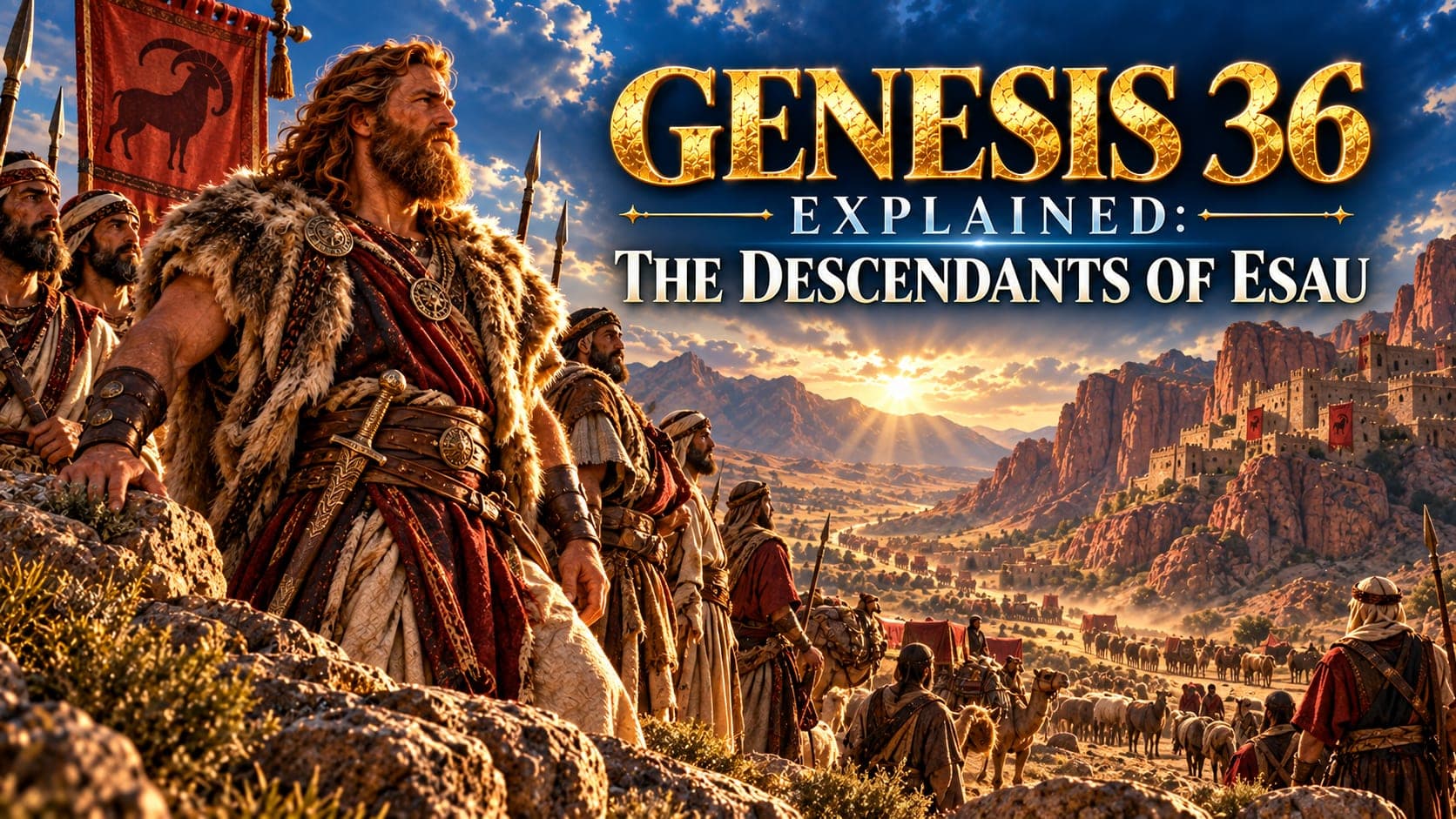
📖 Genesis 36 Explained: Esau's Family and the Kings of Edom
Forty three verses. Not one scene. Not one line of dialogue.
Genesis 36 explained is a family record, the full genealogy of Esau, the brother who sold his birthright and lost the blessing. Most readers skim straight past it on the way to Joseph's story in the next chapter.
Do not skim this one.
- ❓ If Esau lost the blessing, why does he get an entire chapter to himself?
- ❓ Why do his wives have different names here than earlier in Genesis?
- ❓ How did the brother who gave up his birthright end up with kings in his family before Israel ever had one?
- ❓ What is Edom, and why does it keep showing up later in the Bible?
📌 Genesis spends more space recording what became of the son who did not inherit the promise than most readers expect, and none of it happens by accident.
This walkthrough goes through the whole chapter in order: Esau's wives and his move to Seir, the sons and grandsons who became the tribal chiefs of Edom, the family already living in that land before he arrived, the kings who ruled there before Israel ever had one, and the closing list of Edom's territories.
A chapter with no dialogue still has plenty to say about a promise God keeps.
What Happened Just Before This Chapter
Genesis 35 ended at a graveside. Jacob had finally come home to his father Isaac at Hebron, and when Isaac died at a hundred and eighty years old, both of his sons buried him together, Esau and Jacob, standing side by side one last time.
📌 Genesis 36 answers the question that scene leaves open: what happened to Esau after that? He does not disappear once the birthright and the blessing both belong to Jacob's line. He built a family, a territory, and eventually a line of kings of his own, and this chapter is Genesis pausing to record every bit of it before turning its full attention to Joseph for the rest of the book.
Genesis 36 Explained Verse by Verse
1. Esau's Wives and the Move to Seir (verses 1 to 8)
The chapter opens with a single label that decides everything that follows.
"Now these are the generations of Esau, who is Edom."
💡 "These are the generations of" is a phrase Genesis uses again and again to mark a new section: Adam, Noah, Shem, Ishmael, Isaac, and now Esau. The very next chapter opens the same way for Jacob. Genesis is not wandering. It is working through every branch of the family, one at a time, before settling on the one it actually follows to the end of the book.
The chapter names Esau's three wives and where he found them.
"Esau took his wives of the daughters of Canaan; Adah the daughter of Elon the Hittite, and Aholibamah the daughter of Anah the daughter of Zibeon the Hivite; And Bashemath Ishmael's daughter, sister of Nebajoth."
Two Canaanite wives and one from Ishmael's own family. Esau's five sons come from these three women: Eliphaz through Adah, Reuel through Bashemath, and Jeush, Jaalam, and Korah through Aholibamah.
This is the same "two nations" God spoke of before either brother was even born.
"And the LORD said unto her, Two nations are in thy womb, and two manner of people shall be separated from thy bowels; and the one people shall be stronger than the other people; and the elder shall serve the younger."
📌 Genesis 36 is that prophecy becoming an address. Esau is not just a man anymore. He is about to become a nation, with a land, a capital, and eventually a government, standing apart from the brother he once wrestled beside in their mother's womb.
Esau and Jacob part ways for good, and the chapter tells you exactly why.
"And Esau took his wives, and his sons, and his daughters, and all the persons of his house, and his cattle, and all his beasts, and all his substance, which he had got in the land of Canaan; and went into the country from the face of his brother Jacob. For their riches were more than that they might dwell together; and the land wherein they were strangers could not bear them because of their cattle. Thus dwelt Esau in mount Seir: Esau is Edom."
⚠️ The land could not bear them because of their cattle is almost the exact wording used for Abraham and Lot when those two men could not stay in the same territory either. Too much prosperity, not too much conflict, is what finally separates this family. Esau leaves on his own terms, wealthy and unhurried, a very different exit than the brother who once fled for his life after losing his father's blessing.
2. Esau's Sons, Grandsons, and the Dukes of Edom (verses 9 to 19)
The chapter repeats its opening label, this time adding Esau's new home to his name.
What follows is three generations in a handful of verses. Eliphaz, Esau's firstborn through Adah, has five sons of his own. One more name is added almost as an aside.
"And Timna was concubine to Eliphaz Esau's son; and she bare to Eliphaz Amalek: these were the sons of Adah Esau's wife."
⚠️ That one clause is the entire birth record of Amalek, ancestor of the nation that later attacks Israel in the wilderness and that Saul is commanded to fight in 1 Samuel 15. Genesis does not flag him as important here. He is simply Eliphaz's son by a concubine, one more grandson in a long list, born a great deal more history than his one clause suggests.
The chapter then organizes all these names under a title that keeps repeating: duke.
"These were dukes of the sons of Esau: the sons of Eliphaz the firstborn son of Esau; duke Teman, duke Omar, duke Zepho, duke Kenaz, Duke Korah, duke Gatam, and duke Amalek: these are the dukes that came of Eliphaz in the land of Edom; these were the sons of Adah."
💡 "Duke" here is not a European title. It translates a Hebrew word for the head of a clan or tribe, a chief rather than a king. Genesis 36 names fourteen of these chiefs descended directly from Esau: seven through Eliphaz, four through Reuel, and three through Aholibamah. Together they are the tribal structure of a young nation, not yet a kingdom.
📌 Look closely and the name Korah appears twice in this list, in two different family lines. Verse 16 lists him as a duke descended from Eliphaz. Verses 5, 14, and 18 already named him as one of Aholibamah's own sons, a different man entirely. Genesis reuses names across branches of the same family constantly, and this is simply two relatives sharing one.
3. The Horites Who Already Lived There (verses 20 to 30)
Esau did not move his family into empty land. Mount Seir already had people living on it, and the chapter takes eleven verses to name them too.
"These are the sons of Seir the Horite, who inhabited the land; Lotan, and Shobal, and Zibeon, and Anah, And Dishon, and Ezer, and Dishan: these are the dukes of the Horites, the children of Seir in the land of Edom."
⚠️ The Horites were not conquered in a war Genesis ever describes. They were absorbed. Esau's own wife Aholibamah turns out to be a granddaughter of Zibeon, one of these very Horite chiefs, through Zibeon's son Anah. Timna, already introduced as Eliphaz's concubine and Amalek's mother, turns out here to be the sister of Lotan, another of Seir's sons. Esau's new nation is built, in part, by marrying into the family that was already there. Centuries later, Moses tells Israel plainly what eventually happened to that older population.
"The Horims also dwelt in Seir beforetime; but the children of Esau succeeded them, when they had destroyed them from before them, and dwelt in their stead; as Israel did unto the land of his possession, which the LORD gave unto them."
📌 Moses compares Esau taking Seir to Israel taking Canaan. The same God who would later give Israel its land had already given Esau his, and Deuteronomy says so directly a few verses earlier, warning Israel not to touch it. This whole genealogy sits inside a land grant, not just a family tree.
One line in the middle of the list is easy to miss and worth slowing down for.
"And these are the children of Zibeon; both Ajah, and Anah: this was that Anah that found the mules in the wilderness, as he fed the asses of Zibeon his father."
💡 The Hebrew word behind "mules" here is unusual, and some other translations render it as hot springs instead of an animal. Whichever it means, the verse remembers Anah for one specific, ordinary find made while doing chores for his father, the kind of small detail a genealogy almost never bothers to keep.
"These are the dukes that came of the Horites; duke Lotan, duke Shobal, duke Zibeon, duke Anah, Duke Dishon, duke Ezer, duke Dishan: these are the dukes that came of Hori, among their dukes in the land of Seir."
4. The Kings of Edom, Before Israel Ever Had One (verses 31 to 39)
The genealogy suddenly changes shape, and the chapter's boldest line appears.
"And these are the kings that reigned in the land of Edom, before there reigned any king over the children of Israel."
Eight kings follow, one after another. What stands out is how none of them inherit the throne from a father.
"And Bela died, and Jobab the son of Zerah of Bozrah reigned in his stead. And Jobab died, and Husham of the land of Temani reigned in his stead."
⚠️ Every single transition in this list reads the same way: one king dies, and a man from a different city and a different family takes his place. Edom's early kingship passed between clans rather than down a single bloodline, nothing like the dynasty Israel would later build through David. God had promised Jacob kings would come from his own line too.
"And by thy sword shalt thou live, and shalt serve thy brother; and it shall come to pass when thou shalt have the dominion, that thou shalt break his yoke from off thy neck."
📌 Isaac spoke those words over Esau as a consolation, decades before this chapter. A life won by the sword, and dominion of his own. Genesis 36 is that blessing coming true in plain historical fact, kings and territory, generations before Israel crowns its first one.
5. Edom's Final List of Chiefs (verses 40 to 43)
The chapter closes with one more list, organized a different way than the first.
"And these are the names of the dukes that came of Esau, according to their families, after their places, by their names; duke Timnah, duke Alvah, duke Jetheth,"
💡 The dukes named in verses 15 to 19 were grouped by father and son. This final list of eleven names is grouped by place instead, territories rather than family lines, which is why a name like Timnah can appear again here even though it already named a person earlier in the chapter. Genesis is not repeating itself. It is switching from a family record to something closer to a map.
The very last line brings the chapter back to where it started.
"Duke Magdiel, duke Iram: these be the dukes of Edom, according to their habitations in the land of their possession: he is Esau the father of the Edomites."
📌 "Esau, who is Edom" opened the chapter. "He is Esau the father of the Edomites" closes it. Forty three verses stand between the two lines, and every name in between is the answer to what that single identity actually grew into.

Hard Questions Genesis 36 Raises
Why do Esau's wives have different names here than in Genesis 26 and 28? Genesis 26:34 names Judith and a Bashemath, daughter of Elon the Hittite. Genesis 28:9 adds Mahalath, Ishmael's daughter, sister of Nebajoth. Genesis 36 names Adah, daughter of Elon the Hittite, and a different Bashemath, Ishmael's daughter, sister of Nebajoth. The details line up closely enough, an Elon's daughter and an Ishmael's daughter matching Nebajoth's sister, that most Bible teachers read these as the same women under more than one name, a common practice in the ancient world. Genesis itself never explains the different names directly.
Why does Genesis mention kings reigning in Edom "before there reigned any king over the children of Israel," when Israel's first king does not appear until much later in the Bible? The line only makes sense written from a point in time after Israel already had kings of its own. Genesis does not explain who added it or when. It simply stands as a marker inside the text, and it does not change anything about what the rest of the chapter records.
Is it a contradiction that the name Korah shows up in two different family lines in the same chapter? No. Verses 5, 14, and 18 name a Korah among Aholibamah's sons. Verse 16 names a different Korah among the chiefs descended from Eliphaz. Ancient genealogies reused names across branches of the same extended family often enough that two relatives sharing a name is the ordinary explanation, not a copying mistake.
What did Anah actually find in the wilderness? Genesis 36:24 says mules, but the underlying Hebrew word is rare enough that other translations render it as hot springs instead. Scripture does not give enough information to settle which reading is correct.
Practical Tips From Genesis 36
A chapter with no story still has real weight for how you read your own life.
- Not being chosen for one thing does not mean God stops writing your story. Esau lost the birthright and the blessing, and Genesis still spends a full chapter recording exactly what became of his life afterward.
- Watch for the promise God keeps even in someone else's chapter. Isaac's words over Esau in Genesis 27:40 come true in plain historical fact here, proof that a hard blessing was still a real one.
- Prosperity can separate people as easily as conflict can. Esau and Jacob part ways here not because of a fight, but because both families had grown too large to share one piece of land.
- Most names in a family line are forgotten within a generation or two. Fourteen dukes, eight kings, dozens of sons, and almost none of them appear anywhere else in Scripture. What outlasts a family tree is rarely the names in it.
- Small, ordinary details still get remembered. Out of forty three verses of names, Genesis still pauses to note the one thing Anah found while doing chores for his father. Nothing is too small to be worth recording.
Top 5 Bible Verses From Genesis 36
1. Genesis 36:6 to 8
"And Esau took his wives, and his sons, and his daughters, and all the persons of his house, and his cattle, and all his beasts, and all his substance, which he had got in the land of Canaan; and went into the country from the face of his brother Jacob. For their riches were more than that they might dwell together; and the land wherein they were strangers could not bear them because of their cattle. Thus dwelt Esau in mount Seir: Esau is Edom."
The verse that finally separates the two brothers for good, wealthy and unhurried, language borrowed from the exact same problem that once split Abraham and Lot.
2. Genesis 36:12
"And Timna was concubine to Eliphaz Esau's son; and she bare to Eliphaz Amalek: these were the sons of Adah Esau's wife."
One quiet clause holding the entire birth record of the nation that later fights Israel in the wilderness and that Saul is commanded to confront generations afterward.
3. Genesis 36:31
"And these are the kings that reigned in the land of Edom, before there reigned any king over the children of Israel."
A single line that turns a family tree into political history, proof Edom had kings and government generations before Israel ever crowned its first one.
4. Genesis 27:40
"And by thy sword shalt thou live, and shalt serve thy brother; and it shall come to pass when thou shalt have the dominion, that thou shalt break his yoke from off thy neck."
Isaac's consolation blessing to Esau, spoken decades earlier, and the kings and territory of Genesis 36 are that same blessing playing out in plain historical fact.
5. Genesis 36:43
"Duke Magdiel, duke Iram: these be the dukes of Edom, according to their habitations in the land of their possession: he is Esau the father of the Edomites."
The chapter's last line, closing the exact identity, Esau who is Edom, that opened it forty three verses earlier.

Frequently Asked Questions About Genesis 36
What does Genesis 36 mean?
It is the complete genealogy of Esau after he separates from Jacob: his three wives, five sons, and the tribal chiefs, called dukes, who descend from them. It also records the Horite family already living in the land of Seir and the kings who ruled Edom before Israel ever had one.
Why does the Bible give a whole chapter to Esau if he was not the chosen line?
Genesis follows this same pattern with every side branch of the family, Cain in Genesis 4, Ishmael in Genesis 25, and now Esau, closing out each one fully before returning to the line the rest of the book actually follows. Esau still mattered enough to God to be recorded in detail before the story moves on to Joseph.
Who was Edom, and where was it located?
Edom is the nation that grew out of Esau's family in the region of Mount Seir, south and east of the Dead Sea. "Edom" means red, tied to the red stew Esau traded his birthright for back in Genesis 25.
Why did Esau move away from Jacob?
Genesis 36:7 says both men had grown too wealthy in livestock for the land to support them together, the same problem that once separated Abraham and Lot. It was prosperity, not another falling out, that finally sent the two brothers to live apart.
What happened to the Horites who lived in Seir before Esau arrived?
Genesis 36 shows Esau's family intermarrying with them, and Deuteronomy 2:12 later says Esau's descendants succeeded and displaced them from the land, the same way Israel would later take Canaan.
Why does Genesis mention kings of Edom before Israel had any?
Genesis 36:31 simply states the fact: Edom had a working kingship generations before Israel crowned Saul. None of the eight kings listed inherited the throne from a father, so Edom's early kingship passed between different clans rather than down one family line.
Who was Amalek, and why does he matter later?
Genesis 36:12 names him as Eliphaz's son through a concubine named Timna. His descendants, the Amalekites, later attack Israel in the wilderness in Exodus 17, and Saul is commanded to fight them in 1 Samuel 15, a conflict that traces all the way back to this one clause.
Do Esau's wives in Genesis 36 match the wives named earlier in Genesis?
Not by name exactly. Genesis 26 and 28 use different names for what appear to be the same two Canaanite and Ishmaelite wives named again here. Most Bible teachers explain this as ancient double naming, common at the time, though Genesis itself does not explain the switch.
What does the word duke mean in Genesis 36?
It translates a Hebrew word for the head of a clan or tribe, a chief rather than a European nobleman. Genesis 36 names fourteen such chiefs descended from Esau and seven more descended from the Horite Seir.
Did Esau's descendants stay enemies of Israel?
Often, yes. Edom later refused Israel passage through its land in Numbers 20, and the Amalekite line traced back to Genesis 36:12 fought Israel repeatedly. Deuteronomy 2:4 and 5 still calls the Edomites Israel's brothers and commands respect for the land God gave them, a family tie the later conflict never fully erased.
Final Thoughts
Genesis 36 will never be anyone's favorite chapter to read aloud.
📌 A promise spoken over someone still comes true, even outside the covenant line. Isaac told Esau he would live by the sword and hold his own dominion. Kings and dukes and a whole nation later, that word held.
📌 Genesis clears every side branch before it finishes telling the one story it actually cares about. Cain, Ishmael, and now Esau all get a full and honest record before the text narrows down to Jacob's twelve sons for good.
📌 Most of what fills a family tree does not last. Fourteen dukes and eight kings pass through this chapter, and almost none of them are named again anywhere else in Scripture.
You may feel, in some season, like Esau: passed over, watching someone else carry the blessing you wanted.
So here is your one next step.
Read Genesis 27:39 and 40 again, and notice that even the harder blessing Esau received still came from God, and still came true.