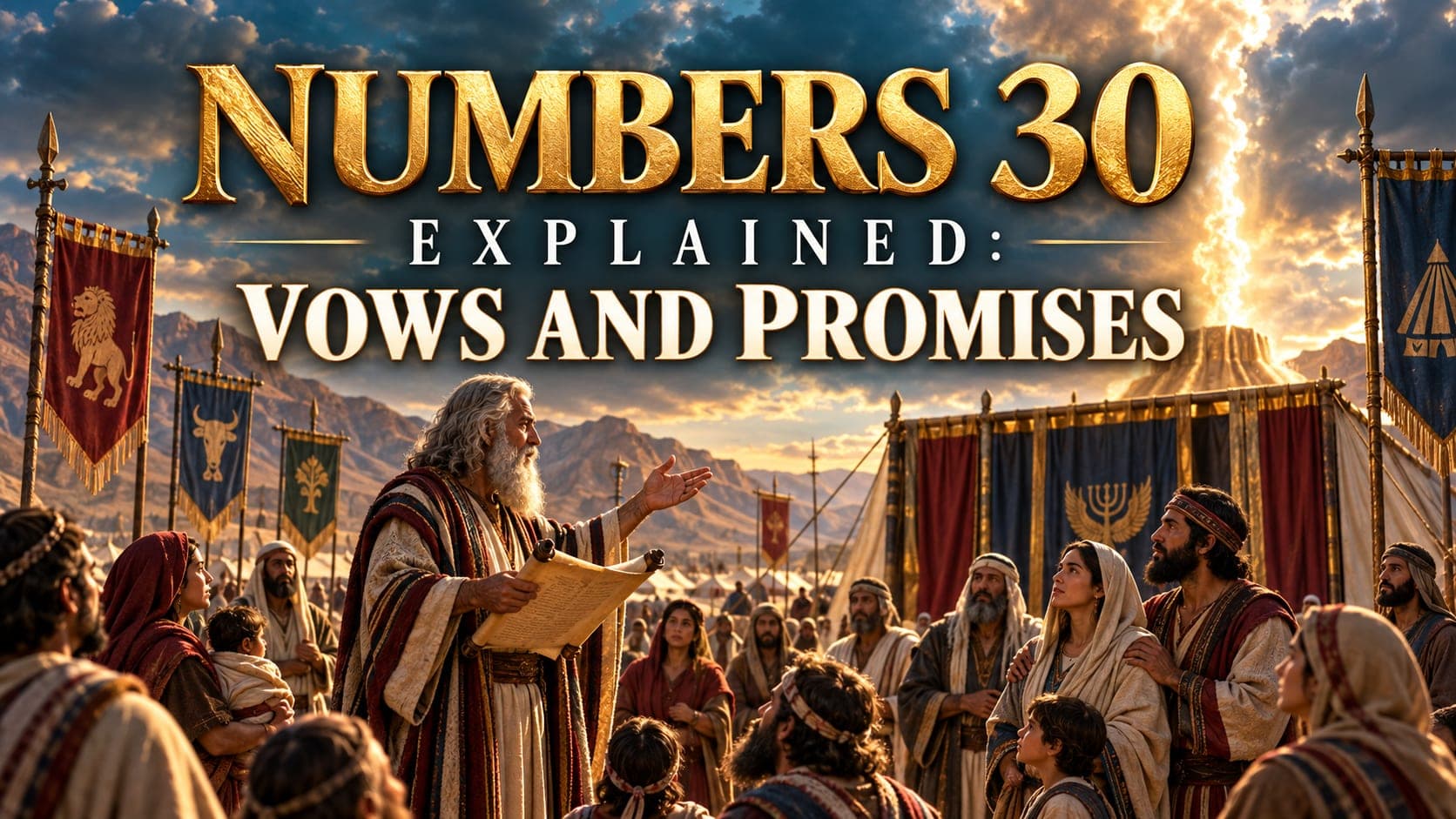
📖 Numbers 30 Explained: The Law of Vows and Who Could Undo One
Sixteen verses. One subject. Whose vow actually gets to stand.
Numbers 30 explained is the shortest piece of law Moses hands Israel in this whole book, and also one of the most personal. It never touches land, food, or an army. It asks a single question about every vow anyone in Israel might make to God, man or woman, and settles exactly whose word is final before God ever counts that vow as binding.
Maybe you have made a promise and then watched someone else decide whether it would actually hold.
- ❓ Why is this entire chapter addressed only to the heads of the tribes?
- ❓ Why can a father or husband undo a woman's vow, but a widow's vow always stands no matter what?
- ❓ What happens to a husband who waits too long before he objects?
- ❓ Does any of this still matter once you read what Jesus says about vows?
📌 A vow was never a private matter in Israel. The moment it left your mouth, it belonged to God, and sometimes it also belonged to the household you lived inside.
This walkthrough goes through the whole chapter in order: the one unconditional rule for a man's own vow, the father who hears his daughter's vow first, the husband who inherits one through marriage, the widow nobody could override, and the husband who confirms a vow simply by staying quiet.
Sixteen verses, and they decide something every other chapter in this book takes for granted.
What Happened Just Before This Chapter
Numbers 29 and Numbers 28 before it spelled out everything Israel owed God on the calendar: the twice daily lamb, the doubled Sabbath offering, the new moon offering, and the crowded seventh month with its trumpet blast, its one day of total rest, and its week of booths. All of that was required worship, the same for every household, written down once and unchanging.
Numbers 30 closes out the three chapter pause in the story, offerings, feasts, and now vows, that sits between Moses learning he will die and Israel marching to war against Midian in Numbers 31. Every offering in the previous two chapters was something God required of everyone. A vow is the opposite. Nobody has to make one. Once someone does, this chapter decides how far that one personal promise actually reaches.

Numbers 30 Explained Verse by Verse
1. One Rule for a Man's Own Vow (verses 1 and 2)
The chapter opens by naming exactly who is listening.
"And Moses spake unto the heads of the tribes concerning the children of Israel, saying, This is the thing which the LORD hath commanded."
💡 Most of the law in this book is spoken straight to the whole congregation. This one is aimed at the heads of the tribes specifically. Scripture never says why, but the reason is not hard to guess. A broken vow would eventually land in front of a tribal leader as a dispute between a family and whoever was owed. Moses makes sure the men who would have to settle that dispute hear the rule before any case ever reaches them.
Then comes the rule itself, stated once, in full.
"If a man vow a vow unto the LORD, or swear an oath to bind his soul with a bond; he shall not break his word, he shall do according to all that proceedeth out of his mouth."
📌 Two different promises are named in the same breath, a vow to give something and a bond to give something up, and the rule covering both is identical: he shall not break his word. No committee reviews a man's vow. No guardian signs off on it. The moment it leaves his mouth, it already binds him.
Jacob had already modeled exactly this kind of vow, generations earlier, alone on a stone pillow at Bethel.
"And Jacob vowed a vow, saying, If God will be with me, and will keep me in this way that I go, and will give me bread to eat, and raiment to put on, So that I come again to my father's house in peace; then shall the LORD be my God: And this stone, which I have set for a pillar, shall be God's house: and of all that thou shalt give me I will surely give the tenth unto thee."
💡 Jacob's vow was conditional on what God would do first. Numbers 30:2 never says a vow has to be unconditional to count, only that once spoken, it has to be kept. That baseline, one adult man, one promise, no third party required, is the fixed point the rest of the chapter measures everything else against.
2. A Daughter's Vow in Her Father's House (verses 3 to 5)
The law immediately turns to a different situation, a woman still living under her father's roof.
"If a woman also vow a vow unto the LORD, and bind herself by a bond, being in her father's house in her youth; And her father hear her vow, and her bond wherewith she hath bound her soul, and her father shall hold his peace at her: then all her vows shall stand, and every bond wherewith she hath bound her soul shall stand."
"But if her father disallow her in the day that he heareth; not any of her vows, or of her bonds wherewith she hath bound her soul, shall stand: and the LORD shall forgive her, because her father disallowed her."
📌 The window is exact: in the day that he heareth. Not sometime later, not whenever he gets around to it. The father has to speak on the very day the vow reaches his ears. Silence through that one day is already an answer, and it is an answer that ratifies the vow completely.
⚠️ Notice what the law does not say. It never calls the daughter guilty for making a vow her father later cancels. "The LORD shall forgive her" is not forgiveness for a sin she committed. It is the text's way of saying the unfulfilled vow is not held against her once her father has rightly spoken.
💡 "Being in her father's house in her youth" names a specific situation, not women in general. An unmarried daughter still living under her father's roof shared his household economy completely. Whatever she promised away could end up costing him. That shared stake is almost certainly why his voice gets a say here at all.
3. A Vow Carried Into Marriage (verses 6 to 8)
The law then covers a vow a woman made before a husband ever entered the picture.
"And if she had at all an husband, when she vowed, or uttered ought out of her lips, wherewith she bound her soul; And her husband heard it, and held his peace at her in the day that he heard it: then her vows shall stand, and her bonds wherewith she bound her soul shall stand."
"But if her husband disallowed her on the day that he heard it; then he shall make her vow which she vowed, and that which she uttered with her lips, wherewith she bound her soul, of none effect: and the LORD shall forgive her."
📌 The exact same window, the exact same silence rule, and the exact same forgiveness clause, just handed from a father to a husband. A vow made before marriage does not simply vanish once a woman marries. It transfers into the new household, and the new head of that household gets the same single day her father would have had.
4. The Widow and the Divorced Woman (verse 9)
One verse, and the pattern the chapter has followed twice already breaks completely.
"But every vow of a widow, and of her that is divorced, wherewith they have bound their souls, shall stand against her."
📌 No father to disallow it. No husband to disallow it. Her vow stands, full stop, exactly the way a man's vow stands in verse 2. This is the shortest verse in the chapter and it carries the most weight. It proves the whole point of verses 3 through 8 was never a woman's word counting for less. It was a shared household economy giving a father or husband a stake in what got promised away.
💡 Once that specific relationship ends, by widowhood or by divorce, so does anyone else's claim to override her. Her vow belongs to her alone, on the exact same terms a man's does.
5. A Vow Made Inside Marriage, and the Husband Who Waits Too Long (verses 10 to 15)
The last and longest case covers a vow made by a woman already married, inside her husband's own house.
"And if she vowed in her husband's house, or bound her soul by a bond with an oath; And her husband heard it, and held his peace at her, and disallowed her not: then all her vows shall stand, and every bond wherewith she bound her soul shall stand."
"But if her husband hath utterly made them void on the day he heard them; then whatsoever proceeded out of her lips concerning her vows, or concerning the bond of her soul, shall not stand: her husband hath made them void; and the LORD shall forgive her."
So far this simply repeats the pattern already set for a father and a betrothed daughter. Then the law adds something new.
"Every vow, and every binding oath to afflict the soul, her husband may establish it, or her husband may make it void."
"But if her husband altogether hold his peace at her from day to day; then he establisheth all her vows, or all her bonds, which are upon her: he confirmeth them, because he held his peace at her in the day that he heard them."
"But if he shall any ways make them void after that he hath heard them; then he shall bear her iniquity."
📌 Verse 15 closes a loophole the rest of the chapter never needed to close. A husband cannot stay silent on the day he hears a vow, let it stand, let his wife act on it, and then change his mind weeks later and cancel it anyway. Verse 14 already said his silence confirmed it. Verse 15 says that if he voids it after that, the guilt for the broken vow moves onto him. He does not get to ratify something by doing nothing and then escape the consequence of breaking it later.
💡 Centuries later, a married woman named Hannah made a vow her husband never formally disallowed. Scripture does not frame her story as a legal case under Numbers 30, but the pattern underneath it matches.
"But Hannah went not up; for she said unto her husband, I will not go up until the child be weaned, and then I will bring him, that he may appear before the LORD, and there abide for ever."
"And Elkanah her husband said unto her, Do what seemeth thee good; tarry until thou have weaned him; only the LORD establish his word. So the woman abode, and gave her son suck until she weaned him."
Elkanah does not disallow her. He says the opposite, and Samuel goes to the tabernacle exactly as Hannah had promised he would.
6. One Closing Statute (verse 16)
The chapter ends by naming, in its own words, exactly what it has covered.
"These are the statutes, which the LORD commanded Moses, between a man and his wife, between the father and his daughter, being yet in her youth in her father's house."
📌 Only two relationships are named: husband and wife, father and daughter. The chapter is honest about its own scope in its last line. It never claims to settle every vow anyone could ever make. It settles these two specific household situations, and verse 9 already told you what happens to a vow that falls outside both of them.
Hard Questions Numbers 30 Raises
Does this chapter mean a woman's word to God counts for less than a man's? The text itself never frames it that way. Verse 9 is the clearest evidence against that reading, a widow or divorced woman's vow stands exactly like a man's in verse 2, with no guardian able to touch it. What verses 3 through 15 protect is not a man's authority over a woman's conscience. It is a shared household economy, where a father or husband carried real financial responsibility for what a dependent family member promised away. Remove that shared dependency, by widowhood or divorce, and the law removes the guardian's veto along with it. This same book had already shown God siding fully with women's legal claims three chapters earlier, when Zelophehad's daughters won a permanent inheritance right at the tabernacle door.
Why does verse 15 add a penalty for a husband who delays, but no matching verse adds one for a father who delays with his daughter's vow? Verses 3 through 5 give the father the same single day window as the husband, but the text never says a father bears any guilt if he changes his mind after staying silent. This is simply what the chapter says and does not say. Reading more into the gap than that would be adding to the text rather than explaining it.
What happens when a man's own vow turns out badly, with nobody left to disallow it the way a father or husband could disallow a woman's? Judges 11 records exactly that risk. Jephthah vowed that whatever came out of his house to meet him after battle would belong to the LORD, and his own daughter was the first to come out.
"And it came to pass, when he saw her, that he rent his clothes, and said, Alas, my daughter! thou hast brought me very low, and thou art one of them that trouble me: for I have opened my mouth unto the LORD, and I cannot go back."
Bible teachers genuinely disagree on what happened next. Some read Judges 11:39 as a literal human sacrifice, which Numbers 30 itself never addresses and the law elsewhere in Scripture forbids. Others read her closing years of mourning her virginity as lifelong dedicated service rather than death. Judges never settles the question for certain either way. What Numbers 30:2 does make clear is the weight Jephthah was under the moment he spoke, a man's own vow binds him with no guardian anywhere in the law able to step in and undo it.
Does Jesus overturn any of this in the New Testament? He does not call vow keeping wrong. He pushes past the whole structure this chapter needed in the first place.
"But I say unto you, Swear not at all; neither by heaven; for it is God's throne: Nor by the earth; for it is his footstool: neither by Jerusalem; for it is the city of the great King. Neither shalt thou swear by thy head, because thou canst not make one hair white or black. But let your communication be, Yea, yea; Nay, nay: for whatsoever is more than these cometh of evil."
Numbers 30 exists because a vow could be disallowed, delayed, or wrongly kept silent about. Jesus points to a standard where a plain yes or no is trustworthy enough on its own, with no vow, bond, or guardian needed to back it up at all.
Top Verses From Numbers 30
1. Numbers 30:2
"If a man vow a vow unto the LORD, or swear an oath to bind his soul with a bond; he shall not break his word, he shall do according to all that proceedeth out of his mouth."
The baseline the whole chapter builds on. One adult, one promise, binding the moment it is spoken, with no guardian required to confirm it.
2. Numbers 30:5
"But if her father disallow her in the day that he heareth; not any of her vows, or of her bonds wherewith she hath bound her soul, shall stand: and the LORD shall forgive her, because her father disallowed her."
A father's disallowal voids the vow and removes the guilt of it, all inside one exact window, the day the vow reaches his ears.
3. Numbers 30:9
"But every vow of a widow, and of her that is divorced, wherewith they have bound their souls, shall stand against her."
The verse that proves the rest of the chapter was never about a woman's word mattering less. With no father or husband in the picture, her vow stands absolutely.
4. Numbers 30:15
"But if he shall any ways make them void after that he hath heard them; then he shall bear her iniquity."
A husband who confirms a vow by silence cannot later cancel it and shift the guilt back onto his wife. The consequence stays with the one whose silence sealed it.
5. Numbers 30:16
"These are the statutes, which the LORD commanded Moses, between a man and his wife, between the father and his daughter, being yet in her youth in her father's house."
The chapter's own summary of its scope, naming exactly two relationships and no more.

Frequently Asked Questions About Numbers 30
What is Numbers 30 about?
Numbers 30 is the law of vows in Israel. It covers a man's own vow, an unmarried daughter's vow her father can disallow, a married woman's vow her husband can disallow, and a widow or divorced woman's vow, which always stands on its own.
What does it mean to vow a vow in the Bible?
Numbers 30:2 describes it as a voluntary promise to the LORD, or a binding oath to give something up. Once spoken, Scripture treats it as a word that must be kept, not a wish that can be quietly forgotten.
Could a father really cancel his daughter's vow to God?
Yes, but only on the exact day he first heard about it, according to Numbers 30:3 to 5. If he said nothing that day, the vow stood permanently. If he spoke against it that same day, it was void, and the text says she was not held guilty for it.
Why does a widow's vow always stand in Numbers 30?
Numbers 30:9 gives no father or husband any authority to disallow it, because neither one is legally over her household anymore. Her vow stands on the exact same footing a man's vow stands on in verse 2.
What happens if a husband waits too long to object to his wife's vow?
Numbers 30:14 and 15 say his silence on the day he heard it already confirmed the vow. If he tries to void it after that, he personally bears the guilt for the broken vow instead of his wife.
Is Numbers 30 saying women's vows matter less than men's?
The text itself does not say that. Numbers 30:9 shows a widow or divorced woman's vow standing exactly like a man's. What the other verses protect is a shared household economy under a father or husband's legal responsibility, not a lower view of a woman's word to God.
What is the difference between a vow and an oath in the Bible?
Numbers 30:2 names both in the same sentence, a vow to give something to the LORD and a bond or oath to give something up, such as a fast. The chapter treats the obligation to keep either one as identical.
Does Jephthah's vow in Judges 11 relate to Numbers 30?
It shows what Numbers 30:2 looks like at its most severe. A man's own vow binds him completely, with no guardian in the law able to disallow it the way a father or husband could disallow a woman's vow earlier in the same chapter.
What does Jesus say about vows in Matthew 5?
Matthew 5:34 to 37 has Jesus telling His followers not to swear oaths at all, and to let a plain yes or no be trustworthy enough on its own. He does not call vow keeping wrong, He points toward integrity that no longer needs the structure Numbers 30 was built to enforce.
Why is Numbers 30 addressed to the heads of the tribes?
Numbers 30:1 names them specifically, likely because disputes over a broken vow would eventually be settled by tribal leaders. Moses makes sure the men who would have to judge such a case hear the rule directly before one ever reaches them.
Final Thoughts
Numbers 30 reads like a small, technical chapter, and it is quietly settling something enormous underneath.
📌 Your own word binds you the moment it leaves your mouth. That is true for a man in verse 2 and just as true for a widow or divorced woman in verse 9. Nobody needed to co sign it for it to count.
📌 Silence is a real answer, not an escape from one. A father or husband who said nothing on the day he heard a vow had already decided, whether he meant to or not.
📌 Delay does not erase responsibility. Verse 15 makes the guilt of a broken vow follow whoever confirmed it by silence and then changed course too late.
You are probably not disallowing a vow this week. But you likely have a promise you have gone quiet on, letting your silence decide something by default instead of deciding it on purpose.
So here is your one next step.
Name one word you have let sit unspoken too long, and either keep it or say plainly that you will not, the way this whole chapter insists has to happen on the day you hear it, not whenever it finally becomes convenient.