📖 Joshua 4 Explained: Twelve Stones From the Jordan
The water is still standing in a heap. Israel is barely on the other side. And God's first instruction is not about Jericho.
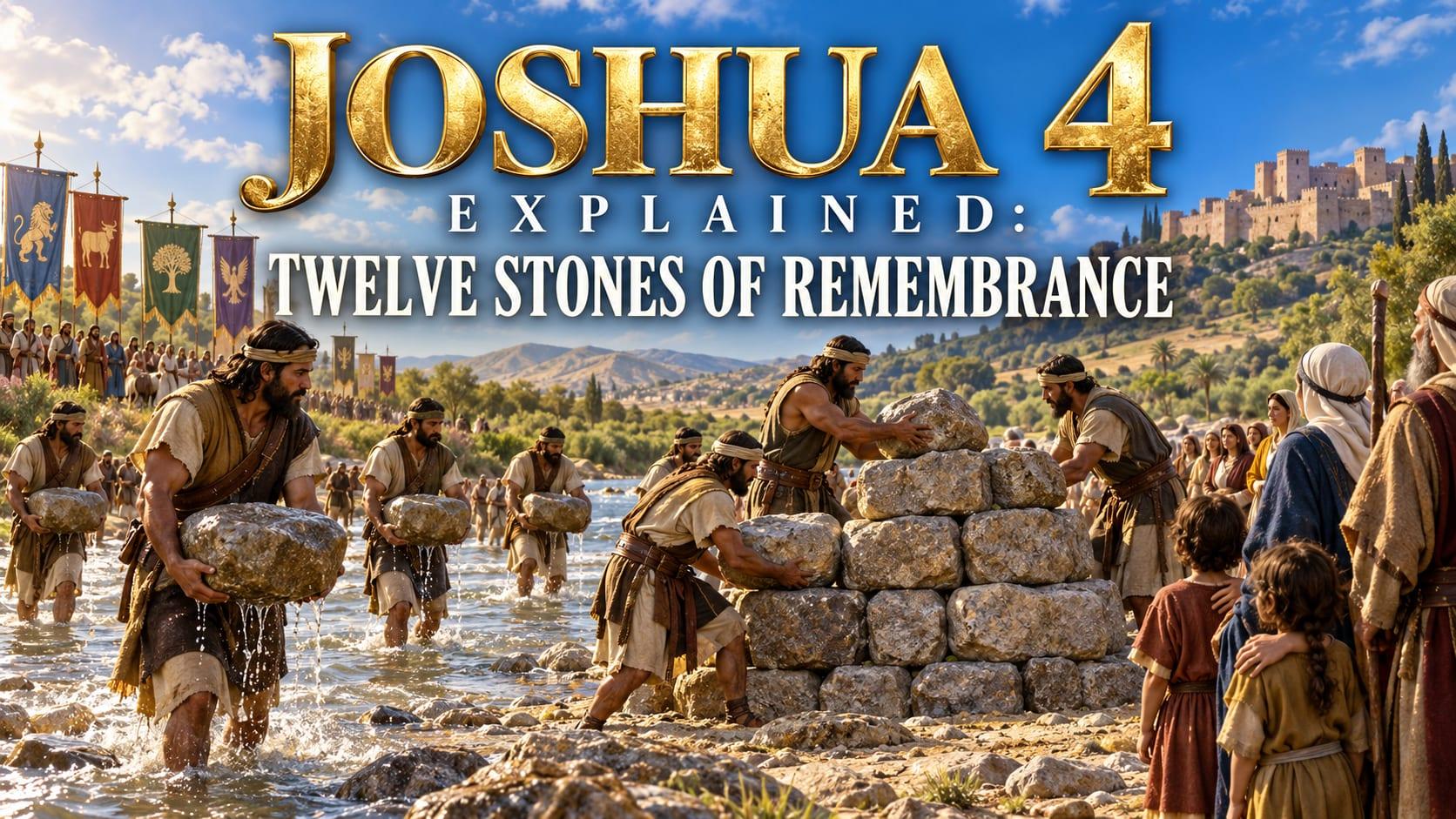
Joshua 4 explained is the chapter where Israel stops, mid miracle, to build something that will outlast the miracle itself. Twelve men carry twelve stones out of the Jordan riverbed before the water ever returns to its banks, so that a question asked years later, by a child who never saw any of this, will have an answer.
Maybe you have wondered why God bothers with monuments at all.
- ❓ Why twelve stones, and why did they have to come from the middle of the river?
- ❓ Is there one memorial in this chapter or two?
- ❓ What does it mean that the LORD, not Joshua, magnified Joshua?
- ❓ Why does the chapter care so much about what children will ask someday?
📌 God does not just want Israel to remember this day. He wants Israel's children, and their children, to ask about it.
This walkthrough goes through the whole chapter: the command to the twelve men, the two separate sets of stones, the armed tribes finishing the crossing, the river closing back up behind them, and the answer Israel is told to give for generations.
Read slowly. This chapter is about what you build to outlast your own memory.
What Happened Just Before This Chapter
Joshua 3 ended with the entire nation walking across the Jordan on dry ground while the water upstream stood up like a wall. The priests carrying the ark were already standing firm in the middle of the riverbed, and every Israelite had just passed by them on dry ground.
One detail from that chapter was left hanging on purpose. Right in the middle of the buildup, before the water even moved, Joshua had quietly set apart twelve men, one from each tribe, and never said why. Joshua 4 is where that unfinished instruction finally gets explained.

Joshua 4 Explained Verse by Verse
1. The Command to the Twelve Men (verses 1 to 5)
The chapter opens the moment the last Israelite steps onto dry ground on the western side.
"And it came to pass, when all the people were clean passed over Jordan, that the LORD spake unto Joshua, saying, Take you twelve men out of the people, out of every tribe a man, And command ye them, saying, Take you hence out of the midst of Jordan, out of the place where the priests' feet stood firm, twelve stones, and ye shall carry them over with you, and leave them in the lodging place, where ye shall lodge this night."
📌 God speaks before the water has even started to return. The twelve men are not sent back for safety or convenience after the fact. They go in while the riverbed is still dry, to take stones from one exact spot, the ground where the priests themselves had stood.
"Then Joshua called the twelve men, whom he had prepared of the children of Israel, out of every tribe a man: And Joshua said unto them, Pass over before the ark of the LORD your God into the midst of Jordan, and take you up every man of you a stone upon his shoulder, according unto the number of the tribes of the children of Israel."
One man, one tribe, one stone, one shoulder. The instruction is deliberately simple enough that nobody could claim later that only part of Israel made this crossing.
2. A Question Built on Purpose (verses 6 to 9)
God tells Joshua exactly what the stones are for, and it is not decoration.
"That this may be a sign among you, that when your children ask their fathers in time to come, saying, What mean ye by these stones? Then ye shall answer them, That the waters of Jordan were cut off before the ark of the covenant of the LORD; when it passed over Jordan, the waters of Jordan were cut off: and these stones shall be for a memorial unto the children of Israel for ever."
💡 Notice the chapter does not aim the memorial at Israel today. It aims it at a child not born yet, asking a question nobody in this chapter will be around to answer in person. The stones exist to make sure the story outlives the eyewitnesses.
That same pattern of a child's question answered with a rehearsed reply runs through the law Israel already carried, including the instructions about the Passover and teaching the commandments to your children. Joshua 4 is not inventing a new habit. It is applying one Israel already knew.
"And the children of Israel did so as Joshua commanded, and took up twelve stones out of the midst of Jordan, as the LORD spake unto Joshua, according to the number of the tribes of the children of Israel, and carried them over with them unto the place where they lodged, and laid them down there."
Then the chapter adds a second detail, easy to skim past, that most readers miss on a first read.
"And Joshua set up twelve stones in the midst of Jordan, in the place where the feet of the priests which bare the ark of the covenant stood: and they are there unto this day."
⚠️ This is a second set of twelve stones, not the same ones mentioned again. One set gets carried out of the river to where Israel camps that night. Another set is set up right in the riverbed itself, in the exact spot where the priests stood holding the ark. Two monuments, two locations, one memory.

3. The Armed Tribes Keep an Old Promise (verses 10 to 13)
While the stones are being gathered, the priests are still standing where they have been since the crossing began.
"For the priests which bare the ark stood in the midst of Jordan, until everything was finished that the LORD commanded Joshua to speak unto the people, according to all that Moses commanded Joshua: and the people hasted and passed over."
"Hasted" is worth noticing. Nobody lingers in the riverbed to admire the miracle. Israel moves with urgency, the way you move when you know the ground under you is only standing open by the will of God, not by nature.
"And the children of Reuben, and the children of Gad, and half the tribe of Manasseh, passed over armed before the children of Israel, as Moses spake unto them: About forty thousand prepared for war passed over before the LORD unto battle, to the plains of Jericho."
📌 Forty thousand armed men from two and a half tribes cross at the front of the column, exactly as Moses had required of them. Years earlier, in Numbers 32, Reuben, Gad, and half of Manasseh asked to settle east of the Jordan instead of in Canaan itself. Moses agreed, on one condition: they would still cross armed and fight alongside their brothers until the land was taken. Moses never lived to see it kept. Joshua 4 is the proof that the deal still held.
4. The LORD Magnifies Joshua (verse 14)
One short verse closes the day with a result nobody had to announce.
"On that day the LORD magnified Joshua in the sight of all Israel; and they feared him, as they feared Moses, all the days of his life."
💡 The sentence credits the LORD, not Joshua, with the result. Joshua never asks to be feared the way Moses was feared. The crossing itself, a flooded river stopped on command, does the convincing without a single word from Joshua about his own authority.
5. The Priests Come Up, and the River Returns (verses 15 to 18)
Only after the stones are set, the tribes have crossed, and the people have hasted over does the LORD give the final order.
"And the LORD spake unto Joshua, saying, Command the priests that bear the ark of the testimony, that they come up out of Jordan."
"And it came to pass, when the priests that bare the ark of the covenant of the LORD were come up out of the midst of Jordan, and the soles of the priests' feet were lifted up unto the dry land, that the waters of Jordan returned unto their place, and flowed over all his banks, as they did before."
📌 The same kind of trigger that opened the river closes it again. The previous chapter showed the water stopping the instant the priests' feet touched it. Here, the water returns the instant their feet lift out of it. Nothing about this crossing happens by a timer or a natural ebb. It starts and ends on the priests' own footsteps, under God's word to Joshua.

6. Gilgal, and Why the Stones Still Matter (verses 19 to 24)
The chapter gives the exact day the crossing finished.
"And the people came up out of Jordan on the tenth day of the first month, and encamped in Gilgal, in the east border of Jericho. And those twelve stones, which they took out of Jordan, did Joshua pitch in Gilgal."
The tenth day of the first month places this four days before Passover was kept again in the land, and almost exactly forty years to the week after the generation that left Egypt had first approached this same border, back when fear turned them away from it at Kadesh Barnea. A new generation reaches the spot their parents refused to trust God for.
Then the chapter repeats the purpose of the stones, almost word for word, but widens the audience.
"And he spake unto the children of Israel, saying, When your children shall ask their fathers in time to come, saying, What mean these stones? Then ye shall let your children know, saying, Israel came over this Jordan on dry land."
"For the LORD your God dried up the waters of Jordan from before you, until ye were passed over, as the LORD your God did to the Red sea, which he dried up from before us, until we were gone over: That all the people of the earth might know the hand of the LORD, that it is mighty: that ye might fear the LORD your God for ever."
📌 The first explanation of the stones, back in verse 7, was aimed at Israel alone. This final explanation widens the purpose to "all the people of the earth." A local memorial at the start of the chapter becomes, by the end of it, a witness meant for every nation that will ever hear the story. The goal was never Israel's pride in its own history. It was the whole earth knowing whose hand did this.
Hard Questions Joshua 4 Raises
Are there really two sets of twelve stones in this chapter, or is the text just repeating itself? What the text says: verse 8 describes twelve stones carried out of the river to the lodging place, and verse 9, with no connecting word suggesting it is the same event, describes Joshua separately setting up twelve stones in the midst of Jordan itself, where the priests had stood. How it has been read: most readers take this as two distinct monuments, one visible at the camp where people actually lived and could ask about it, and one left in the riverbed itself as a quieter, more permanent marker of the exact spot the priests held firm. The text gives no reason to collapse them into one event.
How could stones left in the middle of the Jordan serve as a sign, if nobody could see them once the river started flowing again? What the text says: verse 9 simply states they were set up there, and that they remained there unto this day, with no comment on whether they stayed visible. What this likely means: the sign was never meant to work the same way for both monuments. The Gilgal stones were the ones a child would actually see and ask about. The river stones were a fact on the ground, true and permanent whether or not anyone could view them, the same way a buried foundation still holds a building up even when nobody can see it.
Is verse 14 just Joshua, or the writer of Joshua, boasting about his own reputation? What the text says: the verse credits the LORD as the one who magnified Joshua, not Joshua claiming it for himself. How it fits the chapter: every other verse in Joshua 4 traces the day's events back to the LORD speaking, commanding, and acting. This verse follows the same pattern. The fear Israel felt toward Joshua is presented as evidence of God keeping His word from Joshua 1, not a man managing his own image.

Top Verses From Joshua 4
1. Joshua 4:6 and 7
"That this may be a sign among you, that when your children ask their fathers in time to come, saying, What mean ye by these stones? Then ye shall answer them, That the waters of Jordan were cut off before the ark of the covenant of the LORD; when it passed over Jordan, the waters of Jordan were cut off: and these stones shall be for a memorial unto the children of Israel for ever."
The whole purpose of the chapter in one sentence. A memorial built for a question a child has not asked yet, with an answer already prepared for them.
2. Joshua 4:14
"On that day the LORD magnified Joshua in the sight of all Israel; and they feared him, as they feared Moses, all the days of his life."
The promise made privately in Joshua 1 and repeated publicly in Joshua 3 is, in this one verse, simply kept.
3. Joshua 4:9
"And Joshua set up twelve stones in the midst of Jordan, in the place where the feet of the priests which bare the ark of the covenant stood: and they are there unto this day."
A monument nobody would ever see once the river rose again, built anyway, because it being true mattered whether or not it was visible.
4. Joshua 4:24
"That all the people of the earth might know the hand of the LORD, that it is mighty: that ye might fear the LORD your God for ever."
The purpose widens from one nation's memory to the whole earth's knowledge in the final verse of the chapter.
5. Joshua 4:22 and 23
"Then ye shall let your children know, saying, Israel came over this Jordan on dry land. For the LORD your God dried up the waters of Jordan from before you, until ye were passed over, as the LORD your God did to the Red sea, which he dried up from before us, until we were gone over."
Two generations, two rivers of water, one God credited for both. The Jordan crossing is told as a direct echo of the Red Sea, not a lesser copy of it.
Frequently Asked Questions About Joshua 4
What is the meaning of the twelve stones in Joshua 4?
They were a permanent memorial, one stone representing each of Israel's twelve tribes, set up so that future generations who asked what the stones meant would be told the exact story of how the Jordan was cut off before the ark of the covenant.
Why were there twelve stones instead of some other number?
One stone for each of Israel's twelve tribes, carried by one man from each tribe, made sure the memorial represented the whole nation crossing together, not just a portion of the people.
Were the twelve stones set up at Gilgal the same ones left in the Jordan?
No. Joshua 4:8 and 4:20 describe stones carried out of the river and pitched at Gilgal, while verse 9 separately describes Joshua setting up twelve stones in the riverbed itself, where the priests had stood. The text describes two monuments, not one.
What was Gilgal, and why did Israel camp there?
Gilgal was the first campsite inside Canaan, on the east border of Jericho. It became Israel's base camp for the early stages of the conquest and the place where the Gilgal stones stood as a permanent marker of the crossing.
Why did the armed tribes of Reuben, Gad, and Manasseh cross first?
They were keeping a promise their fathers made to Moses in Numbers 32. In exchange for settling land east of the Jordan, these tribes agreed to send their fighting men across first to help take Canaan before returning home.
What does it mean that the LORD magnified Joshua?
It means God made Joshua's authority unmistakable to the whole nation through the crossing itself. Joshua 4:14 says Israel came to fear him the way they had feared Moses, fulfilling what God had already promised Joshua privately back in Joshua 1 and publicly in Joshua 3.
Why does the Bible care so much about children asking questions in this chapter?
Because Israel's faith was meant to be handed down, not just experienced once. The stones were built specifically to prompt a question from a generation that never saw the Jordan stop, giving parents a built in opportunity to retell what God did.
What day did Israel cross the Jordan?
Joshua 4:19 says the people came up out of the Jordan on the tenth day of the first month, four days before that year's Passover, which Joshua 5 records them keeping once they reached Gilgal.
How does the Jordan crossing in Joshua 4 compare to the Red Sea?
Joshua 4:23 draws the comparison directly, saying the LORD dried up the Jordan the same way He had dried up the Red Sea. The difference is the generation: the people crossing the Jordan were mostly children or not yet born when the Red Sea parted, so this crossing gave them their own firsthand witness of the same kind of miracle.
Why does the chapter say the goal was for "all the people of the earth" to know?
Joshua 4:24 states the purpose was never only Israel's own confidence. It was so that every nation would eventually know the LORD's hand is mighty, tying one local river crossing to a much larger purpose running through the whole Bible.
Final Thoughts
Joshua 4 slows down right when the action should be speeding up, and that slowing down is the point.
📌 What God does, He also makes sure gets remembered correctly. The crossing itself took one day. The stones were built to outlast every person who witnessed it.
📌 Some monuments are for other people to see. Some are just for being true. The Gilgal stones stood where a child could ask about them. The river stones stood where nobody ever would, and the text treats both as equally worth building.
📌 A promise kept by the grandchildren still counts as kept. Reuben, Gad, and half of Manasseh crossed armed decades after their fathers struck the deal with a man who was no longer alive to see it honored.
You will not build a stone monument in a riverbed. But you will have moments worth making sure the next generation hears about correctly, instead of letting them fade into a vague story nobody can actually explain.
So here is your one next step.
Pick one thing God has actually done in your life, and tell it to someone younger than you this week, plainly enough that they could repeat it back.